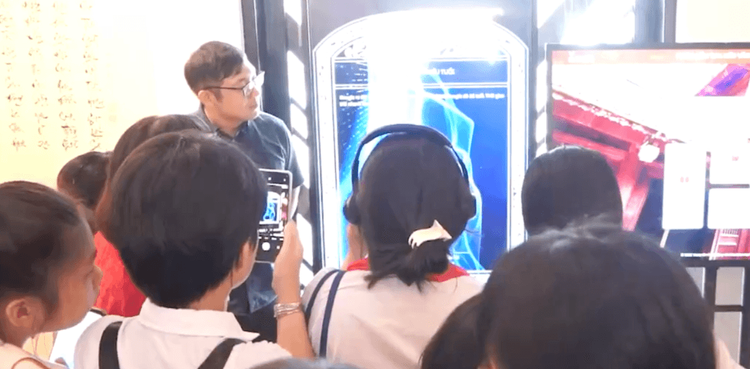
What might artificial intelligence offer to the interpretation of one of Vietnam’s most important historical sites?
We would like to share this video featuring an interesting experiment with AI at Văn Miếu – Quốc Tử Giám (Temple of Literature) in Hanoi.
In recent years, Văn Miếu – Quốc Tử Giám has increasingly experimented with digital technologies as part of its efforts to make cultural heritage more accessible and engaging to contemporary audiences. These initiatives include augmented reality (AR), digital reconstruction, interactive interpretation, and AI-assisted experiences that allow visitors to encounter historical spaces and figures in new ways.
One recent example is “Việt Nam diệu sử”, a digital heritage experience combining AR and AI. Rather than encountering the site only through objects, architecture, and conventional interpretive texts, visitors can interact with digitally reconstructed historical environments and personalities associated with Vietnam’s educational and scholarly traditions.
For Digitizing Việt Nam, experiments like these raise an important question: How can emerging technologies help us not only preserve cultural heritage, but also create new ways of encountering, interpreting, and learning from it?
They also invite us to think critically about the relationship between technology and historical knowledge: What sources are used to construct an AI-generated historical figure? How should interpretation, uncertainty, and reconstruction be communicated to visitors? And what role should historians, curators, and cultural institutions play in designing these experiences?
Watch the video here.
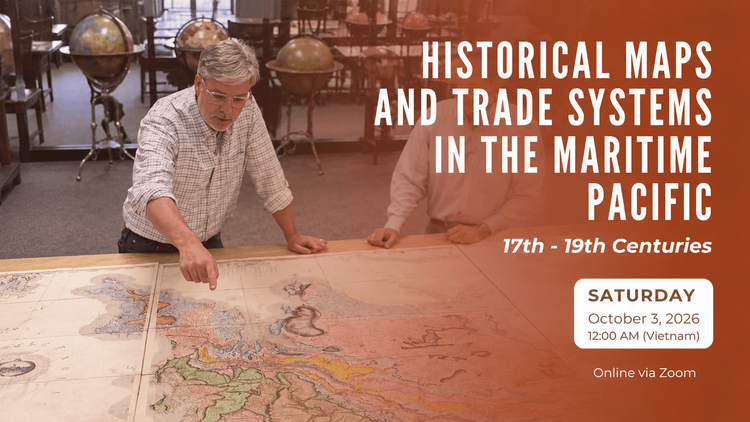
 Speaker: Richard Pegg, Director and Curator of Asian Art, MacLean Collection
Date & time: October 3, 2026 | 12:00 AM (Vietnam Time)
Format: Online via Zoom
Register: https://bit.ly/4rHKc6H
How can historical maps help us reconstruct the networks of trade, diplomacy, and mobility that once connected Vietnam with the wider maritime worlds of East and Southeast Asia?
Digitizing Vietnam is pleased to share an upcoming talk by Dr. Richard Pegg, Director and Curator of Asian Art at the MacLean Collection, hosted by the Center for Southeast Asian Studies at Northern Illinois University (NIU).
Drawing on maps produced between the seventeenth and nineteenth centuries, Dr. Pegg will explore the complex and overlapping systems of exchange that shaped the East and South China Seas. These include the red-seal, Manila, Siam, Fujian, Zheng family, silver–silk, rice–silk, tribute, Muslim, Portuguese, British, and Dutch trading systems.
During these centuries, Vietnamese ports and coastal communities were embedded within commercial networks extending across China, Japan, Southeast Asia, and the broader Indian Ocean and European trading worlds. Examining these networks through historical cartography offers another way of situating Vietnam within a connected maritime history rather than within the boundaries of the modern nation-state.
The event is organized by the Center for Southeast Asian Studies at Northern Illinois University and co-sponsored by the Center for Burma Studies, School of Art and Design, Art Museum, and Department of History at NIU.
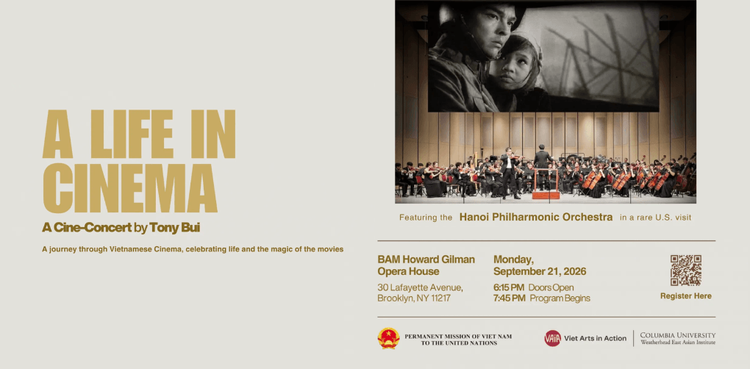
Co-organized by the Permanent Mission of Viet Nam to the United Nations, Viet Arts in Action at the Weatherhead East Asian Institute, and the Hanoi Philharmonic Orchestra, *A Life in Cinema* is a one-night-only cine-concert by Sundance Award-winning filmmaker Tony Bui, who serves as Artistic Director, featuring a rare New York appearance by the Hanoi Philharmonic Orchestra.
Through a carefully curated journey of Vietnamese cinema, the program brings together scenes from decades of films to tell the story of Viet Nam through memories, lives, and experiences captured on screen. From youth and innocence, through periods of upheaval and war, to peace, renewal, and a new era, *A Life in Cinema* reflects the transformation of a nation and its people across generations.
Presented at the historic BAM Howard Gilman Opera House, this cine-concert transforms unforgettable cinematic images into a continuous dialogue between film and music — celebrating the richness of Vietnamese stories, cinema, and cultural heritage.
The event is presented in partnership with the New York Asian Film Festival as part of U.N. General Assembly Week.
- Venue: BAM Howard Gilman Opera House, New York City
- Registration: https://bit.ly/4xSShHW
*Please note: A picture ID matching the name used during registration is required for entry.*
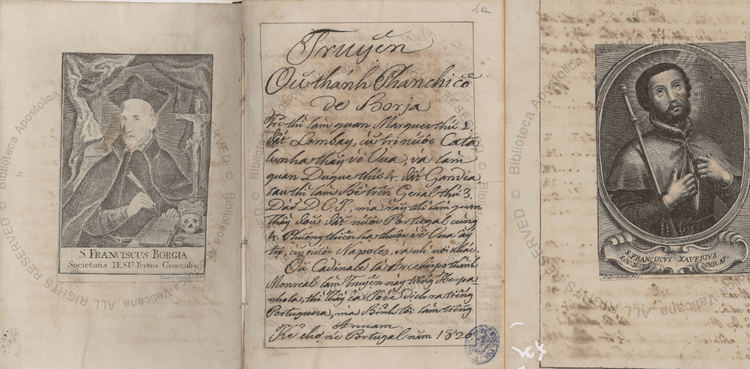
The Borg.tonch Collection, housed in the Library of the Vatican Apostolic Library and digitized in recent years through the Vatican Digital Library, represents an important effort to preserve forty-one manuscripts relating to the history and culture of the Vietnamese Catholic laity in both the missionary territories of Đàng Trong (Cochinchina) and Đàng Ngoài (Tonkin). The collection’s designation, Borg.tonch, is an abbreviation of its full Latin name, Borgia Tonchinensis. “Borgia” refers to the individual who devoted considerable effort to collecting these manuscripts, while Tonchinensis refers to the language identified as Tonkinese - variously known as the language of Đàng Ngoài, Annamese, or Vietnamese.
The collection takes its name from Cardinal Stefano Borgia (1731–1804), an Italian theologian, archaeologist, historian, and collector. He was a descendant of the illustrious and wealthy Borgia family, best known for Pope Alexander VI and his children. Drawing on the family’s considerable financial resources and his position as Secretary of the Sacred Congregation for the Propagation of the Faith (Propaganda Fide) at the Holy See, a position he held for nineteen years, Cardinal Borgia spent substantial sums acquiring thousands of manuscripts in numerous languages from around the world. During this period, the manuscripts now comprising the Borg.tonch Collection came into his possession through the scholarly and transcriptional efforts of Dominican missionaries and members of the Paris Foreign Missions Society (Société des Missions Étrangères de Paris) in Annam, as well as through the contributions of Father Philiphê do Rosario Nguyễn Văn Bỉnh and his companions in the Garasa mission in Lisbon. Following Cardinal Borgia’s death, manuscripts relating to Catholicism were incorporated into the Borgia Collection and displayed at the Borgian Museum in the Vatican. By the mid-nineteenth century, the manuscripts held in the museum had been transferred to the ownership of the Vatican Apostolic Library, where they remain preserved today. In 2021, all of the manuscripts in the Borg.tonch Collection were digitized and made available through the Vatican Digital Library, allowing readers and researchers free access to the materials.
The Borgia Tonchinensis Collection can be further classified according to several dimensions. Linguistically, it comprises not only works written in Vietnamese but also numerous manuscripts containing Portuguese and Latin, sometimes interspersed within the same works. In terms of script, the majority of the manuscripts are written in the Latin alphabet, while approximately ten manuscripts are written in Nôm. With regard to authorship, a substantial proportion of the collection consists of works produced by Father Philiphê do Rosario Nguyễn Văn Bỉnh (1759–1833) and his three companions in the Garasa mission in Lisbon, Portugal - the final representatives of the Catholic literary tradition associated with the Jesuit mission in Vietnam. The remaining manuscripts were contributed primarily by missionaries of the Paris Foreign Missions Society in Vietnam and by Dominican missionaries in Eastern Đàng Ngoài, corresponding roughly to the area east of the Red River today. In terms of subject matter, the manuscripts encompass a remarkably diverse range of genres and themes, including historical narratives concerning missionary activities in Vietnam, lives of Catholic saints, catechisms, prayer books, works of Catholic devotion, biblical narratives, dictionaries, correspondence between clergy and lay Catholics, poetry, biographies, and memoirs. From the perspective of their material and publishing history, most of the manuscripts are handwritten copies produced by Father Bỉnh, although a considerable number were printed in Vietnam and subsequently transported to Rome through arrangements made by the Sacred Congregation for the Propagation of the Faith.
The manuscripts of the Borgia tonchinensis Collection offer striking evidence of the connections between Vietnamese culture and the wider world during the eighteenth century, a period marked by profound global transformations associated with the maritime age. Within these manuscripts are accounts of Vietnamese individuals who found themselves living in exile abroad, efforts by Western missionaries to establish connections between Annam and the wider world, and episodes of Vietnamese history narrated from the perspectives of people living at a time when Annam remained divided between Đàng Trong and Đàng Ngoài. The collection is also of exceptional value for preserving the memoirs and writings of Philiphê do Rosario Nguyễn Văn Bỉnh, whom many scholars regard as one of the earliest Vietnamese writers to compose literary narratives in Quốc Ngữ. His numerous Nôm works likewise provide valuable evidence for the study of the development of Vietnamese writing practices during this period. Several other notable works of Vietnamese Catholic literature survive only through their preservation in the Borgia tonchinensis Collection, including Dũng Lý Hộ Thần by the missionary Girolamo Maiorica and Truyện Evangelio cùng Actum, attributed to priests of the Paris Foreign Missions Society.
With the Borgia Tonchinensis Collection once again introduced to readers through the Digitizing Việt Nam platform under the title Early Vietnamese Catholic Manuscripts and Printed Works, we hope that researchers and scholars in Vietnamese studies will draw on this valuable resource across a wide range of fields, including further exploration of the place of the Vietnamese within the far-reaching processes of globalization during the early modern period.
Check out the Early Vietnamese Catholic Manuscripts and Printed Works collection on Digitizing Việt Nam:
https://www.digitizingvietnam.com/en/our-collections/the-borgia-tonchinensis-collection
This collection and accompanying article were made possible by Nguyễn Nam, an undergraduate researcher at Centre College in Kentucky who specializes in East Asian history and linguistics. His research focuses on Vietnamese Catholic literature written in chữ Nôm and the historical relationship between Portugal and Annam, particularly as shaped by Jesuit missionary activities.
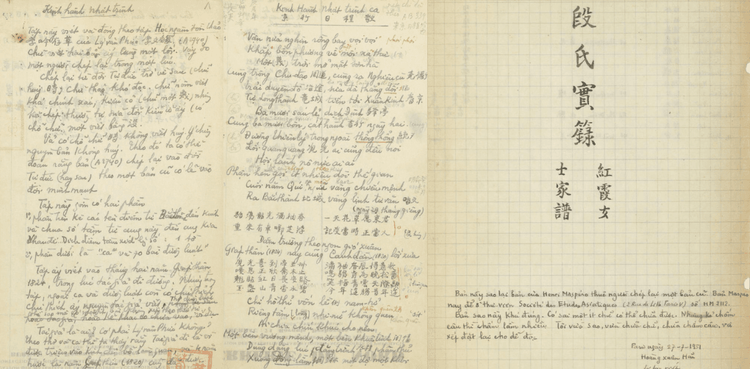
The Hoàng Xuân Hãn Collection brings together an exceptional body of materials assembled and studied by Professor Hoàng Xuân Hãn (1908–1996), one of the most distinguished Vietnamese intellectuals of the twentieth century. Trained in mathematics and engineering in France, Hoàng Xuân Hãn was also a pioneering historian, philologist, educator, and specialist in classical Vietnamese literature. His scholarship traversed the sciences and humanities, linking modern intellectual methods with Vietnam’s rich textual traditions.
Preserved by his family and donated to BULAC in 2024, the collection reflects both the breadth of Hoàng Xuân Hãn’s scholarship and the meticulous process behind his research. It includes rare works in chữ Hán, chữ Nôm, and quốc ngữ; manuscript copies of earlier texts; anthologies of poetry and historical writings; genealogies, maps, dictionaries, periodicals, and extensive research notes. Particularly significant are materials related to Truyện Kiều, Chinh phụ ngâm, Vietnamese Nôm poetry, diplomatic missions, regional histories, and the literary culture of the Lê–Trịnh and Nguyễn periods.
Many documents bear Hoàng Xuân Hãn’s own transcriptions, annotations, corrections, comparative tables, and indexes. They therefore preserve more than the texts themselves: they reveal the working practices of a scholar dedicated to recovering, comparing, interpreting, and transmitting Vietnam’s cultural heritage. Moving among classical Chinese, Nôm, modern Vietnamese, and French, the collection also illuminates the multilingual foundations of modern Vietnamese scholarship.
By cataloguing and digitizing these materials through its BiNA platform, BULAC has made an important part of this scholarly legacy accessible to researchers and the wider public internationally. The collection constitutes an invaluable resource for Vietnamese literary and historical studies while demonstrating how digital access can give renewed life to fragile textual heritage and reconnect it with readers across languages, institutions, and national borders.
Explore the Hoàng Xuân Hãn Collection on BULAC’s BiNA platform.
Spanning several centuries of Vietnamese history, the Collection of Vietnamese Edicts and Official Documents at Penn State University offers a rare window into the workings of the imperial state, the relationship between political and spiritual authority, and the documentary culture of premodern Vietnam.
Held by the Eberly Family Special Collections Library at Pennsylvania State University, the collection comprises 32 imperial edicts and high-level bureaucratic documents dating from the Lê (1428–1789) and Nguyễn (1802–1945) dynasties. The documents are handwritten in Chinese characters (chữ Nho), the script historically used for scholarship and official administration in Vietnam.
Imperial Authority in Written Form
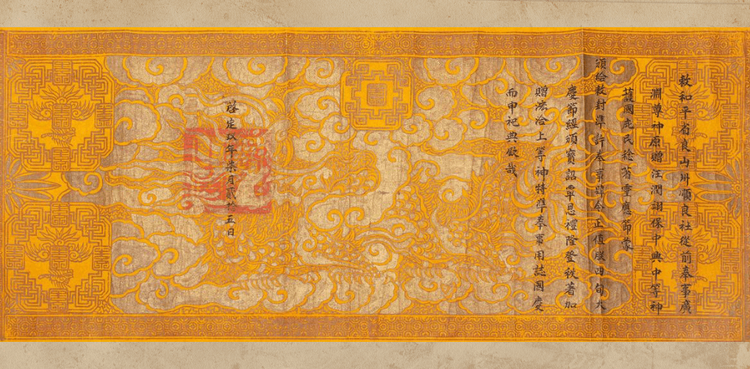
Among the collection's most visually striking objects are imperial edicts (sắc phong). Far more than administrative records, these documents embodied the authority of the emperor and connected the imperial court with religious and communal life throughout the country.
Some edicts record the conferral or enhancement of titles upon deities. Through such acts, Vietnamese emperors incorporated local gods into an officially recognized spiritual hierarchy. The documents therefore reveal an important dimension of Vietnamese kingship: imperial sovereignty extended not only over officials, territories, and human subjects, but also symbolically over the spiritual powers associated with the land.
An edict issued in 1821, the second year of the reign of Emperor Minh Mạng, for example, grants three additional honorific characters to the title of a deity. Written on yellow paper, the document is decorated with a dragon and phoenix in silver ink and a dark-ink cloud motif. Its elaborate material form demonstrates how writing, visual symbolism, ritual, and political authority could converge in a single document.
Documents of Government and Everyday Administration
Alongside the decorated imperial edicts are more restrained bureaucratic documents that illuminate the administrative machinery of the Nguyễn state.
Documents dating from Minh Mạng 19 (1838) through Bảo Đại 19 (1944) include promotions, petitions, commands, and official communications. Many were produced on plain white paper rather than the richly decorated materials associated with imperial edicts. Together, they provide evidence of how government operated through written exchanges among rulers, officials, and administrative institutions.
Their chronological range is particularly significant. The later documents extend into the period of French colonial rule, when the Nguyễn monarchy continued to exist while its political authority was profoundly transformed. The collection thus allows researchers to trace aspects of Vietnamese bureaucratic practice across major political transitions—from an independent imperial state to the complex administrative landscape of colonial Vietnam.
A Heritage of Chữ Nho
The collection is also valuable as a record of Vietnam's historical writing culture. All 32 documents are handwritten in Chinese characters, or chữ Nho. For centuries, Literary Chinese and chữ Nho occupied a central position in Vietnamese government, scholarship, diplomacy, ritual, and elite intellectual life.
By the twentieth century, however, this documentary culture was rapidly disappearing as the Romanized Vietnamese script, quốc ngữ, became dominant. Penn State specifically identifies the use of Chinese characters as an important feature of the collection because the practice has largely become obsolete in contemporary Vietnamese society.
For today's researchers, these documents therefore preserve more than their textual contents. Their calligraphy, formats, papers, decorations, dates, titles, and administrative conventions provide material evidence for understanding how knowledge and authority were recorded and transmitted in Vietnam.
From the Archive to the Digital Collection
The physical collection is preserved at Penn State's Eberly Family Special Collections Library. A digital version makes images and descriptive information available online. Penn State notes that the digital collection currently consists of dealer images showing the fronts of the scrolls, while the physical holdings comprise the complete set of 32 documents.
Individual digital records can provide remarkably detailed information. The 1821 Minh Mạng edict, for instance, is accompanied by its Gregorian and Vietnamese dates, physical description, script and language information, and a transcription of its text. Such metadata makes the collection useful not only for historians but also for scholars interested in Hán-Nôm studies, religious history, manuscript studies, calligraphy, material culture, and digital humanities.
The collection also belongs to a much larger landscape of Vietnamese documentary heritage. Comparable bodies of Sino-Nôm materials preserved in Vietnam demonstrate the importance of royal edicts and administrative records for reconstructing local histories, education, religious practices, political institutions, and the relationship between communities and the state. UNESCO's Memory of the World Committee for Asia and the Pacific, for example, has highlighted these dimensions in its recognition of collections of Sino-Nôm documents from Vietnam.
Reading Vietnam Through Its Documents
Viewed individually, an edict might record the elevation of a deity's title, while a bureaucratic communication might document an appointment, petition, or government instruction. Viewed together, however, the collection opens onto a much broader history.
These documents show a state operating through writing: naming and ranking gods, appointing officials, transmitting orders, responding to petitions, and maintaining administrative relationships across space and time. At the same time, their changing forms and historical contexts allow us to observe transformations in Vietnamese political and documentary culture across the Lê and Nguyễn dynasties and into the colonial twentieth century.
The Collection of Vietnamese Edicts and Official Documents thus provides an important point of entry into the study of Vietnam's imperial past—not simply through narratives written retrospectively, but through documents that once participated directly in the exercise of authority itself.
Explore the collection through the Penn State University Libraries collection page.
Also available on the Digitizing Vietnam Platform: Vietnamese Edicts and Official Documents
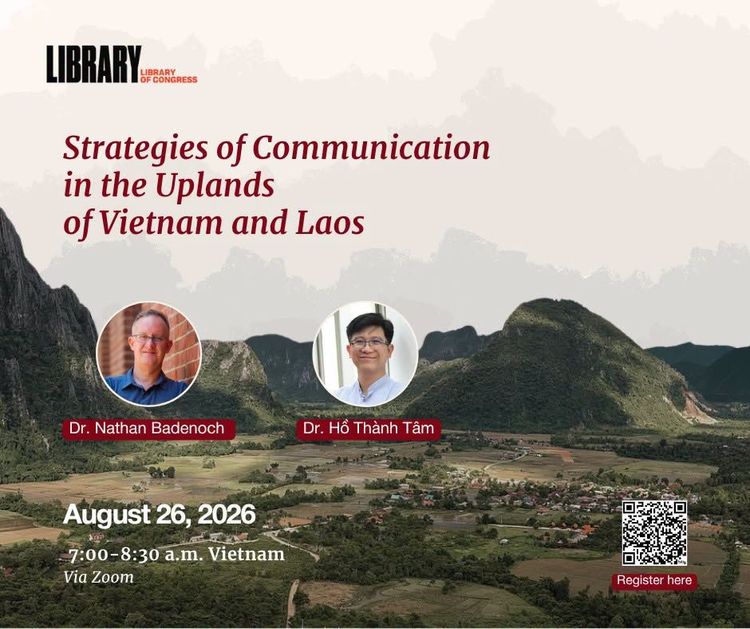
Digitizing Việt Nam would like to share an upcoming online event from the Library of Congress Southeast Asia Collection, bringing together research on language, orality, literacy, and social life in the uplands of Vietnam and Laos.
“Strategies of Communication in the Uplands of Vietnam and Laos” features Dr. Nathan Badenoch and Dr. Hồ Thành Tâm, who will discuss how ethnic minority communities navigate remarkable linguistic diversity and how oral and written practices shape social relationships, knowledge, and ways of recounting the past.
Drawing on his research in Northern Laos, Dr. Nathan Badenoch will explore multilingualism as an everyday social practice. In a region where people move dynamically between languages depending on social context, the spoken word and oral culture continue to provide an important shared foundation. Despite growing pressure from the national language, these multilingual practices demonstrate the continuing importance of smaller languages to the resilience of upland societies.
Turning to the Central Highlands of Vietnam, Dr. Hồ Thành Tâm will examine the emergence of literacy practices amid expanding missionary activity and colonial governance in the late nineteenth and early twentieth centuries. The first Latin-based writing systems for upland communities were developed with the support of French Catholic missionaries and subsequently expanded through Protestant missionary activity. These scripts did more than introduce new ways of recording knowledge: they contributed to a broader sociolinguistic transformation in how communities communicated, organized social relations, and represented their histories, accompanying a gradual shift from predominantly oral communication toward increasingly text-based practices.
The event also highlights the Asian Division’s Lesser Known Languages Collection, a distinctive Library of Congress collection containing materials in approximately 200 languages. Together, the two presentations invite us to consider the relationship between language, media, and historical memory—and what archives of lesser-known languages can reveal about the diverse ways communities produce and transmit knowledge.
Q&A session will follow the presentations, offering participants an opportunity to engage directly with the researchers.
 August 25, 2026
 8:00–9:30 p.m. EDT
 7:00–8:30 a.m., August 26 (Vietnam time)
 Online via Zoom
 Registration:
https://loc.zoomgov.com/.../reg.../WN_eKx0_sueRGyz1W1Ea7G3dQ
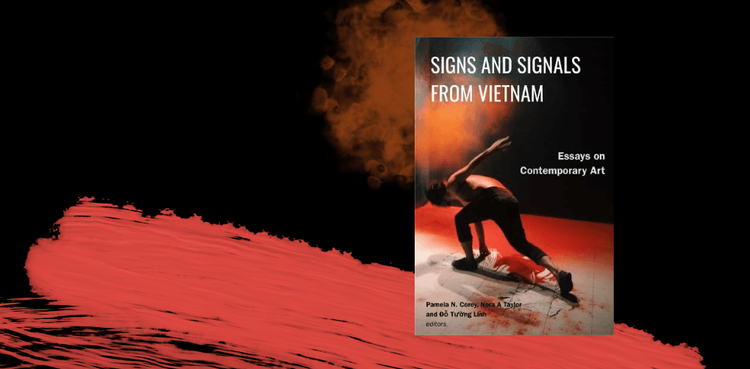
How might we write a history of contemporary Vietnamese art without reducing it to war, national division, or the familiar opposition between artists inside Vietnam and those in the diaspora?
A newly published collection, Signs and Signals from Vietnam: Essays on Contemporary Art, takes up precisely this challenge. Published by NUS Press in 2026, the volume is edited by art historians Pamela N. Corey and Nora A. Taylor, together with curator and researcher Đỗ Tường Linh. Bringing together artists, curators, researchers, and scholars working from different generations and positions, the book offers a multifaceted examination of artistic practice in and from Vietnam over the past three decades.
Rather than attempting to construct a single, definitive history of Vietnamese contemporary art, Signs and Signals from Vietnam embraces multiplicity. Its essays consider how artists have worked through language, archives, performance, narrative, memory, and other forms of experimentation to make sense of histories and experiences that are not always visible in conventional accounts of Vietnam.
In doing so, the collection asks readers to reconsider not only what contemporary Vietnamese art looks like, but also how its histories should be written, who participates in writing them, and which frameworks are adequate for understanding them.
Beyond the familiar narratives of Vietnamese art
The last three decades have witnessed a remarkable transformation in Vietnam's artistic landscape. Artists from Vietnam have gained increasing international visibility, while within the country new galleries, independent initiatives, collections, educational projects, and alternative exhibition spaces have contributed to an expanding contemporary art ecology.
Yet the histories used to explain this work have often remained anchored to a relatively small number of frameworks: colonialism and decolonization, the Vietnam War, the division between North and South, postwar migration and diaspora, and Vietnam's transition during the Đổi Mới period.
These histories remain indispensable. Signs and Signals from Vietnam, however, asks what becomes visible when they are no longer treated as the only organizing structures.
NUS Press describes the volume as deliberately moving beyond familiar “North-South” and “diasporic-national” divisions. Its contributors include Vietnamese, Vietnamese diasporic, and non-Vietnamese writers from different generations, affiliations, and intellectual positions.
The result is not the replacement of one master narrative with another. Instead, the book presents contemporary Vietnamese art as a field produced through overlapping histories, personal experiences, institutions, artistic networks, social transformations, and changing relationships between Vietnam and the wider world.
This multiplicity is one of the book's most important interventions.
As art historian Peggy Wang observes in her endorsement of the volume, the collection treats multiplicity itself as a method, challenging Western-centered frameworks for interpreting contemporary art and insisting that Vietnamese contemporary art be understood through the particular histories and conditions from which it emerges.
Art as a way of reading history
Throughout the collection, art becomes more than an object to be interpreted. It also functions as a means of investigating history.
The essays examine artists' engagements with some of the most persistent questions shaping Vietnamese society and culture during the past several decades: socialist artistic paradigms, gender, diaspora, memory, environmental change, and the politics of historical representation.
Artists approach these questions through remarkably different forms. Language can become artistic material. Archives can be dismantled and reconstructed. Personal memories can complicate official histories. Performance can recover experiences that have left few physical traces. Environmental transformations can become ways of thinking about both the past and the future.
Such approaches are particularly significant in a context where historical narratives may be fragmented across institutional archives, family memories, objects, photographs, oral histories, artworks, and communities.
The book therefore presents contemporary art as a space in which lesser-known histories and contested narratives can be articulated. As NUS Press notes, these artistic practices can communicate histories and personal perspectives that are difficult to accommodate within conventional historical accounts.
This approach also connects the volume with a broader development in scholarship on Vietnamese art: an increasing attention to archives, ethnography, artistic communities, and alternative forms of historical evidence.
Nora Taylor's long engagement with this question is particularly relevant. Her influential research on Vietnamese modern and contemporary art has combined art history with ethnographic and archival approaches. In a 2022 Nguyễn Art Foundation lecture, “From Ethnography to the Archives: Researching Contemporary Vietnamese Art,” Taylor traced ways in which Vietnamese art has been researched since Đổi Mới, paying particular attention to the individuals and communities that contributed to contemporary artistic practice in Hanoi, Ho Chi Minh City, and the diaspora.
Her work has also extended to the preservation of histories that might otherwise disappear. Taylor has served on the advisory board of Asia Art Archive and supervised its digital archive project on Salon Natasha, one of Hanoi's pioneering experimental art spaces. Her research, Nguyễn Art Foundation notes, has consistently sought to recover overlooked histories and challenge dominant narratives of art history.
Signs and Signals from Vietnam extends that intellectual concern from the work of an individual scholar into a deliberately collective conversation.
Who gets to write Vietnamese art history?
One of the most compelling dimensions of the volume is therefore methodological.
Who has the authority to write the history of Vietnamese contemporary art?
An academic? A curator? An artist? Someone working inside Vietnam? Someone observing it from abroad? A member of the Vietnamese diaspora? A researcher from another cultural background?
Rather than resolving these questions by privileging one position, Signs and Signals from Vietnam brings different positions into conversation.
This is reflected in the backgrounds of its three editors.
Pamela N. Corey is Associate Professor of Art History at Fulbright University Vietnam and the author of The City in Time: Contemporary Art and Urban Form in Vietnam and Cambodia (2021). Nora A. Taylor, Alsdorf Professor of South and Southeast Asian Art at the School of the Art Institute of Chicago, has researched Vietnamese art for decades and is the author of the landmark Painters in Hanoi: An Ethnography of Vietnamese Art. Đỗ Tường Linh, meanwhile, works as a curator, researcher, and writer between Hanoi and New York.
The combination matters. Scholarship produced within universities encounters knowledge generated through curatorial practice and through direct participation in artistic communities. Vietnamese, diasporic, and international perspectives coexist rather than being arranged into a simple center-and-periphery relationship.
Art historian David Teh consequently describes the volume as evidence of an increasingly reflexive and multi-perspectival field—one in which Vietnamese contemporary art is no longer interpreted primarily through the shadow of Cold War conflict but also through social, environmental, institutional, and structural contexts.
Rethinking the language of art history
The book also raises a larger question extending well beyond Vietnam: Are the standard categories of art history universal?
Terms such as “modern,” “contemporary,” “abstraction,” and “socialist realism” carry intellectual histories of their own. Applying them unchanged across different societies risks making local artistic histories appear merely as variations on narratives developed elsewhere.
Signs and Signals from Vietnam instead demonstrates how such terms acquire different meanings in different historical environments.
Teh highlights precisely this contribution, observing that familiar art-historical concepts such as abstraction, socialist realism, modernity, and contemporaneity emerge from the volume not as fixed categories but as terms continually contested and redefined through particular artistic and historical circumstances.
Vietnam therefore becomes more than a geographic “case study” to be inserted into an already established global history of contemporary art.
The intellectual movement can work in the opposite direction: studying artistic practices in Vietnam can change the categories through which global contemporary art itself is understood.
This is perhaps one of the most significant propositions underlying the collection.
Building an archive for a still-emerging field
There is another reason why a volume such as Signs and Signals from Vietnam matters.
Contemporary art histories depend upon infrastructure: archives, collections, exhibitions, publications, documentation, criticism, universities, museums, independent art spaces, and people willing to preserve the traces of artistic activity.
Vietnam's contemporary art infrastructure has often developed through a combination of formal institutions and independent initiatives. Nguyễn Art Foundation, for example, currently organizes its work across collections, exhibitions, educational and public programs, publications, interviews, and community-building projects. Its programming has included discussions specifically concerned with methodologies for researching Vietnamese contemporary art and with approaches such as microhistory that recover experiences overlooked by larger historical narratives.
Books such as Signs and Signals from Vietnam participate in that process of infrastructure-building. They do not simply interpret an already completed history. They document a field while that field is still being formed.
The publication brings scholarship, criticism, curatorial knowledge, and artistic perspectives into a durable form that can circulate internationally and become available to future researchers.
Vietnam within, and beyond, global contemporary art
Ultimately, Signs and Signals from Vietnam makes an argument that is simultaneously about Vietnam and about art history itself.
Vietnamese contemporary art should not need to become less Vietnamese in order to become more “global.” Nor should its significance be measured primarily by how easily it fits categories established elsewhere.
Instead, close attention to the particular conditions of artistic practice in Vietnam—the country's political histories, socialist legacies, memories, diasporic movements, environmental transformations, artistic communities, institutions, and experiments with form—can expand our understanding of what contemporary art is and how its histories can be written.
As Thy Phu of the University of Toronto describes it, the collection brings art criticism, visual history, curatorial perspectives, and practitioner approaches into conversation while situating Vietnam within wider global histories and artistic ecologies.
That makes Signs and Signals from Vietnam significant not only for specialists in Vietnamese art.
It speaks to students and researchers of Southeast Asia, curators and museum professionals, educators, artists, and anyone interested in how histories are created from incomplete archives, competing memories, artistic experiments, and multiple points of view.
At 296 pages and featuring 82 colour images, the volume offers both a scholarly intervention and a substantial visual encounter with the field. It was published by NUS Press in 2026 in paperback (ISBN 978-981-325-327-8).
Most importantly, however, Signs and Signals from Vietnam suggests that the history of contemporary Vietnamese art is not simply waiting to be recorded.
It is actively being negotiated—among artists, artworks, researchers, curators, institutions, archives, audiences, and the many different ways of remembering Vietnam.
The “signs and signals” of the title can thus be understood as an invitation: to look more carefully, to listen across different positions, and to recognize that the histories of contemporary art emerging from Vietnam may also change how we understand contemporary art itself.
The Vietnam Studies Group (VSG) invites proposals for its Designated Panel at the 2027 Association for Asian Studies (AAS) Annual Conference, to be held in Boston, Massachusetts, March 18–21, 2027.
This year, the VSG has the opportunity to designate one panel for guaranteed acceptance into the AAS 2027 conference program.
The VSG welcome proposals for complete organized panels in Vietnam Studies, consisting of:
- A panel abstract
- Three or four paper abstracts
- Author information
- A chair
- (Optional) A discussant
Proposals will be evaluated based on their scholarly excellence, originality, and potential to make a meaningful contribution to Vietnam Studies, while also meeting the AAS diversity guidelines.
Submission deadline to VSG: Monday, July 20, 2026
Please consult the AAS 2027 Call for Proposals for detailed submission guidelines. Organizers are encouraged to prepare their submissions in the AAS online system while submitting their proposal to the VSG.
To submit your panel for VSG consideration, please email the complete proposal to Sean Fear, Chair of the VSG Designated Panel Selection Committee, at s.fear@leeds.ac.uk.
Read more at https://bit.ly/VSG2027
The Weatherhead East Asian Institute at Columbia University, the Ministry of Foreign Affairs of Viet Nam, and the U.S.-ASEAN Business Council (USABC) cordially invite policymakers, business leaders, researchers, investors, students, and members of the public to attend the Strategic Dialogue Forum: Viet Nam’s Next Growth Model: Leveraging Strategic Technologies for Competitiveness and Sustainable Growth.
The forum will provide a platform for high-level discussions on how strategic technologies—including artificial intelligence (AI), semiconductors, biotechnology, advanced manufacturing, digital infrastructure, and clean energy—can support Viet Nam’s next phase of development by enhancing productivity, fostering innovation, strengthening resilience, and advancing sustainable growth.
- Venue: Melia Hotel, 44B Ly Thuong Kiet Street, Hanoi, Viet Nam
- Time: 9:00 a.m. – 3:40 p.m., Thursday, June 25, 2026
- Register: https://forms.gle/uRVW97CtiAWkp4Yu9
The forum aims to contribute to ongoing discussions on shaping a future-ready growth model for Viet Nam—one that leverages technological transformation while advancing long-term competitiveness, sustainability, and inclusive development.
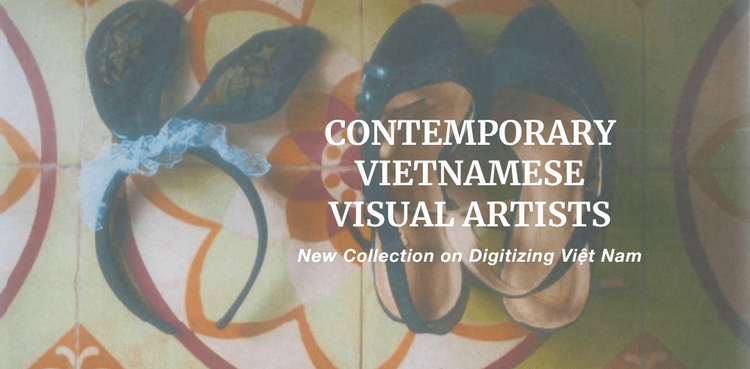
Through a collaboration with KIRTI - a counter-archive dedicated to documenting contemporary artistic practices beyond established institutions and centers of power - Digitizing Việt Nam is pleased to present a collection of interviews and artworks by seven contemporary Vietnamese visual artists. The collection offers not only a snapshot of Vietnam’s artistic landscape today, but also a rare opportunity to encounter artists in dialogue with their own work—to witness how ideas are conceived, tested, developed, and gradually take shape through artistic reflection and practice.
The collection brings together artists whose work engages with questions of identity, memory, urbanization, spirituality, marginality, and social transformation. Dũng Quốc Nguyễn (1983–) presents intimate yet challenging portraits of transgender communities, migrant laborers, and others living on the margins of Vietnamese society. Through bodies and faces often obscured from public view, his paintings question dominant norms of beauty, respectability, and visibility.
Phương Đức (1982–) draws inspiration from folk art and vernacular visual culture, creating paintings and sculptures that combine contemporary artistic language with organic materials, including pigments made from earth and natural substances. His work evokes connections between cultural memory, the environment, and everyday life.
Through photography, Mai Nguyên Anh (1992–) documents people and social realities that are often overlooked. His series, The Story of B, recounts the life of a Vietnamese sex worker through a visual language that is both intimate and deeply reflective. Meanwhile, Yến Dương (1991–) creates layered collages that combine archival imagery with contemporary landscapes, exploring the lingering traces of war, collective memory, and historical forgetting in present-day Vietnam.
The collection also includes reflections by the late Đỉnh Q. Lê (1968–2024), one of the most influential Vietnamese artists on the international stage. Known for his woven photographic works and multimedia installations, Đỉnh Q. Lê speaks about his return to Vietnam, his engagement with history and memory, and his passion for collecting Vietnamese ceramics and antiquities.
Đạt Vũ (1991–) presents images from A Thousand Fish Turn Into Guan Yin, a poetic photographic series inspired by transformation, fluid identities, and his experience of growing up at the intersection of Catholicism and Buddhism. Meanwhile, Duy-Phương Lê Nguyễn (1984–) contributes Mirages (2017–2022), a long-term project documenting idealized visions of urban futures displayed on construction-site billboards across Vietnam. By re-photographing and reframing these images, he exposes the contradictions between aspirations for development, globalization, and the realities of contemporary urbanization.
For Digitizing Việt Nam, this collection represents a broader understanding of what a digital archive can be. Alongside historical texts, newspapers, manuscripts, and archival photographs, we believe there is an ongoing need to document and preserve the living cultural landscapes of the present—and especially the voices of the artists who are helping to shape them.
Our sincere thanks to KIRTI, initiated in 2018 by Hunter P. Deerfield, for sharing this collection with us.
👉 View the collection here.
The Southeast Asia Council (SEAC) of the Association for Asian Studies is inviting proposals for the 2027 Rising Voices panel: “Shrinking Spaces for Free Inquiry in Southeast Asian Studies”.
The initiative supports emerging scholars in Southeast Asian Studies, including:
• Graduate students conducting original field or archival research
• Independent scholars
• Untenured faculty, adjuncts, and lecturers
• Early-career researchers from underfunded institutions in Southeast Asia
Selected participants will present at the Association for Asian Studies Annual Conference in Boston (March 18–21, 2027), with partial financial support from AAS/SEAC and TRaNS.
This year’s panel explores academic freedom, authoritarianism, self-censorship, neoliberal pressures in higher education, and the changing conditions for research and intellectual life across Southeast Asia.
📅 Submission deadline: July 20, 2026
📍 Boston, Massachusetts, USA
A valuable opportunity for rising scholars working on Southeast Asia to bring critical and interdisciplinary perspectives into an international academic forum.
View more details at: https://bit.ly/rising-voices
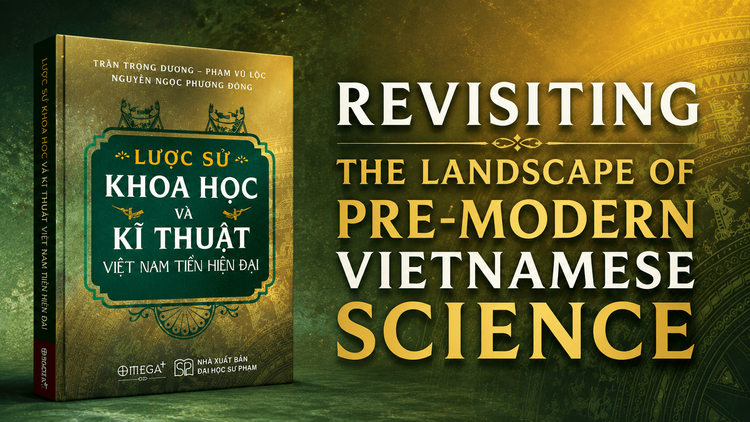
A Brief History of Pre-Modern Vietnamese Science and Technology (Lược sử khoa học và kĩ thuật Việt Nam tiền hiện đại) is a scholarly work compiled by researchers Trần Trọng Dương, Phạm Vũ Lộc, and Nguyễn Ngọc Phương Đông, published in 2026 by Vietnam National University of Education Publishing House in collaboration with Omega Plus Books.
The book offers a comprehensive overview of the formation and development of Vietnamese science and technology during the pre-modern period, highlighting the creativity, adaptability, and capacity for knowledge transmission and transformation that characterized Vietnamese society throughout history. More than simply reconsidering the place of science and technology in Vietnamese history, the work also reevaluates indigenous systems of knowledge that have often been overlooked in modern historical narratives.
Through its examination of fields such as astronomy, calendrical systems, geography and cartography, mathematics, hydraulic engineering, mechanics, weaponry, transportation, and architecture, the book demonstrates that from an early period, the Vietnamese had actively absorbed, adapted, and innovated systems of knowledge in order to respond to environmental conditions, defend the country, and organize social life. The study also analyzes processes of cultural exchange and intellectual interaction between Vietnam, East Asia, and the wider world, thereby affirming the long-standing traditions of creative labor, intellectual curiosity, and innovation among Vietnam’s diverse communities.
Developed through an interdisciplinary approach and grounded in extensive historical sources as well as contemporary scholarship, A Brief History of Pre-Modern Vietnamese Science and Technology serves not only as a valuable reference for readers interested in the history of science, intellectual history, and Vietnamese civilization, but also opens up the possibility of developing a broader future project on the “History of Vietnamese Civilization, Science, and Technology.”
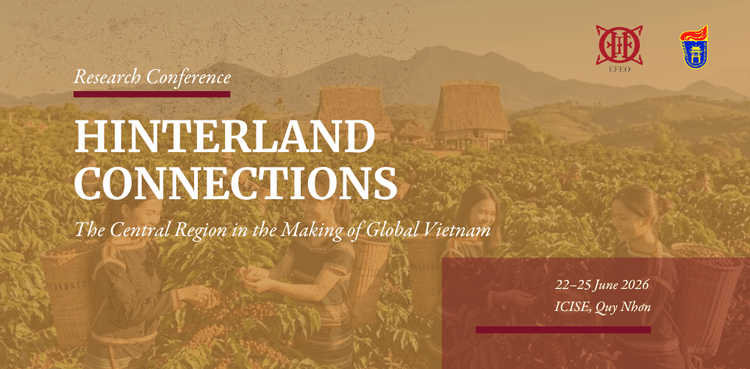
From 22–25 June 2026, the international conference Hinterland Connections: The Central Region in the Making of Global Vietnam will take place in Quy Nhơn and An Khê, bringing together scholars from Vietnam, Japan, Europe, and beyond to examine the historical role of Central Vietnam as a dynamic zone of connectivity between mountains, rivers, coastlines, islands, and the wider maritime world.
The conference will be hosted at the International Center for Interdisciplinary Science and Education (ICISE), Quy Nhơn, Bình Định Province, Việt Nam.
The conference is organized by:
- University of Social Sciences and Humanities – Vietnam National University, Hanoi (USSH-Hanoi)
- École française d’Extrême-Orient (EFEO)
- Alumnae of the HYI Visiting Scholars Program
with support from the Gia Lai People’s Committee.
The program explores themes including maritime trade, upland–lowland interactions, Champa networks, political geography, religion, intermediary trade spaces, colonial transformations, and the environmental histories of Central Vietnam from the 8th/9th century to the 20th century.
CONFERENCE PROGRAM
22 June 2026 — DAY ONE (ICISE)
Opening Remarks
8:00 — Nguyen Thi Thanh Lich
Welcome to Quy Nhơn
8:10 — Hoang Anh Tuan
Introduction
8:20 — Andrew Hardy
Introduction to the Conference
The Central Region at Sea and on Land
Session 1 | 8:30–10:00
8:30 — Tran Duc Anh Son
Reconceptualizing Central Vietnam’s Maritime Geobody
9:00 — Edyta Roszko
Hydro Histories Below Ground: Phu Quy Island
9:30 — Discussion
10:00 — Coffee Break
Connectivities of the Champa Hinterlands
Session 2 | 10:30–12:00
10:30 — Nguyen Thi Tu Anh
Archaeological and Anthropological Indices at the Cat Tien (Lam Dong) Holy Site of Interactions between the Central Highlands and the Mekong Basin
11:00 — Tran Ky Phuong
Cham Buddhist Vestiges of Economic Interactions between the Mekong Basin and the Central Highlands
11:30 — Discussion
12:00–1:00 — Lunch
Maritime Connectivities in the Cham Era
Session 3 | 1:00–2:30
1:00 — Pham Thi Thanh Huyen
Champa Aloeswood in the Islamic World
1:30 — Kikuchi Seiichi, Yuriko Kikuchi & Dang Hong Son
Glass Objects from the Middle East on Cham Island
2:00 — Discussion
Session 4 | 2:30–4:00
2:30 — Endo Satoshi
Vijaya as Hub for Tribute and Commerce in the Song Dynasty Era
3:00 — Momoki Shiro
An Attempt to Compare Central Vietnam as a Medieval to Early Modern Space with Japan
3:30 — Discussion
4:00 — Coffee Break
Post-Champa Domestic and Foreign Trade in Forest Products
Session 5 | 4:30–6:00
4:30 — Nguyen Van Kim
Tu Nui den Song: San vat Trung Nguyen trong giao thuong Dang Trong, The ky 16–18
5:00 — Bui Thi Bich Ngoc
From the Forest to the Sea: the Production, Trade and Consumption of Dau Rai Resin
5:30 — Discussion
6:00 — End of Day One
23 June 2026 — DAY TWO (ICISE)
Headwaters and Checkpoints
Session 6 | 8:00–10:00
8:00 — Phan Thuy Giang
The “nguon” Institution: the Case of Thanh Bong, Quang Ngai
8:30 — Le Thi Mai
Social, Economic and Cultural Flows in the “nguon” of Thu Bon, Quang Nam, 1600–1900
9:00 — Discussion
9:30 — Coffee Break
Session 7 | 10:00–11:30
10:00 — Federico Barocco & Nguyen Thi Nga
Phu Tai Checkpoint as Hub for Upland-Lowland Trade in Tra Bong, Quang Ngai
10:30 — Pham Van Trieu & Hoang Nhu Khoa
Intermediary Spaces in the Flow of Trade between Mountain and Coast, 17th to 19th Century
11:00 — Discussion
11:30–12:30 — Lunch
Session 8 | 12:30–2:00
12:30 — Nguyen Dang Anh Minh
Power Dynamics Along the Ba River, Quang Ngai
1:00 — Dao The Duc
The Role of Chinese Middlemen as Links between Upland and Lowland
1:30 — Discussion
The Politics of Connectivity in the Uplands and on the Coast
Session 9 | 2:00–4:00
2:00 — Andrew Hardy
Gatekeepers of the Ecotone: Trade, Tax and Power in the Borderlands and the Origins of the Tay Son Rebellion
2:30 — Nguyen Quoc Vinh
From Highland Betel Trader to Emperor Thai Duc (r. 1778–1793): Repositioning the Role of Nguyen Nhac in Tay Son Littoral History
3:00 — Nicolas Weber
Making Kings in the Uplands: Religion and Political Possibility in Panduranga, 1796–1835
3:30 — Discussion
4:00 — Coffee Break
Session 10 | 4:30–6:00
4:30 — Phan Phuong Thao
Land Reform in Binh Dinh: Eradicating Tay Son Bases of Support
5:00 — Vu Thi Xuyen
The “nguon” Institution in the Nguyen Taxation System: The nguon of Cam Lo (Quang Tri)
5:30 — Discussion
6:00 — End of Day Two
24 June 2026 — DAY THREE: AN KHÊ
- Travel to An Khê
- Nguyen Quang Ngoc — In Search of An Khe
- Lunch in An Khê
- Visit to Quang Trung Museum, Phu Phong Town
- Return to Quy Nhơn
25 June 2026 — DAY FOUR (ICISE)
The Past in the Present
Re-making the Highlands
Session 11 | 8:30–10:00
8:30 — Peter Bille Larsen
Colonial and Post-Colonial Hinterland-Making Narratives in Quang Binh
9:00 — David Biggs & Ho Thanh Tam
From Plei Piom to thon Le Chi: Villagization in the Longue Duree in Gia Lai
9:30 — Discussion
10:00 — Coffee Break
Religion and Community at Sea and in the Highlands
Session 12 | 10:30–12:00
10:30 — Nguyen Thi Phuong Cham and Hoang Cam
Maintaining Connections between Ly Son Island and the Mainland through Religious Rituals
11:00 — Quang Dai Tuyen
From Rituals to Collective Memory: The Rija Ritual System and the Reproduction of the Cham Village Cultural World in Central Vietnam
(to be presented in his absence)
11:30 — Discussion
12:00–1:00 — Lunch
Summing Up
Session 13 | 1:00–2:00
1:00 — Roundtable
Momoki Shiro, Do Thi Thuy Lan, Vu Thi Kim Van, Do Truong Giang
Mountains, Rivers and Sea: The Geography of Central Vietnam’s Global Role
1:30 — Discussion
Departure
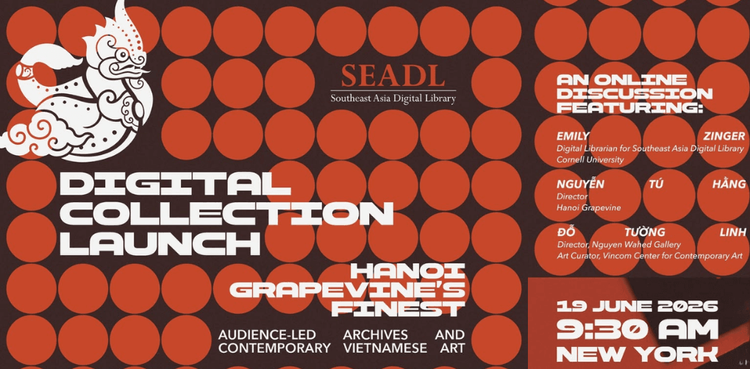
Hanoi Grapevine’s Finest (HGF) — the annual audience-nominated recognition of outstanding contemporary art projects in Vietnam since 2019 — is now officially hosted on the Southeast Asia Digital Library.
This special conversation marks the launch of the archive on the platform and reflects on what it means for a grassroots, community-driven archive to enter an international digital library consortium. Bringing together perspectives from cultural practice, anthropology, and digital librarianship, the discussion will explore questions of whose knowledge counts, how digital archives shape research narratives, and how audience-led cultural memory is preserved within scholarly infrastructures.
Speakers:
• Nguyễn Tú Hằng – Director of Hanoi Grapevine
• Emily Zinger – Southeast Asia Digital Librarian
• Đỗ Tường Linh – Director, Nguyen Wahed Gallery & Art Curator, Vincom Center for Contemporary Art
- June 19, 2026 | 8:30 PM (Vietnam time)
- Virtual via Zoom
- Register here: https://bit.ly/hanoi-grapevine-finest
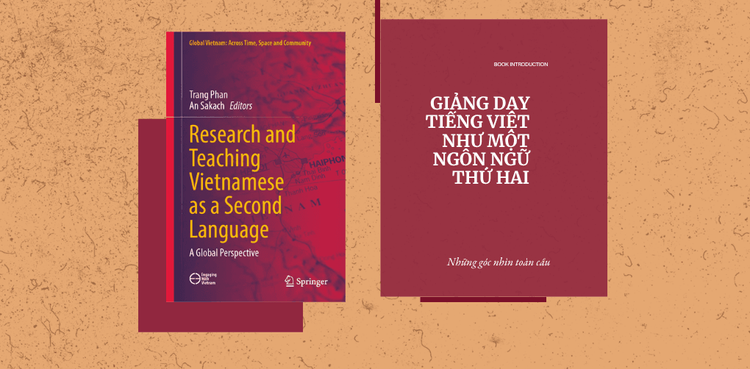
In an increasingly interconnected world, language learning transcends borders, classrooms, and traditional pedagogical approaches. Research and Teaching Vietnamese as a Second Language: A Global Perspective responds to this dynamic landscape, offering a comprehensive examination of Vietnamese as a second language (L2) within diverse sociolinguistic and educational contexts. Edited by Trang Phan and An Sakach, and published by Springer Nature Singapore Pte Ltd. in 2026, this volume situates Vietnamese within the broader framework of Less Commonly Taught Languages (LCTLs), highlighting both the unique challenges and the rich opportunities that arise when teaching and learning in multilingual and multicultural environments.
This book engages scholars, educators, and practitioners in a global dialogue on Vietnamese L2 acquisition, pedagogy, and research innovation. The first section examines Vietnamese learning in global settings, including heritage language use in bilingual families, Vietnamese language acquisition across multilingual contexts, and virtual tandem exchange programs. By bridging empirical research and practical classroom strategies, the volume illuminates pedagogical innovations such as corpus-based vocabulary design, task-based learning, and gamification approaches for heritage learners.
Beyond classroom strategies, the book analyzes cognitive and cross-linguistic influences in L2 Vietnamese. Chapters explore the role of Sino-Japanese knowledge in vocabulary acquisition, motion constructions for Chinese and Korean learners, and wh-word order acquisition by Japanese learners. These studies highlight how learners’ prior linguistic experience shapes Vietnamese L2 development and inform tailored instructional strategies.
Equally important, the book addresses social, cultural, and identity dimensions of language learning. Notably, the volume includes a chapter on translanguaging pedagogy, which examines how teachers and students in U.S. higher education strategically use multiple languages to enhance understanding, cultural connection, and communicative competence. This research emphasizes validating multilingual learners’ identities, fostering inclusive learning spaces, and expanding language acquisition strategies, offering practical guidance for Vietnamese language programs worldwide.
By integrating the voices of educators and learners from diverse regions, the volume provides both theoretical contributions and actionable insights, serving as an essential resource for anyone invested in the global teaching and research of Vietnamese as a second language. Through its global lens, the book celebrates the multiplicity of Vietnamese learning experiences and the creativity, resilience, and agency of learners and teachers worldwide, affirming that the study of Vietnamese as a second language is not only an academic pursuit but also a bridge across cultures, communities, and generations.
More information about the book is available at https://bit.ly/vietnamese-language-classrooms
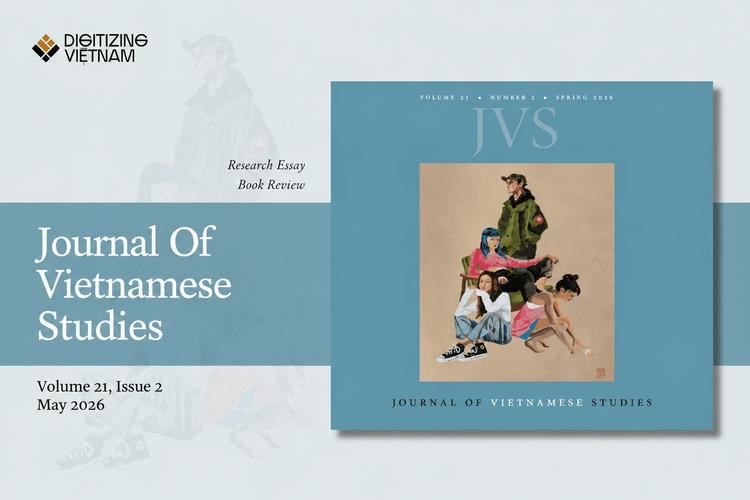
Continuing the commitment to foster scholarly conversations on Vietnamese history, culture, and society, Journal of Vietnamese Studies has officially released Volume 21, Issue 2 (May 2026), builds upon the journal's longstanding contributions to interdisciplinary scholarship and ongoing discussions within the field of Vietnamese Studies.
This issue approaches Vietnam from a diverse range of perspectives, from the history of music and cultural regulation in Vietnam between 1945 and 1976, the effects of financialization on ethnic minority communities in the Central Highlands, to the ways in which alternative visions of Vietnam have been articulated through political discourse. In addition to original research articles, the issue features three book reviews examining important works on South Vietnamese literature, Vietnamese communities in post-socialist Eastern Europe, and contemporary debates surrounding sovereignty, migration, and refuge in a globalized world. Please see below for the full list of articles included in this issue.
Research Essays:
•Capitalist Music Brings Jail: Illegal Music in the Democratic Republic of Vietnam (1945–1976) (Jason Gibbs)
•Financialization and Indebtedness of Coho-Chil Ethnic Minority Communities in the Central Highlands, Vietnam (Phạm Thanh Thôi)
•Voices from the Center: Lập Trường and the Imagining of an Alternative Vietnam (Nguyễn Dịu-Hương)
Book Reviews:
•Reading South Vietnam’s Writers: The Reception of Western Thought in Journalism and Literature (reviewed by Trinh M. Luu)
•Vietnamese Diasporas Along the Former Iron Curtain: From Builders of Socialism to Builders of Capitalism (reviewed by Seb Rumsby)
•Almost Futures: Sovereignty and Refuge at World’s End (reviewed by Wesley Attewell)
The full issue is available at:

As digital transformation continues to reshape every aspect of contemporary society, cultural heritage is also undergoing profound changes in the ways it is preserved, accessed, interpreted, and experienced. The national scientific conference “Heritage and Digital Transformation: Challenges and Opportunities” aims to create an interdisciplinary dialogue among scholars, cultural practitioners, technologists, heritage managers, and educational institutions to reflect on the future of Vietnamese heritage in the digital age.
The conference brings together researchers and institutions working across culture, heritage, technology, and digital humanities, including:
• Vietnam Folk Arts Association
• Institute of Cultural Studies
• Ho Chi Minh City University of Culture
• University of Social Sciences and Humanities, Vietnam National University Ho Chi Minh City
• Ho Chi Minh City Institute for Development Studies
• Southern Institute of Social Sciences
• Vietnam Studies Center – Fulbright University Vietnam
• Representatives from UNESCO Vietnam
The conference program will explore a wide range of topics, including:
• Blockchain applications in cultural heritage management
• Data, power, and institutional challenges in heritage digitization
• Urban heritage in digital spaces and the culture of “check-ins”
• Building digital ecosystems for cultural heritage in Vietnam
• Digital humanities and AI practices in Vietnam Studies
As part of the conference, Digitizing Việt Nam will also participate in presenting the project and its ongoing initiatives in digital humanities and AI for Vietnam Studies.
🕐 Time: 1:30 PM – 5:00 PM, May 28, 2026
📍 Venue: Hall C, Ho Chi Minh City University of Culture
51 Quốc Hương Street, An Khánh Ward, Ho Chi Minh City
We look forward to meeting researchers, students, and members of the public interested in heritage, technology, and the future of Vietnam Studies in the digital era.
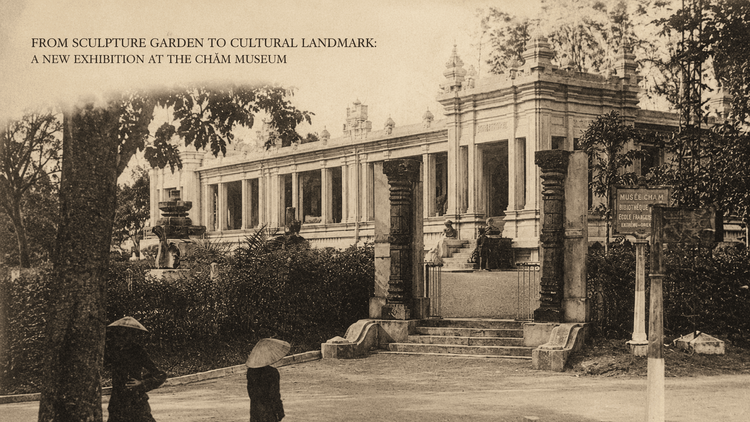
The Museum of Cham Sculpture stands as one of the most important cultural landmarks in central Vietnam and one of the world’s finest museums dedicated to Chăm art and civilization. Located in the heart of Da Nang, the museum preserves an extraordinary collection of sandstone sculptures, altars, and architectural masterpieces dating from the 7th to the 15th centuries. Through these remarkable works, visitors can explore the spiritual, artistic, and historical legacy of the ancient Champa Kingdom, whose influence once extended across much of central Vietnam.
Founded during the French colonial period, the museum itself is closely connected to the history of archaeological research and preservation in Vietnam. In recognition of this history, a special photographic exhibition entitled “From the Sculpture Garden of Thoàna to the Cham Art Museum” will be on display from 18 May to 18 August. The exhibition presents rare archival photographs from the École française d'Extrême-Orient (EFEO), highlighting the institution’s significant role in the establishment and early development of the museum.
Through historical photographs and documents, the exhibition retraces the transformation of the original sculpture garden at Thoàna into what later became the Museum of Cham Sculpture. It also offers visitors a glimpse into the early preservation efforts, archaeological expeditions, and scholarly collaborations that helped safeguard Chăm cultural heritage for future generations.
For those living in or traveling to Da Nang during this period, the museum and exhibition offer a unique opportunity to discover both the beauty of Chăm art and the fascinating history behind the museum itself. Visitors are warmly invited to explore this exceptional exhibition and experience one of Vietnam’s most treasured cultural institutions.

The photo archives of the École française d'Extrême-Orient (EFEO) continue to offer remarkable visual windows into the historical landscapes and societies of Vietnam. EFEO has recently made available 248 newly digitized photographs taken in central Vietnam by Jean Le Pichon, then an officer in the Indochinese Guard.
Jean Le Pichon first settled in Vietnam in 1927 as a planter before joining the colonial administration following the economic crisis of 1929. Rising through the ranks of the Indochinese Guard from guard to chief inspector, he became known for favoring a mediating role in the field. During his travels through the mountainous regions between Huế, Pleiku, and Kon Tum, he encountered and documented the Katu people, collecting observations on their traditions and cultural life. He was encouraged in this work by Father Léopold Cadière of the Paris Foreign Missions Society, a corresponding member of EFEO and co-founder of the Bulletin des Amis du Vieux Huế.
These photographs capture more than architecture and scenery. They preserve fragments of everyday life, local communities, built environments, and cultural spaces across a period of profound historical transformation. As historical visual records, they also invite reflection on the layered relationship between colonial documentation, ethnographic observation, memory, and cultural heritage preservation.
For researchers and students of Vietnamese Studies, collections such as these are invaluable not only as archival materials but also as interconnected sources for digital humanities research. When brought into dialogue with maps, texts, oral histories, and local archives, historical photographs help reveal how places and communities changed across time.
Discover the 248 newly released entries here: EFEO Photo Library

📅 Date: 14 May 2026
🕛 Time: 12:00–1:30 PM (Vietnam time)
💻 Format: Online via Zoom
🔗 Registration: https://bit.ly/4u3bIM1
👤 Speaker: Tommy Chai, PhD Candidate, Strategic and Defence Studies Centre, Australian National University
How has geography shaped the political and strategic realities of mainland Southeast Asia across history? How do river systems, frontier zones, trade corridors, and older forms of political authority continue to influence regional order today?
In this seminar, Tommy Chai (PhD Candidate, Strategic and Defence Studies Centre, Australian National University) explores continental Southeast Asia not simply as a collection of nation-states, but as a historically interconnected strategic space centred around the Irrawaddy, Chao Phraya, Mekong, and Red River basins, extending into surrounding upland and frontier regions such as Yunnan.
The talk examines how geography and historically embedded modes of political legitimation create enduring constraints that shape both regional actors and external powers seeking influence in the region. Rather than viewing political outcomes through the lens of “successful” or “failed” state-building, the seminar asks how the strategic environment itself defines what becomes politically and operationally possible over time.
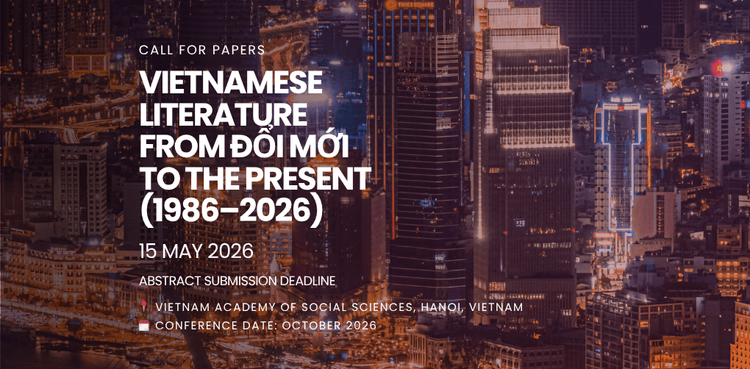
On the occasion of the 40th anniversary of Đổi Mới (Renovation), the Institute of Literature under the Vietnam Academy of Social Sciences is pleased to announce the international conference:
📚 “Vietnamese Literature from Đổi Mới to the Present (1986–2026)”
The conference aims to critically reflect on the achievements, limitations, transformations, and future directions of Vietnamese literature over the past four decades, while fostering scholarly dialogue on literary theory, criticism, creative practice, reception, and the place of Vietnamese literature in an era of global integration and contemporary change.
🔹 Topics include (but are not limited to):
• Vietnamese literature in the context of Đổi Mới and socio-economic transformation
• Achievements and limitations of Vietnamese literature (1986–2026)
• Literary theory, criticism, translation, and dissemination
• Major literary trends, genres, authors, and representative works
• Interdisciplinary and multidisciplinary approaches to literary studies
• Emerging challenges and future prospects for Vietnamese literature
📍 Venue: Vietnam Academy of Social Sciences, Hanoi, Vietnam
🗓 Tentative conference date: October 2026
📌 Abstract submission deadline: 15 May 2026
📌 Notification of acceptance: 30 May 2026
📌 Full paper deadline: 1 September 2026
🌐 Conference languages: Vietnamese and English
🔗 Registration form: https://forms.gle/dNy3quHxoMR2V7AA6
📧 Contact: htqtvvh2026@gmail.com

How were women imagined, represented, and mobilized in socialist and postcolonial visual cultures during and after the Cold War?
Digitizing Vietnam would like to share the upcoming fourth session of the online seminar series Socialist Visual Cultures and Decolonization: Circulation, (Re)interpretation, and Resistance of Visual Models in the Context of the Cold War, organized by researchers from Northwestern University, EHESS, University of Strasbourg, CNRS, INHA, and IrAsia.
This session explores the theme: “Women and the Politics of Emancipation in Socialist and Decolonial Contexts”
Featuring presentations by:
- Christine Varga-Harris: “Models of Decolonization and Female Emancipation: Women in Africa and South Asia vis-à-vis Soviet Women in the Visual Repertoire of Soviet Woman during the 1950s and 1960s”
Nora Annesley Taylor: “Mother, Worker, Hero: Socialist and Post-Socialist Imaginings by Contemporary Vietnamese Women Artists”
The seminar series brings together scholars examining visual production in postcolonial socialist contexts, with attention not only to images themselves, but also to their circulation, reception, mediation, and reinterpretation across different societies.
- Time: Wednesday, May 13, 2026, 19:00–21:00 PM (Vietnam)
- Registration link: https://bit.ly/48Kv406
We encourage students, researchers, artists, and anyone interested in visual culture, socialism, decolonization, and Vietnam studies to attend and share with their networks.
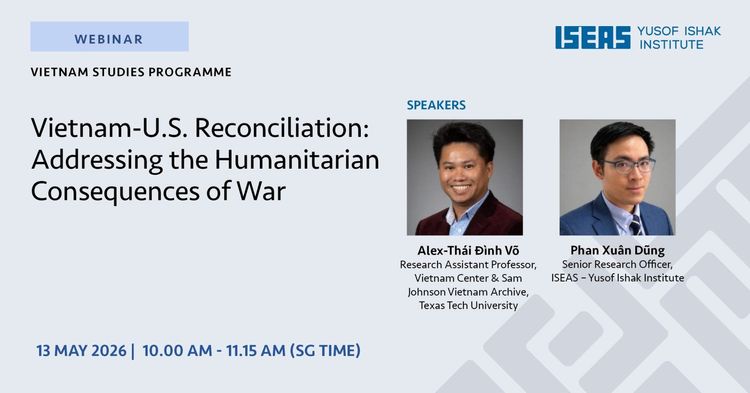
How do former enemies move from conflict to cooperation—and what remains unresolved? This webinar explores the ongoing process of Vietnam–U.S. reconciliation through two key humanitarian efforts: the search for Vietnamese wartime missing persons and support for those affected by Agent Orange/dioxin.
Featuring insights from Alex-Thái Đình Võ and Phan Xuân Dũng, the discussion will examine how trust, healing, and policy intersect—and where gaps still persist between commitments and realities on the ground.
Join us for a timely conversation on memory, responsibility, and the future of bilateral cooperation.
🔗 Register here: http://bit.ly/4nch1WT
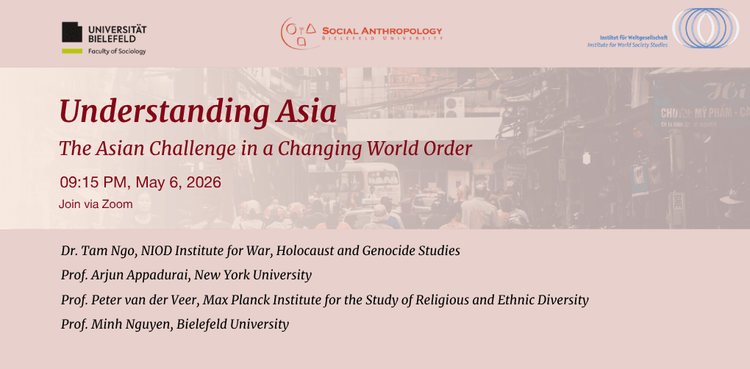
As the post–World War II global order continues to shift, longstanding assumptions about globalization, alliances, and geopolitical identities are being reexamined. This roundtable brings together leading scholars to explore how Asia is being reimagined amid rapid economic growth, rising nationalism, and emerging technologies of sovereignty. The discussion will address how these transformations are reshaping both regional dynamics and global futures.
Featured Speakers:
Dr. Tâm Ngô – NIOD Institute for War, Holocaust and Genocide Studies
Prof. Arjun Appadurai – New York University
Prof. Peter van der Veer – Max Planck Institute (Emeritus Director)
Prof. Minh Nguyen – Bielefeld University
Time (Vietnam): 09:15 PM, May 6, 2026
Register here: https://bit.ly/4w9ChAJ

At first glance, the notion of “market socialism” appears as a synthesis—a model that promises to combine the dynamism of market economies with the ethical commitments of socialist governance. Yet this apparent harmony conceals deeper tensions. Rather than resolving the relationship between growth and equality, the system may in fact intensify the contradictions between them. It is precisely this problem that The Contradictions of Market Socialism: Labour, Capital, and Welfare in Privatizing China and Vietnam, edited by Minh T.N. Nguyen and Jingyu Mao and published by Bristol University Press and Policy Press in April 2026, sets out to examine with clarity and rigor.
The volume belongs to the Research in Comparative and Global Social Policy series, a body of work that seeks to understand how different societies respond to shared global challenges through evolving welfare and policy frameworks. Within this context, Nguyen and Mao position China and Vietnam not as isolated cases, but as part of a broader landscape of transformation in labour, welfare, and governance. At the same time, their editorial approach remains grounded in detailed empirical research, focusing on the lived realities of workers navigating rapidly changing economies that are simultaneously socialist in name and capitalist in practice.
The historical backdrop is familiar. Beginning in the late 1970s in China and the mid-1980s in Vietnam, both countries undertook sweeping reforms that dismantled central planning and introduced market mechanisms. These changes generated remarkable economic growth, reduced poverty on a massive scale, and transformed social life. Yet, as Nguyen and Mao emphasize in their introduction, these same reforms also reshaped the role of the state and destabilized earlier systems of labour protection and welfare. The state now operates within a dual imperative: it must promote capital accumulation to sustain growth while simultaneously maintaining its legitimacy through claims of socialist care and social protection. The coexistence of these imperatives produces not balance but contradiction, most visibly in the tension between the commodification of labour and the promise of its protection.
At the center of the volume is the concept of “hyperflexible accumulation,” a term developed by Nguyen and Mao to capture a distinctive regime of labour transformation in market socialist contexts. Under this regime, labour is made increasingly adaptable, mobile, and disposable, while the conditions that sustain workers’ lives are themselves absorbed into market processes. Platform economies redefine workers as independent partners, shifting risk away from companies and onto individuals, even as algorithmic systems exert intense control over their time and movement. In manufacturing, forms of employment that once appeared stable now resemble gig work, characterized by short-term contracts, outsourced labour, and fluctuating demand. Across sectors, workers are encouraged to understand themselves as self-managing enterprises, responsible for navigating uncertainty without collective guarantees.
A defining strength of the volume lies in Nguyen and Mao’s insistence that labour cannot be understood in isolation from the broader structures that sustain it. Their framework repeatedly returns to the question of social reproduction—the processes through which workers maintain their lives, families, and futures. Historically, rural land and collective systems provided a degree of security that buffered workers from market volatility. With the commodification of land and the restructuring of rural–urban relations, these forms of support have eroded. Workers are increasingly dependent on wage income and must contend with rising costs of housing, healthcare, and education. What emerges, in Nguyen and Mao’s analysis, is a profound transformation in everyday life, in which participation in the market becomes not simply a choice but a necessity.
The book further demonstrates that contemporary welfare systems, while formally expanded, often fail to provide meaningful protection. Although China and Vietnam now maintain social insurance schemes and other welfare institutions, Nguyen and Mao show that these systems tend to offer limited coverage and frequently place responsibility on individuals rather than institutions. In this sense, welfare operates less as a mechanism for shielding people from market risks than as a framework that integrates them more deeply into market participation . This shift marks a significant departure from earlier socialist arrangements, in which labour and welfare were embedded in collective structures that provided not only material support but also a sense of social belonging.
The erosion of this earlier “socialist social contract” is one of the book’s most compelling themes. As Nguyen and Mao suggest, workers were once tied to institutions that structured their lives, offering employment, housing, and welfare within a unified system. Today, these connections have largely been dismantled. Responsibility for survival has been individualized, and the collective dimensions of labour have weakened. Yet the language of socialism persists, continuing to shape expectations and political discourse even as the material conditions it once described have changed.
Against this backdrop, the volume traces how workers respond to these transformations. Nguyen and Mao highlight both visible forms of contestation, such as protests and labour disputes, and more subtle patterns of withdrawal from formal systems. Workers often turn toward flexible, short-term, or informal arrangements, not because they are unaware of the risks, but because such arrangements better accommodate the immediate pressures of survival. The widespread practice of withdrawing pension contributions early, for instance, reflects not only economic necessity but also a deep mistrust in long-term institutional guarantees. This tendency toward disengagement signals a growing disconnection between the reproduction of workers’ lives and the reproduction of the system itself.
By bringing together diverse empirical studies and a strong conceptual framework, Nguyen and Mao offer a powerful rethinking of contemporary political economy. Their volume demonstrates that the transformations unfolding in China and Vietnam are not merely local phenomena but part of broader global processes in which labour, welfare, and social life are being reorganized under conditions of intensified market integration. At the same time, they highlight the specificities of market socialist contexts, where the enduring presence of the state and the language of socialism produce distinctive configurations of power and responsibility.
What ultimately emerges is not a stable model of development but a system defined by unresolved tensions. Economic growth coexists with deepening insecurity, welfare expansion with limited protection, and state authority with increasing individualization of risk. In this sense, the contradictions of market socialism, as Nguyen and Mao make clear, are not anomalies but structural features. They shape not only policy and institutions but also the everyday experiences of millions of workers whose lives unfold within these shifting conditions.
The question the book leaves us with is both simple and profound. What does it mean for a system to depend on labour while simultaneously undermining the conditions that make that labour possible? The answer, as this volume demonstrates, lies not in abstract theory alone but in the lived realities of those navigating these contradictions in their daily lives.
Open access to the book is available here.
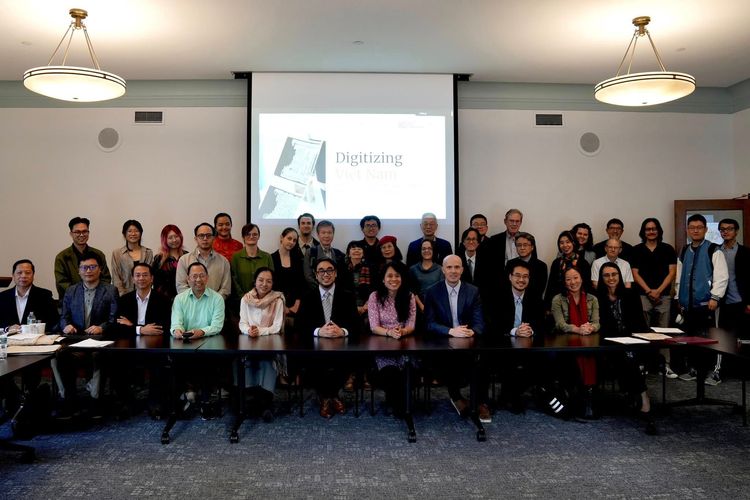
On April 18, 2026, scholars, librarians, technologists, and students gathered at Butler Library for a full-day workshop titled “Digitizing Vietnam: Vietnamese Studies in the Age of Digital Humanities and Artificial Intelligence”, exploring how digital humanities (DH) and artificial intelligence (AI) are reshaping Vietnamese Studies. More than a presentation of tools, the workshop became a sustained inquiry into a deeper question: what happens to a field grounded in language, history, and interpretation when computational systems increasingly mediate its materials?
Digitizing Vietnam as an Indra’s Net
From the outset, the conversation was framed not around technology alone, but around relationships.

Prof. John Phan shares the conceptual framework of Digitizing Việt Nam, titled "Indra's Net".
Prof. John Phan introduced a conceptual lens that would echo throughout the day, describing the emerging ecosystem of digital collections as something like Indra’s Net: a structure in which each node reflects all others, and meaning emerges through connection. The issue, as he emphasized, is not simply access. It is that materials, though digitized, still do not fully “speak to each other.” What is needed is not just aggregation, but a relational infrastructure.
It is within this frame that Digitizing Vietnam was introduced, not only as a platform, but as a network built through collaboration.

Dr. Hoàng Vũ elaborates on the Columbia-Fulbright collaboration of the project.
In the opening remarks, Dr. Hoàng Vũ emphasized that the project is fundamentally sustained through partnerships across institutions, organizations, and individuals working at different scales of preservation and research. These include collaborations with Vietnamese institutions such as Viện Hán Nôm and Đại học Khoa học Tự nhiên (Đại học Quốc gia TP.HCM), as well as international partners including the Southeast Asian Digital Library (SEADL), the Vatican Digital Library, and the University of Washington. Alongside institutional partnerships, he underscored the importance of individual scholars, archivists, and contributors whose work enables collections to be digitized, interpreted, and shared. Taken together, these relationships form the underlying infrastructure of the platform, one that extends beyond any single institution.
The morning session then unfolded the platform across four intertwined dimensions: collections, research, pedagogy, and outreach. These were not presented as separate modules, but as a continuous system. Collections anchor the work in large-scale digitized corpora, Hán-Nôm texts, periodicals, and multimedia archives. Pedagogy and outreach extend these materials into classrooms and public engagement. Research includes digital tools, OCR pipelines, search systems, and experimental AI interfaces that mediate between them, enabling new forms of interaction.
Yet a key point emerged early: digitization is not simply extraction.

Dr. Trâm Nguyễn highlights the central principle of the project: "to be human-centered".
As Dr. Trâm Nguyễn emphasized, the project aims not only to preserve cultural heritage, but to “bring the archive back to life.” This involves transforming static materials into active sites of engagement—spaces where historical texts enter into dialogue with contemporary users, classrooms, and creative practices.

Vân Lê expands on the evolution of extraction into regeneration and re:generation.
Vân Lê pushed this idea further by reframing outreach as a space of re:generation. If collections are where data is aggregated and validated, outreach is where that data is transformed—reworked into narrative, recombined into new forms, and used to generate meaning. Human experience, in this framing, is not structured by data alone, but by narrative and poetry. AI, therefore, is not the endpoint of interpretation, but a tool for opening new interpretive pathways.

Phúc Lê explains the AI Diplomat Vision and the distributed digital Indra's net.
It is precisely at this point that Phúc Lê’s presentation extends the argument outward.
If data can be regenerated within a system, what happens when systems themselves begin to communicate?
Phúc Lê proposed the idea of an “AI diplomat”: a network of specialized, collection-grounded AI systems, each rooted in its own corpus but capable of querying and collaborating with others. Rather than isolated tools, these systems would form an ecosystem, routing questions across collections, synthesizing responses, and enabling research that spans domains and geographies.
In many ways, this vision operationalizes Phan’s earlier metaphor. Indra’s Net becomes not just a way of thinking about collections, but a model for how computational systems themselves might interact.

Albert Errickson showcases his multiple personal projects as a humanities researcher, including Nôm Flow, a learninng tool for Nôm.
Albert Errickson demonstrated how AI is reshaping the playing field for humanities scholars. He presented several projects he has developed with the support of AI, including the Han Nôm Research Hubs, which integrate a wide range of Hán Nôm collections with tools for working directly on the texts, such as OCR and document comparison. He also engaged the audience with his NomFlow app, a learning tool that uses spaced repetition to guide users through canonical Nôm works line by line, with stroke order provided for each character.
From here, the workshop moved into broader discussions across Vietnamese Studies and beyond, with Tuan Hoang and Virginia Shih, where this tension between scale and meaning became more concrete.
Constraints and Tensions: Data, Bias, and Interpretation
Speakers in the early afternoon highlighted both the promise and unevenness of computational approaches. Large-scale corpus analysis enables new forms of pattern recognition and contextualization, yet these capabilities depend on incomplete datasets, linguistic complexity, and uneven digitization. The challenge is not only technical, but it is also epistemological.

Prof. Cindy Nguyen emphasizes the importance of spaces for human co-inquiry.
Prof. Cindy Nguyen captured this tension clearly. While emphasizing the power of turning words into vectors and uncovering semantic patterns across corpora, she also returned to the importance of the question space itself. Human inquiry, slow, dialogic, and situated, remains central. The proliferation of AI tools does not eliminate that space; it makes its role more visible.
The conversation then shifted toward the infrastructures that make these systems possible.

Emily Zinger speaks about SEADL and how she has been using and questioning AI in archival work.
In the session on digital collections and curatorship, speakers emphasized that AI is only as strong as the data it is built upon. Emily Zinger introduced the concept of ground-truth diversity, noting that many existing models are trained on datasets that marginalize Southeast Asian materials. What appears as technical success often conceals systemic gaps. Training data, in this sense, is not neutral; it is a form of curatorial practice that shapes what AI systems can recognize and reproduce.

Dr. Judith Henchy presents early efforts of preservation and digitization in Vietnam.
Dr. Judith Henchy extended this perspective historically, situating digitization within a longer continuum of preservation technologies. From microfilm to early digital archives, each stage has involved trade-offs between access, control, and sustainability. Her observation that “digitization is not the solution, it’s part of the problem” underscored the need for critical engagement rather than technological optimism.

Prof. Masaaki recounts digitizing initiatives of Han Nom collection at University of Osaka and University of Kyoto.
These questions became even more concrete in Prof. Shimizu Masaaki’s discussion of Chữ Nôm. OCR technologies remain limited in their ability to process complex historical scripts. Yet digitization still fundamentally reshapes pedagogy. High-resolution images enable students to engage texts analytically, comparing character structures, tracing phonetic components, and uncovering patterns across sources. In this context, AI functions not as a replacement for expertise, but as a potential collaborator within a human-led interpretive process.
By the late afternoon, the scope expanded to situate these discussions within broader East Asian digital humanities. Shared challenges, multilingual corpora, classical texts, and uneven archival landscapes suggested that Vietnamese Studies is part of a larger transformation across the humanities.
The closing roundtable returned to the central questions that had surfaced throughout the day. What constitutes meaningful knowledge in an AI-mediated environment? How do we balance scale with nuance? And what kinds of collaborations, between scholars, institutions, and systems, will define the next phase of the field?

Prof. Peter Bol discussed how AI has brought the humanities back to itself by going beyond quantitative methods and relying on language as the major medium of inquiry instead.
As Prof. Peter Bol observed, the significance of AI may lie in a subtle but important shift. Where earlier digital humanities emphasized quantification, AI brings the field back toward language, toward interpretation, ambiguity, and dialogue.
The workshop closed with a dinner reception, but its core insight remained open-ended. The future of Vietnamese Studies will not be determined by technology alone, but by how it is shaped, through curation, critical engagement, and creative use.
In this sense, Digitizing Vietnam is both a platform and a proposition: that archives can become dynamic spaces of interaction, where data is not the endpoint of knowledge, but the beginning of new forms of understanding.

In the early morning of January 7 in 1796, four Annamese Catholics were drifting aimlessly at sea off the coast of the Portuguese colony of Macao. They anxiously waited for Western merchant ships passing by Macao in hopes of securing passage, while also fearing that the soldiers of the Bishop of Macao might capture them and imprison them or deport them back home. Fortunately, from afar, six English merchant ships appeared at once. The four Annamese rowed toward each ship in turn, asking the captains if they could come aboard and work without pay. Ragged from having slept at sea for many consecutive days, they failed to impress five captains in succession and had to approach the final ship to plead their case. Expecting yet another refusal, they were overjoyed when the captain of the Santa Anna agreed to take them to Portugal. Thus, at the last moment, they escaped the reach of the Bishop of Macao and set out on a six-month sea voyage to Lisbon - unaware that this journey would mark the final time they would ever see their homeland of Annam, their families, and their friends.
This is the story of Father Philipphê (Philip) do Rosario Nguyễn Văn Bỉnh (1759–1833) and his three companions Joseph Trung, Thomas Nhân, and Francis Ngần - the last Catholics belonging to the Jesuit tradition in Vietnamese history. Their diplomatic mission in 1796 was closely tied to the notorious Garasa Schism, which shook the Catholic Church in Tonkin at the end of the 18th century. With the aim of petitioning Queen Maria I and Prince Regent João VI of the Portuguese Empire to appoint a Portuguese bishop who would represent the grievances of the Jesuit Christians, Father Bỉnh and his companions crossed the seas filled with hope, only to meet bitter disappointment at the end of 1807, when the Portuguese royal family fled Lisbon to Brazil to escape Napoleon Bonaparte’s invasion, thereby ending all hope of securing a Portuguese bishop for Tonkin. When their goal of obtaining a bishop could not be fulfilled, and the Apostolic Nuncio of the Holy See prevented him from returning home, Father Bỉnh spent the final 26 years of his life writing more than twenty works in three languages to express his thoughts and feelings in exile. Three of these works - namely the manuscripts Borg.tonch.17, Borg.tonch.18, and Borg.tonch.34 - were especially handwritten in the Nôm script and preserved in the collection of Cardinal Stefano Borgia at the Vatican Library.
In most of his writings, Father Bỉnh transcribed and translated Portuguese texts into Vietnamese using the Quốc ngữ script, as this was the linguistic legacy left to the Annamese Christians by Father Alexandre de Rhodes of the Society of Jesus (Jesuits). The fact that these three manuscripts were written in the Nôm script demonstrates their particular importance to Father Bỉnh, since the Annamese Catholics of that time were accustomed to reading Nôm texts rather than Quốc ngữ. According to Father Bỉnh, Quốc ngữ was merely a tool used by missionaries to learn Vietnamese quickly, whereas Nôm was truly “the national script.” That he copied only these three works in Nôm suggests that he regarded them as the greatest gifts he could offer to the Christians in Tonkin, should he not survive to return home. So what do these nearly 1,000 pages of Nôm text - Father Bỉnh’s intended gifts - contain?
Manuscript Borg.tonch.18, also known as “Father Bỉnh’s Prayer Book” or “The Novena Prayer Book,” completed in 1815, is a collection of prayers commonly recited by Jesuit Christians daily, during Sunday Mass, and on major feast days. It also includes novenas for various saints and important liturgical celebrations that Father Bỉnh carefully translated from Portuguese. The first saint to be mentioned in this text is Saint Anne, traditionally regarded by the Catholic Church as the maternal grandmother of Jesus Christ. Father Bỉnh held special devotion to her because the ship that carried him from Macao to Lisbon bore her name, which he considered a great miracle. Next is Saint Joseph, patron saint of Annam since the time Father de Rhodes evangelized Tonkin more than a century before Father Bỉnh was born. The book also contains a short novena for Christmas, celebrating the birth of Christ in Bethlehem. Additionally, there is a novena dedicated to the Seven Sorrows of the Virgin Mary - though not a major feast, it held deep personal significance for Father Bỉnh. Near the end of the book is a list of nearly one hundred indulgences granted to the Christians who visit churches in Rome and the Holy Land on designated feast days. Father Bỉnh also included a lengthy moral instruction addressing the education of children and the arrangement of marriages among the Christians in Tonkin. Beyond Nôm, the final pages include Latin prayers for priests to recite during novenas. The book concludes with a litany to Saint Francis Xavier, Father Bỉnh’s favorite saint, along with his final wishes regarding the return of his writings to the Christians in Tonkin. An appendix describes the Holy Temple of Jerusalem and miracles from the time of Christian persecutions in the Roman Empire.
Manuscript Borg.tonch.17, titled “Exhortations on Attending Mass and Saintly Stories,” completed in 1818, continues the work of manuscript 18. According to Father Bỉnh, the original manuscript grew too long when bound, so he separated about 300 remaining pages into a new volume - resulting in manuscript 17. Although it is framed as an exhortation to attend Mass regularly, the manuscript is largely composed of saintly tales and miracle stories drawn from both Scripture and real life. It is structured in three main parts. The first explains the solemnity of the Mass, though it includes many miracle stories related to it to encourage the faithful. The second explains why attending Mass brings grace to both body and soul, but consists largely of diverse tales: miracles from the Old Testament, from hagiographies, from the New Testament, stories from nature and folklore, and missionary histories of the Jesuits in China and Tonkin. This diversity reflects Father Bỉnh’s characteristic narrative style - discursive and multi-thematic within a single topic. The final part explains the harms of neglecting Mass, again illustrated through miracle stories in which many Christians suffer grave consequences for their irreverence. Together, manuscripts 17 and 18 form a distinctive devotional work that combines formal prayers with engaging religious narratives to make spiritual teachings more accessible to the common faithful.
Manuscript Borg.tonch.34, titled “Strong Reasons for Sustaining the Soul”, is in fact a long-lost work by the missionary Girolamo Maiorica (1591-1656), regarded as the Father of Catholic Nôm literature. Maiorica authored around fifteen Nôm works now preserved in the National Library of France (Bibliothèque nationale de France), but this particular text, “Strong Reasons for Sustaining the Soul” or “Meditação da Alma” in Portuguese, was not among them. Fortunately, Father Bỉnh copied the entire work into both Quốc ngữ (Borg.tonch.30) and Nôm (Borg.tonch.34), preserving its final trace. The opening section of manuscript 34 includes instructions for praying the Rosary and various prayers, likely copied from manuscript 18. The core of the manuscript consists of approximately 80 pages which are the full “Strong Reasons for Sustaining the Soul.” This work is modeled after the classic Spiritual Exercises of Saint Ignatius of Loyola, founder of the Jesuits. Maiorica encourages the Christians to meditate on one reflection per day, forming 31 meditations over a month. These meditations cover fundamental Catholic teachings about the state of the soul after death, strengthening the faith of believers. The final section includes devotions on the Seven Sorrows of Mary and the Nine Sorrows of Christ, attributed to Pope Saint Gregory.
Among Father Bỉnh’s works, these three Nôm manuscripts hold the highest importance, as they were his top priority to send back to the Jesuit Christians in Tonkin. He devoted great effort to translating stories from Portuguese into Vietnamese and then transcribing them into Nôm so that the Jesuit Christians could read them. As for his Quốc ngữ works, he instructed fellow Jesuit brothers to copy them into Nôm for the same purpose. With the digitization of these manuscripts on the Digitizing Việt Nam platform under a complete Nôm and Quốc ngữ transcription, Father Bỉnh’s final wish, which is the return of his writings to his homeland for future generations to read, has finally been fulfilled.
Readers are welcome to explore these three manuscripts in the collection “The Hán-Nôm Catholic Prayer Manuscripts of Philipphê Bỉnh” on Digitizing Việt Nam:
https://www.digitizingvietnam.com/en/our-collections/the-han-nom-catholic-prayer-philipphe-binh
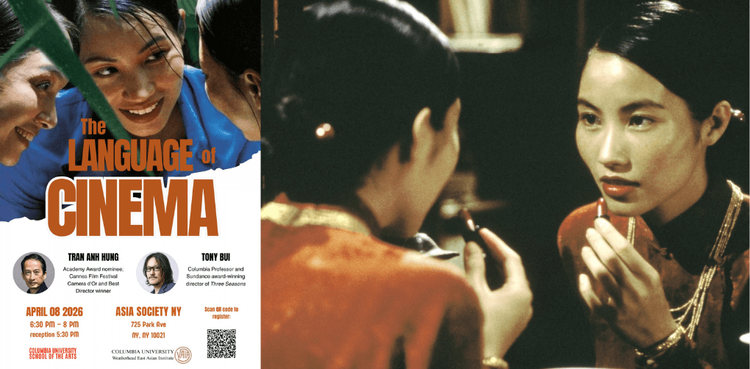
Event Details
- Date: April 8, 2026
- Time: 5:30 – 8:00 PM (EDT)
- Venue: Asia Society, 725 Park Ave, New York, NY
- Registration: https://bit.ly/48m1w8D
On April 8, 2026, Weatherhead East Asia Institute will be hosting a rare conversation with French–Vietnamese filmmaker Trần Anh Hùng, joined by filmmaker and Columbia professor Tony Bui. The event offers a close look into Trần’s distinctive cinematic language—one shaped less by dialogue than by image, rhythm, and atmosphere.
Across works such as The Scent of Green Papaya, Cyclo, and The Taste of Things, Trần constructs films that move through texture and sensation: the weight of silence, the choreography of bodies, and the slow unfolding of memory through space and gesture. His cinema resists explanation, instead inviting viewers to feel their way through it.
This conversation traces that approach - how sound, stillness, and performance converge to produce meaning beyond words. It also opens a space to reflect on questions that run quietly through his films: how memory is carried, how culture is sensed rather than stated, and how cinema can hold both intimacy and history at once.
For audiences interested in Vietnamese cinema, global film language, or the craft of visual storytelling, this is a rare opportunity to hear directly from one of its most singular voices.
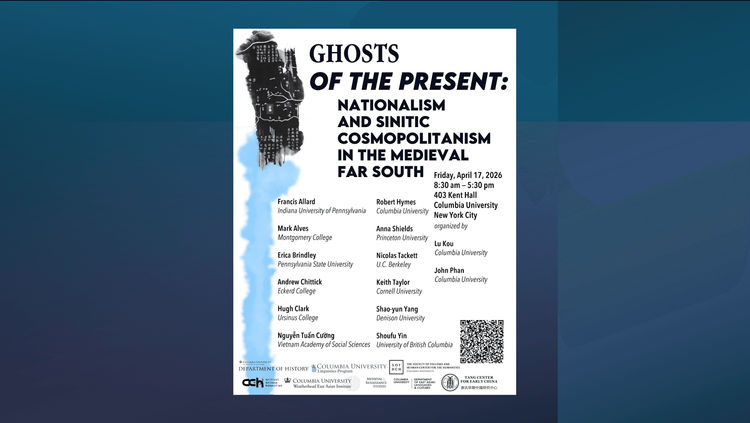
📅 April 17, 2026
🕢 8:30 AM - 5:30 PM (EDT)
📍 403 Kent Hall, 1140 Amsterdam Ave, New York, NY
👉Register here: https://bit.ly/4ch5BNL
This one-day conference brings together an interdisciplinary group of archaeologists, linguists, historians, and literary scholars to explore the “vernacular realities” of the medieval far south—historically known as Lingnan (Lĩnh Nam), a region spanning present-day Southern China and Northern Vietnam.
Moving beyond modern nationalist frameworks that retrospectively divide this past into “Chinese” or “Vietnamese” histories, the conference examines a region shaped by fluid cultural, linguistic, and political exchanges. Through a keynote lecture, three thematic panels, and a concluding roundtable, participants will investigate how local communities engaged with, adapted, and resisted Sinitic imperial systems.
By foregrounding local experiences and cross-regional connections, Ghosts of the Present seeks to challenge inherited historiographies and offer new perspectives on the medieval past and its enduring influence on contemporary understandings of East and Southeast Asia.
*The event is moderated by Lu Kou and John D. Phan, and features leading scholars from institutions across North America and Asia, including Francis Allard (Indiana University of Pennsylvania), Mark Alves (Montgomery College), Erica Brindley (Pennsylvania State University), Andrew Chittick (Eckerd College), Hugh Clark (Ursinus College), Robert Hymes (Columbia University), Nguyễn Tuấn-Cường (Vietnam Academy of Social Sciences), Anna Shields (Princeton University), Nicolas Tackett (UC Berkeley), Keith Taylor (Cornell University), Yang Shao-yun (Denison University), and Yin Shoufu (University of British Columbia).
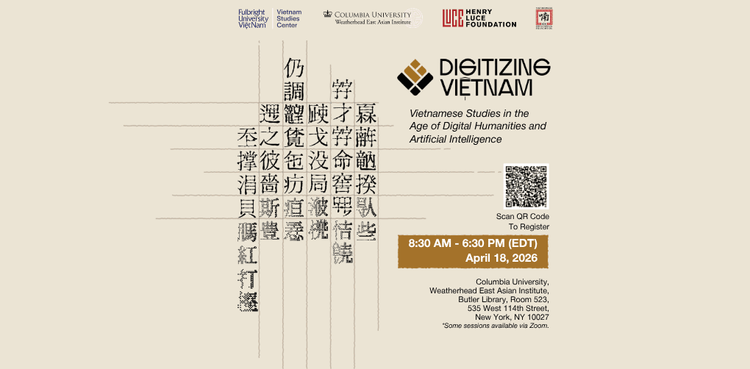
Digitizing Việt Nam warmly invites you to attend the event “Digitizing Vietnam: Vietnamese Studies in the Age of Digital Humanities and Artificial Intelligence.”
Digitizing Vietnam is an inter-institutional digital hub that harnesses the power of Digital Humanities (DH) and Artificial Intelligence (AI) to advance Vietnamese Studies in a comprehensive way. Funded by the Henry Luce Foundation and housed within Columbia University’s Vietnamese Studies Program, the project collaborates with Fulbright University Vietnam to develop digital collections, research tools, pedagogical resources, and platforms for sharing knowledge about Vietnam with broader audiences.
◆Time: 8:30 AM – 6:30 PM (EDT), Saturday, April 18, 2026
◆Location: Room 523, Butler Library, 535 W 114th St, New York, NY 10027
◆Registration here
◆All sessions will be available via Zoom. Join Zoom Webinar here.
This event marks the official launch of the Digitizing Vietnam Digital Humanities (DH) Hub and AI platform—a multi-functional system designed to support research, teaching, and scholarly collaboration.
The program brings together scholars, technologists, and researchers to explore how Digital Humanities and Artificial Intelligence are reshaping Vietnamese Studies. Through presentations, workshops, and discussions, participants will have the opportunity to:
◆Experience new DH and AI tools firsthand
◆Explore Digitizing Vietnam’s digital collections and curatorial practices
◆Reflect on the opportunities and limitations of AI in the humanities and social sciences
The program includes:
◆Introduction to the Digitizing Vietnam platform and hands-on, application-focused workshops
◆Panels on DH & AI in Vietnamese and East Asian Studies
◆Roundtable discussion: “The AI Horizon”
The project team hopes this event will serve as a space for connection across disciplines, methods, and scholarly communities, helping to shape the future of Vietnamese Studies in a digital and AI-driven context.
Some sessions will be available via Zoom.
*This event is generously sponsored by the Weatherhead East Asian Institute.
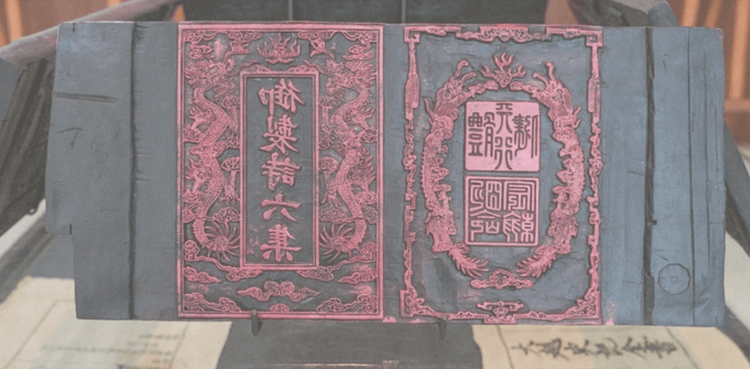
In an era of rapid digital transformation, how do we preserve personal and organizational histories? How do private archives shape social memory, research, and public knowledge?
The University of Social Sciences and Humanities, VNU-HCM (USSH) invites scholars, archivists, practitioners, and students to contribute to an international conference exploring the evolving role of private archives in the digital age.
📍 Date: July 30, 2026
📍 Venue: USSH, Ho Chi Minh City
Key Themes
- Legal, theoretical, and technological frameworks of private archives
- The role of archives in social memory and national development
- Building archival culture and public participation
- International models and comparative experiences
This is an opportunity to join a global conversation on how archives—often fragmented, personal, and overlooked—can become vital infrastructures of knowledge in the digital era.
Important Deadlines
- Abstract submission: April 10, 2026
- Full paper submission: May 30, 2026
📖Selected papers will be published in the official conference proceedings (ISBN).
Conference Themes
a. Theoretical, Legal, and Technological Foundations
- Theoretical issues in private archival activities
- Legal frameworks and policies on digital data management in the private sector (Vietnam)
- Ownership, rights, and exploitation of archival materials
- Technologies: AI, cloud computing, digital platforms
- Risks and challenges: security, preservation, ethics
- Legal and ethical issues (IP, copyright, ownership)
b. Role of Private Archives in National Development
- Organization and exploitation of private archival resources
- Role in social memory (families, communities, organizations)
- Relationship with cultural heritage and societal values
- Contribution to national data resources and policy-making
c. Building an Archival Culture and Society
- Promoting archival culture and socialization
- Public participation (conferences, exhibitions, outreach)
- Awareness-building initiatives
- Role of education and research institutions
d. International Experiences
- Comparative models from different countries
- International legal and policy frameworks
- Stakeholder participation (private sector, NGOs, communities)
- Technology trends and online archival platforms
Important Dates
- 📌 Abstract submission: before April 10, 2026
(Author(s), affiliation, email, title, abstract, keywords) - 📌 Full paper submission: before May 30, 2026
Submission Guidelines
- Format: A4, Times New Roman (Unicode), size 13
- Margins: Left 3 cm, Right 2 cm, Top 2.5 cm, Bottom 2.5 cm
- Line spacing: 1.5
Structure:
- Title: Vietnamese or English
- Abstract: 150–200 words
- Keywords: 3–5
- Length: max 8,000 words (excluding references & appendices)
- Citation style: APA 7th Edition
📄 File name format:
AuthorName_ShortTitle.doc
Contact Information
📩 Abstract & full paper submission:
Dr. Do Van Hoc
Email: hocdovan@hcmussh.edu.vn
Tel: +84 918 696 610
📩 General inquiries:
Ms. Tu Thi Hong Hanh
Email: tuthihonghanh@hcmussh.edu.vn
Tel: +84 909 435 724
Read the whole call for papers here.
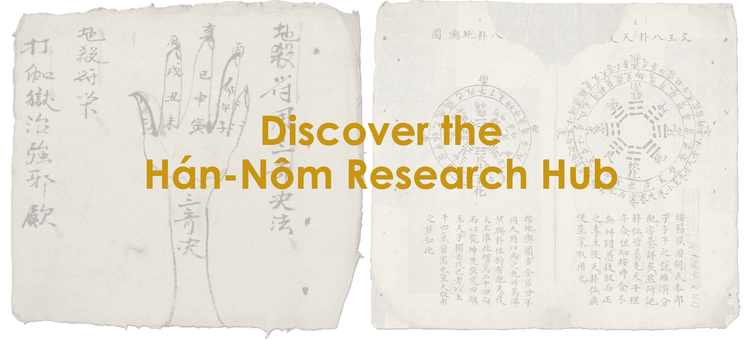
For many centuries, before the Latin-based Quốc Ngữ script became the dominant writing system, most Vietnamese knowledge and cultural life were recorded in Classical Chinese (Hán) and Nôm, the script developed by Vietnamese scholars to represent the Vietnamese language. From literature and history to geography, philosophy, and religion, the corpus of Hán–Nôm texts preserves important traces of Vietnam’s intellectual and cultural life across different historical periods.
Today, many Hán–Nôm texts remain scattered across libraries, archives, temples, and private collections. As a result, access to these valuable materials remains difficult not only for the general public but also for researchers.
To help expand access to this important body of sources, Digitizing Vietnam has developed the Hán–Nôm Research Hub page as part of its digital platform.
The Hán–Nôm Research Hub page is designed as a digital scholarly space dedicated to introducing and connecting Hán–Nôm resources. Here, readers can explore digitized collections, research projects, and initiatives that are helping bring Vietnam’s classical textual heritage into the digital environment.
By linking collections and scholarly projects from a variety of institutions, the page serves as a shared access point for Hán–Nôm research, supporting scholars, students, and anyone interested in Vietnamese history and culture.
The Hán–Nôm Research Hub page is part of the broader mission of the Digitizing Vietnam platform—an inter-institutional initiative that leverages digital technology and artificial intelligence to advance research and broaden access to knowledge in Vietnamese Studies worldwide.
Through these efforts, Digitizing Vietnam aims not only to preserve Vietnam’s textual heritage but also to create new ways to explore, research, and teach Vietnamese history and culture in the digital age.
Explore the Hán–Nôm Research Hub page:
https://www.digitizingvietnam.com/en/research/han-nom
This seminar series is organized by the Venice Centre for Digital Humanities for the Community (VeDPH), Department of Humanities, Ca' Foscari University of Venice. The seminars will be held at Ca' Foscari University of Venice (VeDPH Lab, Palazzo Malcanton Marcorà, 2nd floor) and can be attended either in person or online.
Spring/Summer 2026 Seminars: 5:00–6:30 p.m. CET/CEST (11:00 p.m.–12:30 a.m. Vietnam Time)
18 March – James Coleman (University of Pittsburgh)
Networks and Books of Islands in the Early Modern Mediterranean
15 April – Laura Leuzzi (Robert Gordon University, Aberdeen)
New Media and Motherhood: New Glances
13 May – Fabrizio Nevola (University of Exeter)
Making the Renaissance Public: apps, digital reconstruction, and issues of interpretation
17 June – Herman Cappelen (University of Hong Kong)
AI and Universities: Extinction or Transformation? Online Participation: https://bit.ly/4d4OuiY

In her article “The Cost of Open by Default in the AI Era: Can We Protect Donor Materials from Generative AI?” (30 January 2026), Rosalyn Metz, Chief Technology Officer for Libraries and Museums at Emory University, raises a foundational question for archives and cultural heritage institutions:
When generative AI can collect, synthesize, and commercialize data at unprecedented scale, is the “open by default” model still sustainable?
Metz’s article is not merely a reflection on technology; it is a warning about a fundamental shift in the digital knowledge ecosystem.
Four Pressures Undermining “Open by Default”
According to Metz, archival institutions are currently facing four major pressures:
1. Harvesting Knowledge Frameworks
AI companies are not only collecting content; they are also extracting the classification systems, annotations, and knowledge structures built over decades. As Metz writes, they are not merely “scraping content,” but exploiting—often for profit—the frameworks institutions have created to describe, relate, and interpret that content (“the frameworks we have built to describe, relate, and explain the content”).
2. The “Infrastructure Tax”
Data-harvesting bots can overload systems and disrupt access for legitimate users. Metz describes this as a form of attack, where bots consume so many system resources that human users are slowed down or locked out entirely—a “denial-of-service attack against our human users.”
Libraries are effectively paying an “infrastructure tax” to maintain open access in the face of such activity.
3. Harvesting Physical Collections
The revival of large-scale digitization initiatives such as Google Books raises another concern: companies do not use data just once. They return whenever they build new models. Meanwhile, libraries typically receive only a one-time payment.
4. Erosion of Trust
Perhaps Metz’s most urgent concern is the erosion of trust between donors and archival institutions.
When donors give their complete works or collections, they expect protection. Yet today, as Metz acknowledges, institutions cannot provide absolute guarantees that materials will not be scraped, ingested, and commercialized by AI systems.
Contractual Barriers and Technical Challenges
Metz analyzes new contractual clauses requiring institutions to prevent:
- The use of materials to train generative AI models
- The imitation of an author’s voice or style
- The creation of substantially similar derivative works
While contracts may permit internal AI uses (such as OCR or metadata generation), the larger question remains: How can these terms be enforced when the internet remains an “open buffet” of content? Metz argues that strict compliance leaves only two options:
- Remove content from the public web; or
- Require users to sign explicit legal agreements.
Both solutions run counter to the open-access ethos heritage institutions have championed for decades.
A Middle Path?
Metz points to emerging standards such as:
- Really Simple Licensing — a framework that embeds machine-readable licensing metadata directly into content;
- Web Bot Auth — a mechanism requiring bots to authenticate before accessing content.
These aim to create machine-enforceable mechanisms to restrict or monetize bot access. However, until major legal cases—such as The New York Times Company v. Microsoft Corporation—reach final rulings, the legal boundaries governing AI training on public content remain unsettled.
A Perspective from Digitizing Việt Nam
For Digitizing Việt Nam, the questions Metz raises are especially urgent. The project is building digital infrastructure to expand access to materials related to Vietnam. Yet alongside open access comes an ethical responsibility to donors, authors, and communities.
“Open” cannot mean “implicitly available for unlimited extraction.”
Rosalyn Metz’s article reminds us that:
- Digital infrastructure is not only a technical issue, but also a legal and ethical one.
- Donor trust is the foundation of any digitization initiative.
- We need models of openness that are intentional and controlled — “open with intention.”
In the AI era, the question is no longer whether we should open access, but: How do we open responsibly while still protecting knowledge and the people who entrusted it to us?
Session 319: Digital Horizons of Vietnam Studies
Friday, March 13, 2026 | 11:00 AM – 12:30 PM PDT
Vancouver Convention Centre (VCC), Room 115
At the 2026 Association for Asian Studies Annual Conference in Vancouver, Digitizing Việt Nam will stand at the center of a major roundtable on digital scholarship in the field: Session 319: Digital Horizons of Vietnam Studies: Collections, Collaborations, Creative Applications.
Organized and chaired by Cindy Nguyen (UCLA), the roundtable brings together leading scholars working across institutions and continents to reflect on how Vietnam Studies is being reshaped through digital collections, transnational collaboration, and experimental methodologies.
Over the past decades, Vietnam Studies has undergone profound transformation—expanding interdisciplinarily, incorporating multilingual scholarship, and deepening engagement with Vietnam and its global diaspora. As the field marks fifty years since the end of the Vietnam War/Second Indochina War/American War, it is also entering a new phase defined by digital infrastructures and public-facing scholarship.
This roundtable will focus on specific case studies and live demonstrations, emphasizing collaboration, methodological innovation, and training the next generation of scholars.
Featured Projects
- George Dutton (UCLA) will discuss the digitization of the Đại Nam Nhất Thống Chí gazetteer, addressing key challenges in OCR for historical Vietnamese and Sino-Nôm materials, textual annotation strategies, and ensuring cross-disciplinary usability of large textual corpora.
- Nguyễn Tô Lan (Vietnam Academy of Social Sciences) will present the Vietnam Buddhist Resource Digital Repository, a scholar-led initiative dedicated to collecting, digitizing, and providing free global access to resources on Vietnamese Buddhism, with particular emphasis on Sino-Nôm texts. The project models sustainable, open-access infrastructure rooted in scholarly collaboration.
- Vy Cao (Luxembourg Centre for Contemporary and Digital History) will introduce the DISTAM-funded “RAG’it” project, applying Retrieval-Augmented Generation techniques to trace the development of neologisms across early twentieth-century Vietnamese periodicals such as Nam Phong and Tân Việt. The project demonstrates how AI tools can illuminate intellectual change within print culture.
- Cindy Nguyen (UCLA) will present her “Social Worlds” project, drawing from a colonial multilingual Vietnamese encyclopedia to show how combining close reading with computational methods—such as vector space modeling—allows researchers and students to rethink interpretation as a core scholarly act.
- John Phan (Columbia University) will present Digitizing Vietnam, a collaboration between Columbia University and Fulbright University Vietnam. The initiative is developing a digital hub for Vietnam Studies that integrates digitized collections, bibliographic tools, and pedagogical materials, expanding global access to Vietnamese historical resources.
Rather than traditional formal papers, the session is structured around short presentations and demonstrations, prioritizing engaged discussion, collective brainstorming, and the formation of new collaborations.
Additional Highlights in Vietnam Studies at AAS 2026
- Roundtable Tribute: The Life and Work of Gerard Sasges
Scheduled for Friday morning at 9:00 AM, this roundtable will honor the esteemed historian’s intellectual legacy. Appreciation is extended to Peter Zinoman for organizing this tribute at the eleventh hour.
VSG-Sponsored Panel (Session 1110):
Constructing Socialism: State-Building and Governance in the Democratic Republic of Vietnam, 1954–1975
Taking place Sunday morning, this panel will revisit foundational questions about governance and socialist state formation in the DRV. Thanks are due to the Vietnam Studies Group (VSG) selection committee and organizers for advancing this important conversation.Session 621: Knowledge at the Margins
Scheduled for Saturday morning, this panel—composed primarily of scholars from Southwest Jiaotong University (PRC)—will examine reading communities and the social life of texts in nineteenth-century Vietnam. It may represent one of the first Vietnam-focused AAS panels centered on scholars from a single Chinese institution, marking an important moment in the internationalization of Vietnam Studies. Another panel with participants largely from France further reflects the growing global scope of the field.- Session 114: Archives and Data in Dialogue (Thursday evening), organized by French early-career scholars, exploring multilingual archives, postcolonial methodology, and digital research practices in Vietnamese Studies.
As AAS 2026 approaches, Vietnam Studies will demonstrate both intellectual continuity and methodological transformation. For Digitizing Việt Nam, Session 319 will serve not only as a presentation platform but as a space to advance collaborative digital infrastructure—shaping how Vietnamese history, texts, and ideas will be accessed, studied, and taught in the years to come.
👉 Find the complete list of sessions and abstracts here.
- Ha Noi, Viet Nam
- June 5–6, 2026
The Vietnam Center & Sam Johnson Vietnam Archive and the Institute for Peace & Conflict (Texas Tech University), in collaboration with the University of Social Sciences and Humanities – Vietnam National University, Ha Noi, are pleased to announce an international conference on history, archives, and U.S.–Vietnam relations.
Conference Themes
The conference welcomes interdisciplinary perspectives on U.S.–Vietnam relations, including diplomatic, political, economic, social, cultural, and military dimensions — from early encounters in the late 18th century, through major wars and conflicts, to normalization and today’s Comprehensive Strategic Partnership. Particular attention is given to research engaging archival sources and archival methodologies.
Who Should Submit
- Scholars and researchers
- Veterans and wartime participants
- Graduate and undergraduate students
Format & Publication
- Individual papers or pre-organized panels
- 90-minute sessions (60 minutes presentations + 30 minutes discussion)
- All presentations will be video recorded and made publicly available
- Selected papers will be published in the conference proceedings
Proposal Deadline: March 1, 2026
250-word abstract + 2-page CV/resume
Submit to: usvietnamconference2026@gmail.com
Post-Conference Orientation Tour
A post-conference academic tour to Ha Noi, Ha Long Bay, Hue, Da Nang, and Ho Chi Minh City is planned (limited capacity, self-funded).
📩 For inquiries: usvietnamconference2026@gmail.com
👉 Learn more about the conference: https://tinyurl.com/us-vn-conference

About the Author
Sara Ann Swenson is an Assistant Professor in Religion at Dartmouth College, where she focuses on contemporary Buddhism in Vietnam. She holds a PhD and MPhil in Religion from Syracuse University, an MA in Comparative Religion from Iliff School of Theology, and a BA in English from the University of Minnesota Duluth. Swenson’s work bridges anthropology, religious studies, and social theory, offering a nuanced view of the role of Buddhism in modern Vietnam.
About the Book
In Near Light We Shine: Buddhist Charity in Urban Vietnam (Oxford University Press, 2025, part of the AAR Academy Series), Sara Ann Swenson presents one of the first major ethnographic studies on Vietnamese Buddhism, delving into how grassroots Buddhist charity movements have shaped the urban landscape of modern Vietnam. This pioneering book offers a new perspective on the intersection of religion, migration, urban development, and humanitarian efforts. Through detailed ethnographic research and interviews, Swenson brings to light the diverse and often marginalized voices involved in these charity movements, offering readers an unprecedented view of Buddhist charity in Vietnam.
As Vietnam's rapid urbanization strains public infrastructure, particularly in urban centers like Ho Chi Minh City, religious communities have stepped in to meet critical social service needs. Volunteers, often led by Buddhist practitioners, have adapted Buddhist teachings and practices to organize charity events that support the most vulnerable: low-income laborers, elderly women, migrant workers, and queer individuals. In Near Light We Shine, Swenson examines why people join these grassroots movements, exploring the philosophical and social dynamics that drive this kind of charity.
Swenson’s book draws from two years of ethnographic research in Ho Chi Minh City, offering deep insight into the intersection of Buddhism and charity and providing an analysis of the diverse motivations of volunteers and recipients alike. The book explores the tensions between different approaches to charity and altruism, revealing the philosophical and ontological disputes over what constitutes "true charity" in a rapidly changing society. Volunteers promote Buddhist cosmologies that are at times traditional, pro-socialist, skeptical, queer, and modern, shaping not just how they engage with charity, but how they view their role in transforming society.
By examining these movements through a Buddhist lens, Swenson explores how religion, charity, and social networks come together to create moral communities that address the complex issues brought on by urban migration and development in Vietnam. Near Light We Shine highlights how Buddhist charity is not just about giving but is deeply embedded in the creation of social meaning and the negotiation of power dynamics in contemporary Vietnam.
Key Themes and Insights
- Grassroots Buddhist Charity: The book explores how grassroots charity movements adapt Buddhist teachings to meet urban Vietnam’s growing humanitarian needs. These volunteers work to provide vital services like road construction, subsidized medicines, and food distribution.
- Philosophical and Ontological Debates: Swenson delves into the different philosophical underpinnings of charity, highlighting both the conflicts and collaborations between traditional Buddhist values, pro-socialist ideals, queer identities, and scientific approaches to charity.
- Diverse Perspectives on Altruism: The book gives voice to a range of marginalized Buddhist practitioners, including day laborers, queer men, elderly women, Buddhist nuns, and urban migrants, exploring how these groups engage with charity and the Buddhist tradition in deeply personal and transformative ways.
- Buddhism as Adaptable Resource: Near Light We Shine demonstrates how Buddhism functions as an adaptable resource for moral community building, both in the context of Vietnam’s urban development and in the global landscape of grassroots humanitarian work.
Why Read This Book?
Near Light We Shine is not just a study of charity; it is a profound exploration of how religious practices are reshaped by social, cultural, and political forces in a rapidly modernizing society. This book will appeal to scholars of religion, anthropology, Southeast Asian studies, and anyone interested in the intersection of religion, charity, and social justice in the context of urban Vietnam. Swenson’s ethnographic approach sheds light on the lived experiences of marginalized individuals within these movements, offering a more holistic understanding of Buddhist charity as a force for social transformation.
The book is now available from Oxford University Press. Pre-order your copy and engage with the first comprehensive study of grassroots Buddhist charity in Vietnam, with an exclusive 30% discount using code: AUFLY30.
A film that asks what happens after history
Being officially shortlisted for the 98th Academy Awards in the category of Best Documentary Short Film, On Healing Land, Birds Perch (Đất Lành, Chim Đậu) is a powerful mid‑length documentary (≈33 minutes, 2025) by Vietnamese‑born filmmaker Naja Pham Lockwood. Rather than revisiting the Vietnam War through familiar battle lines or political abstractions, the film begins with a single, globally recognized photograph—and then asks a quieter, more unsettling question: what becomes of the people and families who are turned into symbols by history?
At its center is Eddie Adams’s Pulitzer Prize–winning photograph “Saigon Execution” (1968), an image that has circulated for decades as an emblem of the war’s brutality. Reproduced endlessly in textbooks, museums, and media, the photograph has often stood in for an entire conflict. Lockwood’s film gently but firmly resists this flattening. It turns away from the image’s symbolic weight and instead follows the long, human afterlife of that moment.
From icon to aftermath
Rather than re‑litigating the photograph as evidence or argument, On Healing Land, Birds Perch shifts the frame to those who inherited its consequences. Through rare and intimate interviews, the film brings together: The daughter of General Nguyễn Ngọc Loan, the South Vietnamese officer who fired the shot; The children of Nguyễn Văn Lém, the man who was executed; and The son of a family allegedly killed by Lém, a contested but crucial part of the photograph’s backstory. These individuals did not choose the roles history assigned to their parents, yet they live with the photograph’s interpretations, judgments, and silences. The film reveals how a single frozen second reverberates across decades—shaping family narratives, migration paths, public scrutiny, and private grief.
Intergenerational trauma and moral inheritance
One of the documentary’s most striking contributions is its focus on intergenerational trauma. Trauma here is not only psychological but social and symbolic: the burden of being publicly linked to an image that the world believes it already understands.
The film shows how children of both “sides” navigate moral inheritance without a clear resolution. There are no easy reconciliations, no definitive historical verdicts. Instead, Lockwood allows contradiction, uncertainty, and empathy to coexist. In doing so, the documentary resists the binary logic—victim versus perpetrator, good versus evil—that so often dominates representations of war.
Diaspora, refuge, and the meaning of “healing land”
The Vietnamese title, Đất lành, chim đậu, refers to a proverb meaning “on good, healing land, birds will perch.” It evokes refuge, resettlement, and the possibility of rebuilding life after upheaval. This idea resonates deeply with the film’s diasporic lens.
Many of the film’s participants, like the filmmaker herself, are shaped by displacement and resettlement—by becoming refugees, immigrants, and “new Americans.” Healing, the film suggests, is not the erasure of the past, nor a final reconciliation with history, but the fragile, ongoing work of living forward while carrying what cannot be undone.
A Vietnamese‑born perspective on a global image
That this film is directed by a Vietnamese‑born filmmaker is especially significant. “Saigon Execution” is among the most widely circulated images of the Vietnam War, yet its meanings have largely been constructed through Western media and institutional frames. Lockwood’s approach does not seek to replace one authoritative narrative with another. Instead, it recenters Vietnamese voices—particularly those whose lives were irrevocably shaped by the photograph, yet rarely heard in its retellings..
Why this film matters today
At a time when images of violence circulate globally within seconds—often detached from context or consequence—On Healing Land, Birds Perch offers a vital counter‑gesture. It reminds us that images do not end when the shutter closes. They travel, accumulate meanings, and leave long shadows across generations.
The film’s quiet, humane insistence on listening makes it not only a meditation on the Vietnam War, but also a timely reflection on displacement, memory, and the ethics of representation in the digital age.
The film will be available to view via Los Angeles Times Short Docs on Feb 2, 2026
👉 Watch On Healing Land, Birds Perch on LA Times Short Docs
https://www.latimes.com/shortdocs
(Availability may vary by region; readers are encouraged to check the listing directly.)

Bibliotactics: Libraries and the Colonial Public in Vietnam (University of California Press, 2026) by Cindy Nguyen examines the modern library as a contested social and political space in twentieth-century Vietnam. Established under French colonial rule as symbols of Western modernity and instruments of imperial knowledge, state libraries in Hanoi and Saigon were intended to discipline reading practices and shape colonial subjects. Yet, as this book demonstrates, Vietnamese readers did not passively accept these intentions. Through everyday use, public critique, and multilingual engagement, they reimagined the library as a site of social life, cultural negotiation, and political possibility.
Drawing on extensive archival research, including library circulation records, administrative reports, and public debates, Cindy Nguyen traces the emergence of a colonial public from 1917 to 1958, a period marked by dramatic transformations in literacy, education, and language. She situates libraries at the center of what she describes as a “competing world of letters,” where Confucian scholarly traditions in Chinese characters intersected with the expansion of French and vernacular Vietnamese education. In this multilingual environment, reading extended beyond solitary and silent practice to encompass collective, oral, and socially embedded forms of engagement that exceeded Western norms and colonial expectations.
The book further bridges colonial history with contemporary concerns about literacy, information access, and digital futures. By employing methods from digital humanities, Nguyen critically analyzes historical data, exposing its silences and biases, and connecting past infrastructures of knowledge to present debates on information literacy and inequality. Ultimately, Bibliotactics reframes the history of libraries in Vietnam as a story not of institutional control alone, but of reader agency, public formation, and enduring struggles over culture, language, and access to knowledge, offering insights that resonate far beyond Vietnam, in an era increasingly shaped by digital information systems and global debates about reading cultures.
Cindy Nguyen’s book, Bibliotactics: Libraries and the Colonial Public in Vietnam, is now available for free open access or as a print copy through the University of California Press.
For more information, please visit:
https://bibliotactics.com/

Columbia University Libraries proudly unveils the Vietnamese Hán-Nôm Digital Collection, an exceptional digital archive of approximately 1,100 rare and invaluable texts drawn from the Hán-Nôm holdings of the National Library of Vietnam, Thắng Nghiêm Temple (Hà Nội), and Phổ Nhân Temple (Hưng Yên).
At the heart of this collection is a remarkable preservation effort led by the Vietnamese Nôm Preservation Foundation (VNPF), which, together with the National Library, digitized these works to safeguard Vietnam’s literary and intellectual heritage. Spanning the premodern to early modern eras, the texts illuminate a vast spectrum of knowledge, from literature, history, and geography to religion, medicine, musicology, folklore, and general science, all recorded using the Hán - Nôm script.
Following VNPF’s completion of its mission and dissolution in 2018, the collection was acquired by Columbia University Libraries in 2021. Today, the Libraries steward the archive in collaboration with the Digitizing Việt Nam Project, an ongoing initiative carried out by the Weatherhead East Asian Institute at Columbia University in collaboration with the Vietnam Studies Center at Fulbright University Vietnam, dedicated to supporting access, tools, and scholarship for students and researchers of Vietnamese studies worldwide.
View the collection here: https://dlc.library.columbia.edu/npf_vietnamese
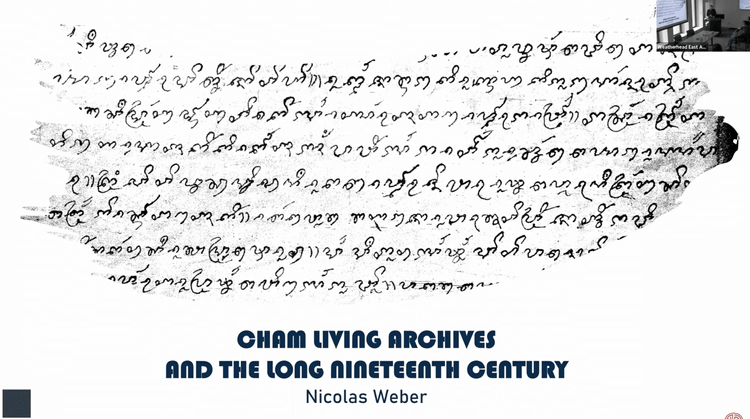
On December 5, 2025, Professor Nicolas Weber presented a talk on a nineteenth-century Cham verse narrative, The Rhyme of Looking Forward, one of fifteen texts in his book project Forbidden Voices, Silenced Memory: The Making of a Cham Century. The project restores Cham perspectives and memory to the making of modern Southeast Asia by centering voices long excluded from state-centered histories.
Hosted by the Weatherhead East Asian Institute and co-sponsored by NYSEAN, the event was moderated by John Phan, Associate Professor of East Asian Languages and Cultures at Columbia University.
History Carried by Voice
Rather than turning to imperial or colonial archives, Professor Weber focused on Cham verse narratives—texts composed in modern Cham and meant to be chanted or sung. These narratives circulated through memory, performance, and copying, surviving not through institutions but through communities. Weber described them as “living archives”: sources that preserve emotional truth, moral reasoning, and lived experience where official records fall silent.
Collapse and Memory
The Cham are an Austronesian people and heirs to the former kingdom of Champa, which once spanned much of today’s central Vietnam. By the early nineteenth century, Champa had been reduced to its southern principality, Panduranga, which retained limited autonomy until its annexation by the Nguyễn dynasty in 1832 under Emperor Minh Mạng. The annexation brought violent repression, land reorganization, forced labor, and the dismantling of Cham political and ritual life.
It was in this context that The Rhyme of Looking Forward was composed. Rather than narrating events directly, the poem renders annexation as the collapse of an entire moral world. Images of thunder, fire, and trembling earth depict conquest as cosmic catastrophe, while scenes of broken kinship and ritual humiliation convey how violence entered everyday life. Through dense and unsettling metaphors, the poem records how meaning itself became unstable.
A Living Text
More than a century later, in 1968, Cham intellectuals republished The Rhyme of Looking Forward during the Vietnam War, pairing it with a moral teachings text. As Weber explained, this return was not nostalgic. It transformed memory into a guide for endurance during another moment of upheaval marked by war, religious conflict, and assimilation pressures. The poem’s survival across centuries demonstrates how Cham communities repeatedly turned to verse to make sense of rupture and reaffirm ethical foundations.
Why It Matters
Professor Weber concluded by arguing that Cham verse narratives are not supplementary sources but corrective histories. They restore marginalized voices, challenge state-centered accounts of the past, and remind us that history is not only written in archives, but also sung, remembered, and carried forward through community life.
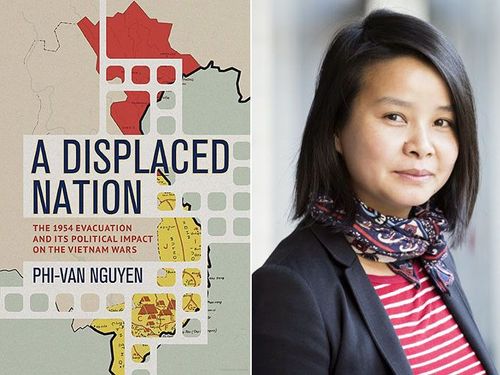
A new Weatherhead Studies title untangles the many "conflicting and almost contradictory interpretations" of the 1954 relocation of more than 800,000 Vietnamese.
The 1954 Geneva Agreements that formally ended the First Indochina War also instigated the relocation of more than 800,000 Vietnamese from the Democratic Republic of Vietnam (the North) to the State of Vietnam (the South, or, as it would soon be known, the Republic of Vietnam).
A new title in the Studies of the Weatherhead East Asian Institute series, A Displaced Nation: The 1954 Evacuation and Its Political Impact on the Vietnam Wars (Cornell University Press) by historian Phi-Vân Nguyen, situates this massive population transfer within a much longer chronology — a timeline that extends from Vietnam's 1945 declaration of independence through the end of hostilities with its neighboring states some 45 years later, at the close of the Cold War.
In telling the 1954 evacuees' stories across decades, Nguyen reveals them to be a much more heterogeneous group than they were often made out to be, whether by partisans on both sides of the North/South divide or by foreign governments with a stake in the conflict. A restive subset of the newcomers to South Vietnam thought of themselves as internal exiles; they were followed by a post-1975 generation of actual exiles, some of whom clung to the dream of regaining what they lost to the communist takeover while others in the diaspora eventually made their peace with the regime.
As Nguyen writes of these often-fractious communities, near the end of her book: “People wondered whether several Vietnams could coexist. For some, it became increasingly clear that there were multiple Vietnams that existed across political borders and interacted with one another.”
Phi-Vân Nguyen is Associate Professor in the Department of Humanities and Social Science at the University of Saint-Boniface in Winnipeg, Manitoba. Via email, she answered our questions about A Displaced Nation.
Here in the United States, even people who assume they know something about the Vietnam conflict may be less familiar with the 1954 evacuation and its ripple effects. Can you briefly describe this event, and why it proved to be so consequential over the following decades?
Phi-Vân Nguyen: The evacuation happened when the Geneva Agreements temporarily divided Vietnam at the 17th parallel and assigned the north to the Democratic Republic of Vietnam and the south to the State of Vietnam. As a result of this ceasefire, the armed forces had a 300-day time period, starting July 21, 1954, to gather in the zone assigned to their political authority. But article 14d also allowed civilians to join the zone of their choice. By the end of this transitional period, over 800,000 people left the north to go to the non-communist zone in the south, whereas only 150,000 people went to the north.
This evacuation attracted a wave of solidarity because the Western world was moved by the fate the Vietnamese who fled the Communist regime in the north. This population movement had a significant impact, and not just because it was a lot of people to welcome and resettle on short notice. This wave of support boosted Saigon's legitimacy by giving the impression it enjoyed some popular backing. This worldwide backing also convinced a group of intellectuals and political leaders among the evacuees that the Western world would not leave Vietnam divided and the north under communist rule. Some had the impression that their own struggle to fight communist expansion, revert the partition, and return to the north would prevail in the future because of this widespread support. Surprisingly, this impression did not remain constant during the war but kept coming up over the following decades and even after many of them left overseas after the fall of Saigon.
In your essay in The Cambridge History of the Vietnam War, Volume I: Origins, you write: “The adoption of global approaches to the history of the Vietnam Wars has enabled a new focus on multidimensional, multi-institutional, and longue durée connections.” Tell us how your account of the 1954 evacuation and its consequences benefits from some of those connections.
Nguyen: The idea of longue durée generally applies to a very long time frame, a near immobile history, which contrasts with an event or economic or political cycles. But in the context of the Vietnam wars, it refers to the historical processes and dynamics which develop or build up over a time that is longer than a battle, a military campaign, a presidential administration, the implication of a belligerent (France, or the United States). The longue durée refers to processes that often run across the three Vietnam wars, or connect them to the Pacific War, or the earlier process of decolonization.
In A Displaced Nation, I try to show that the Vietnam wars were not just three separate armed conflicts: a war of decolonization against the French (1946-1954), a war of unification (1959-1975), and a war opposing Communist brothers when Vietnam fought against its two neighbors, Cambodia and China (1978-1989). It was also a continuous war opposing Vietnamese to each other about what the postcolonial country should become.
Shifting the chronological limits and subject of study also opens our horizons. We don’t only see the continuities between these armed conflicts: Looking at the evacuation also allows us to see the wide range of transnational connections intersecting in Vietnam and how people and ideas circulated across these networks during the wars. The evacuation, for example, shows that the Vietnam wars were not only a war of decolonization, a frontline of the Cold War, or a civil war opposing Communist to Nationalist parties. For many members of the Roman Catholic church, this was also a struggle to protect freedom of religion, determine the role of the Catholic faith in a democracy, and define the composition and orientation of the Church in postcolonial Vietnam.
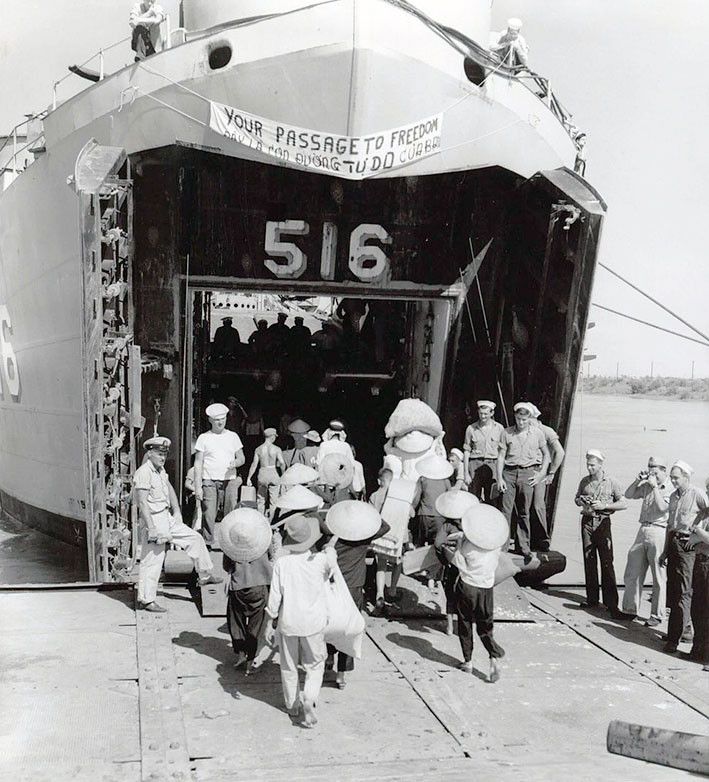
Above: Vietnamese evacuees board the amphibious U.S. Navy vessel LST 516 for their journey from Haiphong, North Vietnam, to Saigon, South Vietnam, during Operation Passage to Freedom in October 1954. (U.S. Navy photo / Public domain via Wikimedia Commons)
In this history, names matter, as the same population is referred to, at various times and by various sources, as “evacuees,” “migrants,” and “refugees.” (And that’s even before we reach the “boat people” of the next generation.) Why are these different terms important?
Nguyen: The 1954 evacuation was important to many people, but this same population movement meant something different for them. From the perspective of the United States, the people leaving the north were victims fleeing persecution. This interpretation allowed the United States to imply that Hanoi was a threat to its own population. So, this was one way to continue the war by other means after the ceasefire. Yet it implied that these refugees would find solace once resettled in a safe place. Most Vietnamese-language documents and newspapers back then, however, referred to the people leaving the north as migrants because many intellectuals and political leaders among the evacuees rejected the idea that they were victims and insisted that their departure was temporary. They were convinced that one day, they would return to the north.
Interestingly, the State of Vietnam and later the Republic of Vietnam, as well as many of these evacuees, realized that there were conflicting and almost contradictory interpretations of the evacuation. But they chose to entertain that confusion because this was the best way to capture the attention and support of the Western world.
This compromise is in fact revealing of a larger problem. The coalition of states and people who joined their forces in the fight against communist expansion did so for different reasons. The United States wanted to stop communism at the 17th parallel and Saigon wanted to build a strong Republic in the south. Yet many evacuees wanted to continue the war and free the north from communist rule. So, Washington, Saigon, and the evacuees fought together. But they had ultimately different war goals.
Your work builds to a poignant finish as you write: “The end of the Cold War ultimately led many evacuees to acknowledge that the Vietnam of their imagination would never exist within the borders they envisioned. Vietnam would continue to exist across continents.” I wonder if you can expand a little on this idea of a country that transcends geographic and political boundaries—and what it might look like in 2025, 50 years after the end of the American war.
Nguyen: For a very long time, we saw the Vietnam wars as a long fight for the making of a nation-state. However, the armed conflict has produced large population movements. Sometimes alternative visions of the nation-state traveled abroad with these people and the hope that some entertained of returning to Vietnam even revived during the Third Indochina War. These projects have shifted since the end of the war but the disconnect between different visions of the nation-state has remained.
The opening of Vietnam's borders since 1986 has increased the opportunities for Vietnamese to travel and families to reunite. Vietnamese living overseas have come back to the country to visit, work, or retire, and people from Vietnam have left the country to study, work, or live abroad. Yet the circulation of goods and ideas, along with this movement of people, has not reinforced one unique vision of the nation-state. In fact, 50 years after the end of the war, Vietnam refers to both a country of origin that is common to all these people and a diaspora scattered across the globe.
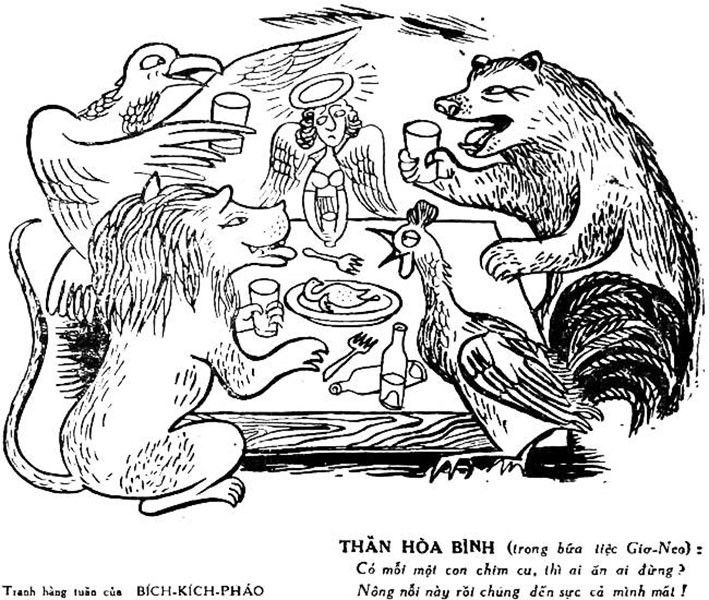
This August 1955 political cartoon by Bích Kích Pháo satirizes the division of Vietnam by foreign powers. The Russian bear and French rooster feast, the British lion and American eagle are eager to partake, and the tiny Vietnamese dove lies in the center of the table as the Angel of Peace looks on uneasily. This image is reprinted in Phi-Vân Nguyen's A Displaced Nation: The 1954 Evacuation and Its Political Impact on the Vietnam Wars.
By Jeff Tompkins
December 03, 2025
This special issue of the Sungkyun Journal of East Asian Studies reflects the journal’s renewed focus—since 2019—on pre-1945 humanities topics within the “Sinographic cosmopolis,” a cultural sphere shaped by literary Sinitic (LS). Vietnam, as part of this world, has increasingly appeared in recent submissions, prompting the editors to assemble five studies on Vietnam’s engagement with LS.
The issue opens with Nguyễn Tuấn Cường’s study of how early modern Vietnamese scholars read and annotated Confucian texts. Focusing on the Tứ thư ước giải, he uncovers rare examples of vernacular Sinitic (baihua) grammar embedded in otherwise classical commentary and explores why such materials are so scarce in Vietnamese sources.
Next, Nguyễn Hoàng Yến analyzes the 1903 text Nam Nữ Giao Hợp Phụ Luận, introducing it to English-language scholarship. She investigates why its author chose to publish a treatise on sexual intercourse in LS rather than in Nôm, French, or Quốc Ngữ, even at the height of French colonial influence.
Drawing on expertise in Japanese kundoku glossing, Nguyễn Thị Thu Huyền examines the bilingual LS–Nôm Luận ngữ ước giải. Her article, the journal’s first to integrate Nôm data, shows how Vietnamese commentators identified and read proper nouns in classical texts.
In the fourth article, Yong-tai Kim and Rahel Plassen survey South Korean scholarship on Vietnamese LS materials, noting how Vietnamese sources serve Korean scholars as a comparative “historical mirror.” They highlight current research trends as well as institutional obstacles within Korean academia.
The final contribution, by Alan Dai, translates a 1922–23 serialized LS narrative, Record of the History of Korean Aristocrat Lady Yi Adrift. The work illustrates the surprising longevity of LS in Vietnam and the continued cultural links between Vietnam and Korea well into the 1920s.
Read the complete issue here.
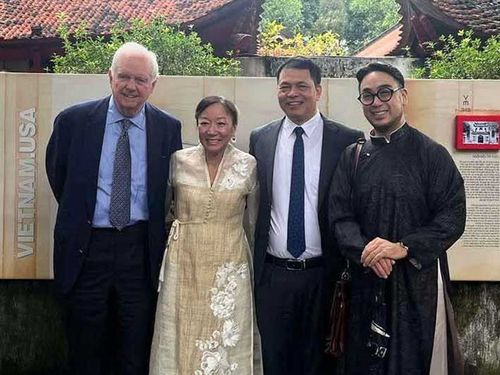
In Vietnam in the first week of November, faculty from the Weatherhead East Asian Institute’s Global Vietnam Studies Program (GVSP) held a series of bridge-building events that extended and deepened Columbia University’s engagement with the fast-developing socialist republic.
Through high-profile meetings in Hanoi and Ho Chi Minh City, Dorothy Borg Associate Professor in the History of the United States and East Asia Lien-Hang T. Nguyen (Director of the Weatherhead East Asian Institute); Associate Professor of East Asian Languages and Cultures John Phan; Weatherhead Artist in Residence Tony Bui; and Senior Advisor for Vietnam Thomas J. Vallely strengthened existing ties and fostered new connections with four major educational and civic institutions. Taken together, the meetings affirmed education’s role as a bridge between cultures and as a symbol of national heritage.
November 3: The Temple of Literature–Quốc Tử Giám and the Vietnam National Academy of Music
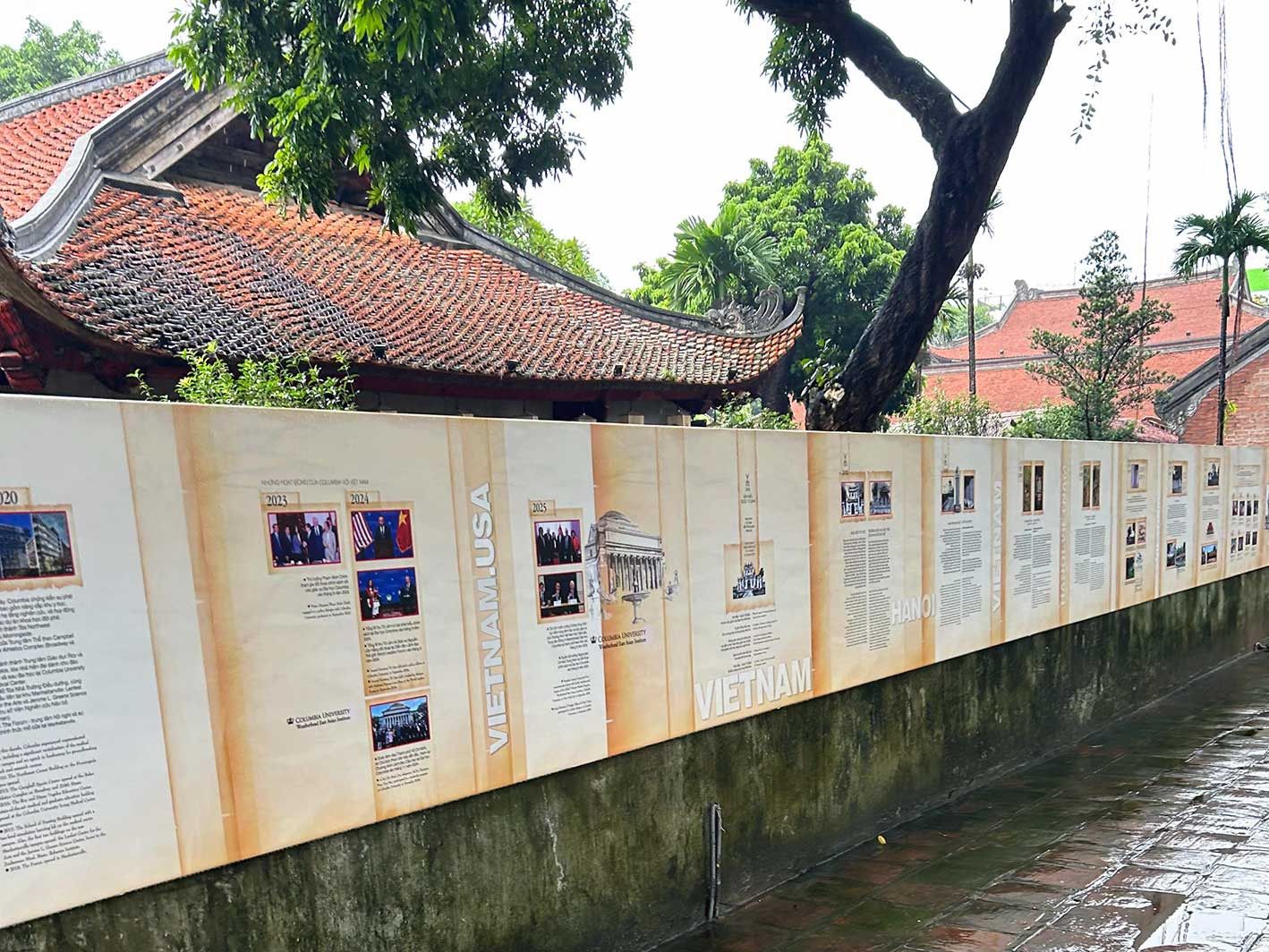
Informational panels about Columbia University and the Global Vietnam Studies Program on display outside the Temple of Literature–Quốc Tử Giám in Hanoi on Nov. 3, 2025. The Columbia exhibit will remain on view until Tet, the Lunar New Year, in February 2026.
The GVSP team’s tour began on November 3 with an “East–West Cultural and Educational Heritage” seminar at Hanoi’s Temple of Literature–Quốc Tử Giám. The oldest center of higher learning in Vietnam, the Temple of Literature–Quốc Tử Giám was founded under the Ly Dynasty in 1070. Long revered as a symbol of the country’s devotion to scholarship and moral cultivation, it functions today as both a heritage site and a center for academic and cultural exchange.
The Columbia professors and their Vietnamese counterparts reflected on how traditional educational philosophies can inform modern teaching and global citizenship. Deputy Director Le Thi Anh Mai opened by recalling the Temple’s historical role as Vietnam’s first university and a cradle of moral education based on principles of self-cultivation: a place, as Tony Bui later put it, “where the act of learning was inseparable from the act of becoming a better human being.”
Professor Nguyen noted that Columbia shares the Temple’s mission of training humane, morally grounded citizens. The university’s famed Core Curriculum, she explained, partly derives from that mission:
“Columbia’s goal was to ground education in science, philosophy, literature, music, and art, giving students a shared intellectual foundation that would prepare them for thoughtful citizenship in a complex and interconnected world.”
Developing this theme, Professor Phan said, “As different as we seem to be, both Columbia and this historic institution share a common vision for humanity: one in which the spirit is trained under expert guidance, to gather knowledge, and to transform the world.” Professor Phan went on to make an eloquent case for Global Vietnam Studies at Columbia, singling out its ability to combine the benefits of the Core Curriculum with “the specific strengths, values, and richness of Vietnamese culture.” (Read his complete Quốc Tử Giám address here.)
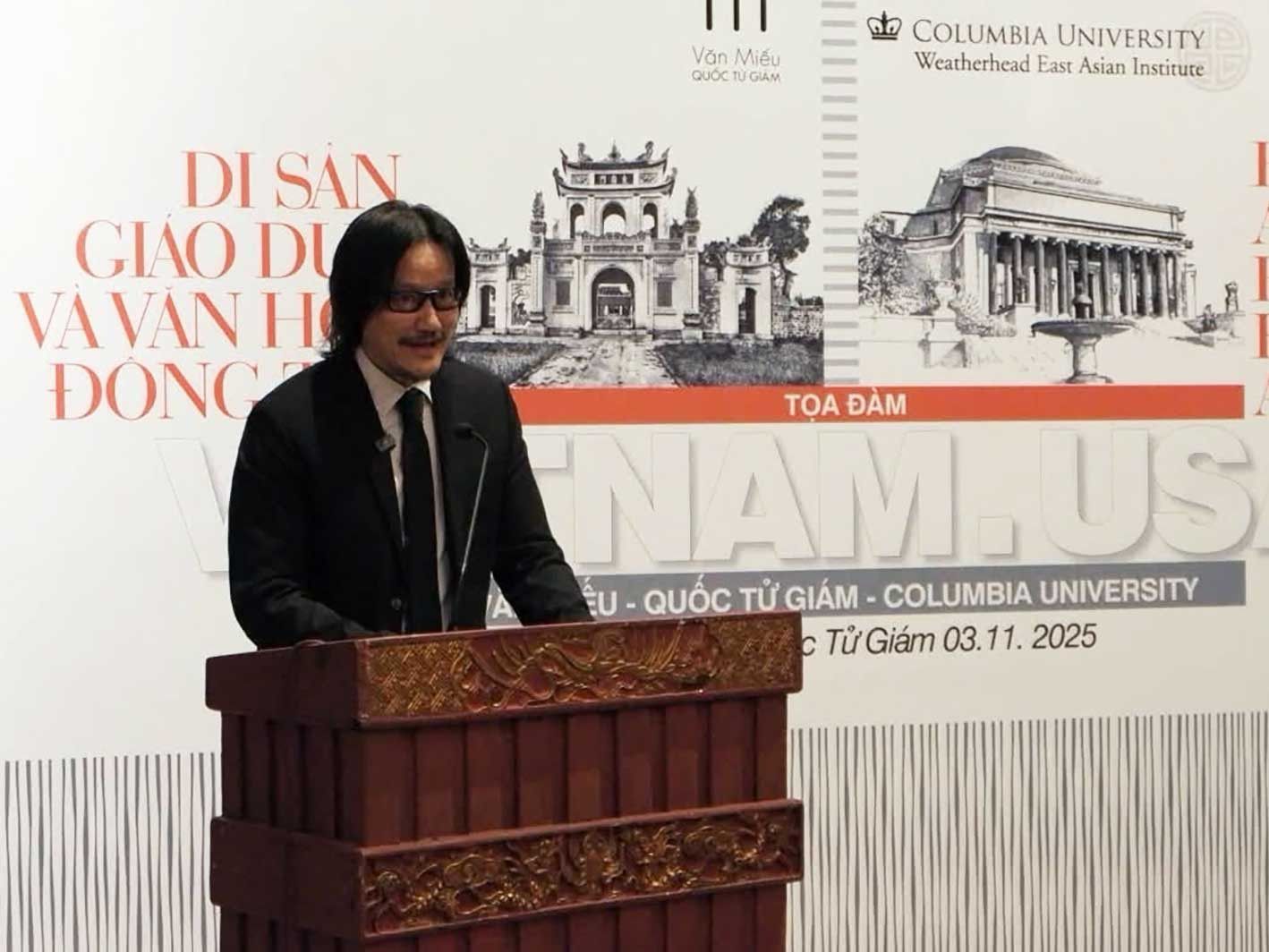
WEAI Artist in Residence Tony Bui at the Temple of Literature – Quốc Tử Giám in Hanoi on Nov. 3, 2025.
Tony Bui announced a new GVSP initiative, Vietnam Arts in Action (VAiA), which is conceived as a platform for supporting artistic exchange between Vietnam and the wider world, particularly by giving young Vietnamese filmmakers, artists, and students opportunities to collaborate with peers from Columbia and elsewhere. Bui told listeners, “The arts are not separate from education but a vital part of it.”
Looking to the future, participants also discussed Digitizing Vietnam, the joint effort between Weatherhead and the Center for Vietnamese Studies at Fulbright University Vietnam (FUV) that is preserving rare and historic Vietnamese images, manuscripts, and other documents through AI tools and other sophisticated digital technology.
A final takeaway from the seminar was that in addition to the commonalities noted above, Eastern and Western models of education also complement each other through their differences: the former’s emphasis on ethics and community and the latter’s focus on creativity and critical inquiry.
L to R: Artist in Residence Tony Bui; WEAI Director Lien-Hang T. Nguyen; National Academy of Music (VNAM) Director Dr. Le Anh Tuan; and VNAM Deputy Director Bui Cong Duy at VNAM in Hanoi on Nov. 3, 2025.
Later that day, Professor Nguyen and Artist in Residence Bui were welcomed at the Vietnam National Academy of Music by its Director, Associate Professor Dr. Le Anh Tuan, and distinguished faculty. Founded in 1956 and formerly known as the Hanoi Conservatory of Music, the National Academy is Vietnam’s premier institution for training and teaching in traditional and classical music. Its Deputy Director, Bui Cong Duy, is a professional violinist who performs internationally and was recently named one of “Vietnam’s Most Influential” by The Tatler.
Weatherhead’s meeting with Le Anh Tuan, Bui Cong Duy, and their colleagues laid the groundwork for a partnership between the National Academy and the new Vietnam Arts in Action initiative Bui had announced earlier that day at Quốc Tử Giám — demonstrating VAiA’s intention to use the arts as a bridge between Columbia and Vietnam.
November 4: The Diplomatic Academy of Vietnam
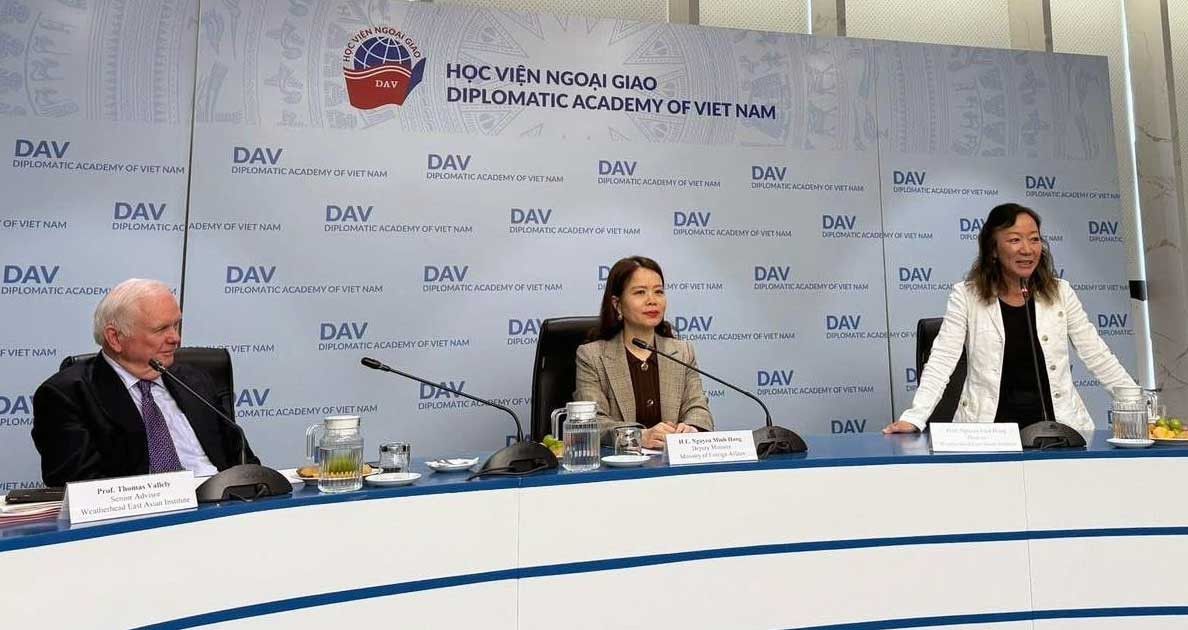
L to R: Thomas J. Vallely; Nguyen Minh Hang, Deputy Foreign Minister of Vietnam; Lien-Hang T. Nguyen at the Diplomatic Academy of Vietnam in Ho Chi Minh City on November 4, 2025.
One day later the Columbia delegation arrived in Ho Chi Minh City for a “Policy Dialogue” at the Diplomatic Academy of Vietnam, a research and training institution. American Ambassador to Vietnam Marc Knapper joined Professor Nguyen and Senior Representative Vallely. Representing Vietnam were Deputy Foreign Minister Nguyen Minh Hang, Deputy Minister of Science and Technology Bui The Duy, other government officials, and local businesspeople.
In her opening speech, Deputy Minister Nguyen Minh Hang reiterated Vietnam’s commitment to the Vietnam-US Comprehensive Strategic Partnership, signed in 2023, and to expanding the bilateral relationship that the two countries have developed since resuming diplomatic relations in 1995.
The Deputy Minister cited educational ties and professional training as two particularly promising areas for expansion. She held up Fulbright University Vietnam’s exchange program as an exemplar and expressed confidence that developing linkages with Columbia, such as GVSP’s Vietnam Leadership Program (VLP), which facilitates workshops and seminars for Vietnamese officials led by American experts and scholars, will in turn create opportunities for further cooperation.
In the ensuing presentation, the American delegates learned about Vietnam’s investment in cutting-edge science and green technology as primary drivers of its development and about the contributions it expects in this area from the private sector. Senior Advisor Thomas Vallely moderated a panel discussion centered on the challenges confronting Vietnam as it tries to reach its development goals while navigating an increasingly unstable geopolitical environment.
November 7: Fulbright University Vietnam
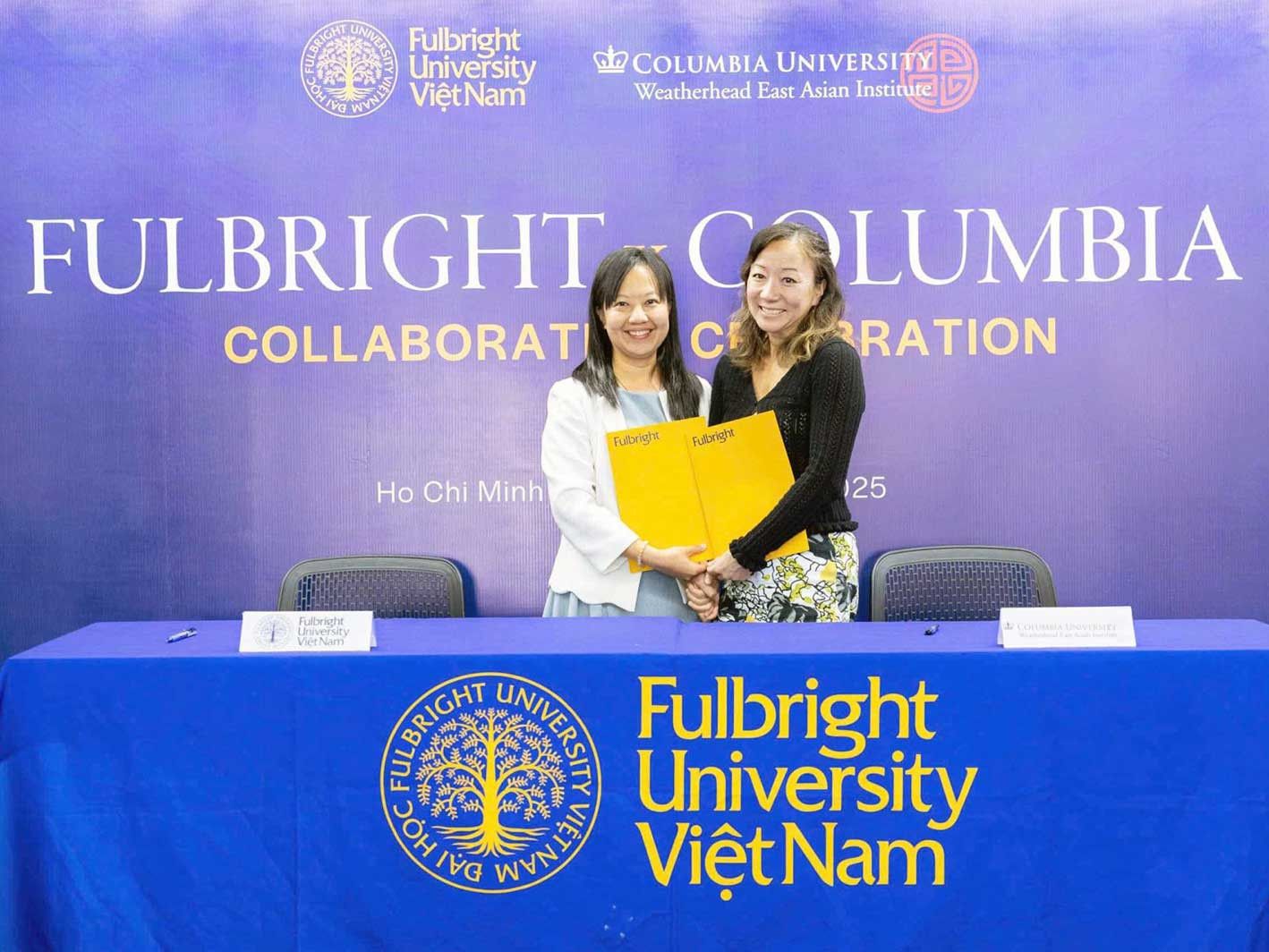
President of Fulbright University Vietnam Dr. Dinh Vu Trang Ngan with Lien-Hang Thi Nguyen in Ho Chi Minh City on Nov. 7, 2025.
In Ho Chi Minh City on November 7, Weatherhead formalized an agreement with Fulbright University Vietnam (FUV) on a long-term collaboration that is envisioned as a sustainable bridge between Vietnamese higher education and Columbia's international research network.
FUV President Dr. Dinh Vu Trang Ngan declared at the signing, “Fulbright University Vietnam is a university built in Vietnam, for the future of Vietnam, with the goal of bringing the best education to Vietnamese students and young people around the world.” Weatherhead’s agreement with FUV will help fulfill that vision through faculty and student exchanges and expanded opportunities for joint research.
The partnership’s new phase is intended to bolster Vietnam’s policy-making capacity by building on the work already being done by GVSP’s Vietnam Executive Leadership Program (VELP)—fostering connections between academia and the business community that will result in practical solutions to development challenges.
L to R: Thomas Vallely, senior advisor, WEAI, Columbia University; Dr. Jonathan Pincus, Dean, Fulbright School of Public Policy and Management (FSPPM); Annabel Lee, Director of Strategic Policy Engagements and Campaigns (APJ) and ASEAN, Amazon Web Services; Hiep Huynh, General Director, ACEN Vietnam, in the panel discussion Towards a "New Era of Development": Technology, Higher Education, and the Future of Reform in Vietnam at Fulbright University Vietnam on Nov. 7, 2025.
Coverage in Vietnamese media:
thethaovanhoa.vn
Vietnam.vn
VietnamPlus.vn

Speaker: Nicolas Weber, Senior Faculty Member, Vietnam Studies Major, Fulbright University Vietnam
Moderator: John Phan, Associate Professor of East Asian Languages and Cultures, Columbia University
When: Friday, December 5, 2025, 12:00–1:30 PM ET
Where: International Affairs Building, 420 W 118th St, Room 918, New York, NY 10027
Set within Professor Nicolas Weber’s forthcoming book Forbidden Voices, Silenced Memory: The Making of a Cham Century, this talk explores one of its central sources: a 19th-century Cham verse narrative known as The Rhyme of Looking Forward. As one of fifteen texts featured in the project, the narrative is read as a “living archive”—a body of poetic memory that restores Cham perspectives to the historical landscape of modern Southeast Asia. Through its lines, generations of Cham observers recorded what they witnessed and endured, articulating their experiences of upheaval and their interpretations of regional transformation across the 19th and 20th centuries.
Nicolas Weber is a Senior Faculty Member in the Vietnam Studies major at Fulbright University Vietnam. His research focuses on Southeast Asian history, ethnic history, and diasporic networks, with a particular emphasis on the Cham world. Before joining Fulbright, he taught at Sun Yat-sen University (China) and the University of Malaya (Malaysia).
This event is hosted by the Weatherhead East Asian Institute and co-sponsored by NYSEAN. Further details and registration information are available on the WEAI website.
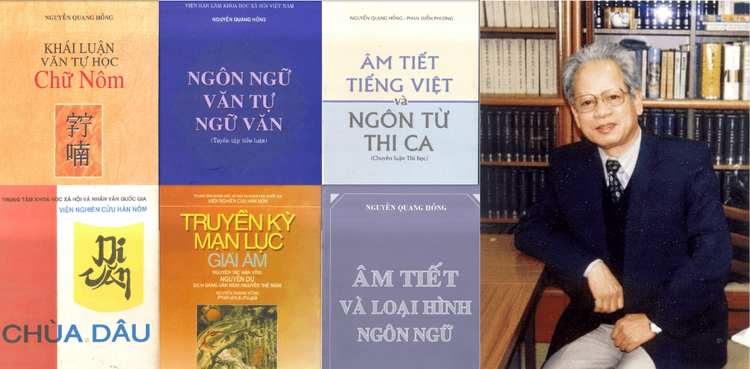
On the afternoon of October 7, 2025, Prof. Dr.Sci. Nguyễn Quang Hồng—who devoted his life to the studies of the Vietnamese language and the Hán–Nôm heritage—passed away, entering the vast silence beyond all language.
To the Professor, time—time lived—was the precious condition that made possible his reflections on that singular human invention: language. "The author sat at his desk and typed this monograph for more than a year. Yet the period during which he pursued the questions posed in the work adds up to over twenty years,” he confides in the preface to An Introduction to the Grammatology of Chữ Nôm, recalling his tireless pursuit of the great questions of Vietnamese and its writing. That unceasing research journey crystallized into major works gathered in the collection Language · Writing · Philology on Digitizing Vietnam—only “the tip of the iceberg,” layered over decades of reflection, investigation, and painstaking scholarly labor: concerns ranging from system to detail, from phonetics to literature, from antiquity to the present—all to reach the uttermost of the Vietnamese story.
In his scholarly rigor, the author rarely spoke about himself. The long, winding road—surely with many rough stretches—into the “uttermost ends” of the Vietnamese language is summed up by him in two sentences: “The author is a linguist who, together with linguistics, entered the study of Chữ Nôm and Hán–Nôm texts and works. Viewed in general, then, the author is someone passionately devoted to the work of our national philology.”
Prof. Dr.Sci. Nguyễn Quang Hồng was born in 1940 in Trà Kiệu village, Duy Xuyên district, Quảng Nam province. 1960–1965: studied in Beijing, graduated B.A. in Philology (Peking University, 1965). 1970–1974: graduate studies in Moscow; defended the Candidate of Philological Sciences (Moscow State University & the USSR Institute of Oriental Studies, 1974). 1982–1985: research fellow; defended the Doctor of Philological Sciences. He was appointed Associate Professor in 1984 and Professor in 1991.
The Language · Writing · Philology collection brings together Prof. Nguyễn Quang Hồng’s studies in linguistics, scriptology, and philology. Among them, Vietnamese Syllables and Poetic Language is a monograph co-authored with Dr. Phan Diễm Phương. The studies are diverse, spanning many phenomena and problems, and can be grouped into two main strands: (1) Linguistics and Vietnamese language studies; (2) Philology and Hán–Nôm studies. Digitized items in Digitizing Vietnam’s repository include:
❃ Syllables and Types of Language
❃ Language · Writing · Philology
❃ An Introduction to the Grammatology of Nôm
❃ Explanatory Notes on Truyền kỳ mạn lục
❃ Vietnamese Syllables and Poetic Language
❃ The Inscriptions of Dâu Pagoda: Cổ Châu lục – Cổ Châu hạnh – Cổ Châu nghi
SKETCHING A PORTRAIT OF VIETNAMESE IN LINGUISTICS: WHEN LINGUISTIC SENSIBILITY GUIDES SCIENTIFIC THOUGHT
Looking at Prof. Nguyễn Quang Hồng’s linguistic work on Vietnamese, we see not only weighty findings with wide interdisciplinary impact, but also a meticulous comparative program tracking movements within a language and across languages to find the right “frame” for analyzing Vietnamese. Alongside broad engagement with existing models is a guiding “linguistic sensibility”—a keen effort to reconstruct, scientifically, the inner psycholinguistic reality, rather than mechanically imposing a fashionable model.
From this foundation, he established that the tone-bearing syllable (syllabeme) is the minimal meaning-bearing unit of modern Vietnamese; the syllable’s structure is viewed as onset – rime (rime = nucleus + coda), while tone and the medial glide are properties of the whole syllable. Within this framework he situated Vietnamese in a comparative–typological context with other tone languages of East and Southeast Asia (Việt–Mường, Tai–Thai, Sinitic, Tibetic…), treating the syllable as central and analyzing in detail onset – rime – tone; he also bridged phonology and poetics, using verse (especially The Tale of Kiều) to test rhyme, distinguish full rhyme/allowable rhyme, and explain the aesthetic of “harmonious sound.”
In comparison with Chinese, he showed that intra-syllabic segmentation is clearer in modern Vietnamese (and Middle Chinese) than in modern Beijing Mandarin. Vietnamese is rich in reduplication (nhí nhảnh, bồi hồi…) and metathesis/wordplay; Middle Chinese had a comparable phenomenon (“fanqie-like manipulations”), whereas modern Beijing Mandarin tends toward full-syllable repetition (mànmànr, lànlànde), reducing intra-syllabic variation. Reading the Professor’s meticulous comparisons, one seems to step into a linguistic laboratory where diverse syllables are dissected and set in motion under the absorbed gaze of a scientist.
RESEARCH ON CHỮ NÔM: CONNECTING WITH THE WISDOM AND HEART OF GENERATIONS
One cannot speak of Prof. Nguyễn Quang Hồng without the now-classic studies of Chữ Nôm, such as An Introduction to the Scriptology of Chữ Nôm and the Explanatory Dictionary of Chữ Nôm.
An Introduction to the Scriptology of Chữ Nôm is a foundational work treating Nôm through historical linguistics – comparative scriptology – textual scholarship. It establishes a basic conceptual toolkit (language/script; tục tự, thổ tự, phương tự; “non-standard” Chinese characters; what “Chữ Nôm” is), situates Nôm within Vietnam’s traditional scripts (Cham, Thai; Dao Nôm, Ngạn Nôm, Tày Nôm…), and traces the origins and conditions of Nôm through Việt–Sinitic contact, Sino-Vietnamese readings, Lý-dynasty epigraphy, and hypotheses about its emergence. On that basis, he presents the Chinese character model (structure, formation, morphemes), contrasts typological traits of Nôm with other Sinitic-based scripts, distinguishes borrowed Chinese characters from Nôm creations, and proposes a general classification for Vietnamese Nôm.
The Explanatory Dictionary of Chữ Nôm marks a major advance in the study and explication of Nôm, illuminating the creativity and self-reliant spirit of the Vietnamese in language. Based on 124 classical works/texts, each entry has clear provenance with contextual examples.
“By engaging with the Hán–Nôm heritage, we simultaneously engage with the intellect and the heart of countless generations of our forebears across every sphere of our country’s social life in the past.”
The Professor emphasized: “Language—and with it, script—is not merely a vehicle for transmitting information, but a vehicle for transmitting culture, especially from one generation of the nation to the next.”
For him, researching Chữ Nôm was not only a scholarly passion but also a connecting mission, so that generations of Vietnamese might feel the intellect and singular creativity of their ancestors beyond the bounds of time.
SOLVING EVERYDAY RIDDLES WITH SCHOLARLY WIT: THE SHORT i AND THE LONG y
Alongside academic works, Prof. Nguyễn Quang Hồng wrote with humor and grace about everyday language puzzles. A widely loved essay is the story of the short i and the long y. It began with a letter from a technician who types on-screen text for Bình Thuận Television. Unsure whether to write công ti or công ty (“company”)—the director said one thing, the department head another—he asked if there was a rule.
A small matter that isn’t small: Prof. Nguyễn Quang Hồng answered in detail—over four pages—patiently moving from Ministry of Education rules (a syllable ending in the vowel i is written with i, except after u/y as in duy, tuy, quy) to conventions formed over centuries (long y in Sino-Vietnamese words; short i in native words). For the technician’s question, the Professor refused to clamp Vietnamese into a rigid right/wrong vise; instead he showed the calm vision of a scholar who has gone deep enough into the language to trust its resilient flexibility:
“I think that in actual writing practice we should not be too rigid, insisting on applying at once what has been propagated in school. Moreover, what we have learned in school must be tested in social reality; only then can we find more appropriate standards that we hope will be accepted by everyone. If necessary, I am also ready to write ‘công ty’ to suit the ‘taste’ of your supervisor—which may also be the wish of the company that is your agency’s partner!”
He also gently corrected the writer for qui định instead of quy định (“regulation”): “As for quy, I don’t understand why you follow some others in writing qui. Granted, whether you write quy or qui you still pronounce it q + uy, but writing with -ui veers off from the series of words that all rhyme in -uy: duy, huy, luy, tuy, suy, nguy, etc.” The rigor of the linguist led him to catch an “error” not against external rules but against the internal dynamics of the language. “In this case—even if my boss threatened to dock my pay or fire me—I would still write Quy, and would by no means ‘shorten’ it to Qui, mind you,” he quipped—reminding the technician to safeguard Vietnamese, signing off with the colloquial đâu nghe (“mind you”) like a gentle word to a friend. In the stately pages of Language · Writing · Philology, that letter and those two words seem to reveal another face of the author—warm, familiar, simple: a Vietnamese who loves Vietnamese.
The “patchwork rustic words” above can hardly capture the roving dedication of Prof. Dr.Sci. Nguyễn Quang Hồng—a man who went to the farthest reaches of language, touching the finite frontier of a human life. Recall the word “hundred years” in Kiều’s line “Trăm năm trong cõi người ta,” meaning a human lifetime in this world: the character “hundred” (bách 百) set beside lâm 林—the finite beside the infinite. Digitizing Vietnam hopes to join readers in connecting with this finite collection and to grant the work a new “hundred years” of life—to carry the finite toward the infinite.
👉 Read the Language · Writing · Philology Collection:
https://www.digitizingvietnam.com/vi/our-collections/ngon-ngu-van-tu-ngu-van
👉 Read Tự điển Chữ Nôm Dẫn giải:
https://www.digitizingvietnam.com/vi/tools/han-nom-dictionaries/tu-dien-chu-nom-dan-giai
❀ Our deepest gratitude to Prof. Dr.Sci. Nguyễn Quang Hồng (1940–2025) for the legacy he leaves to posterity.
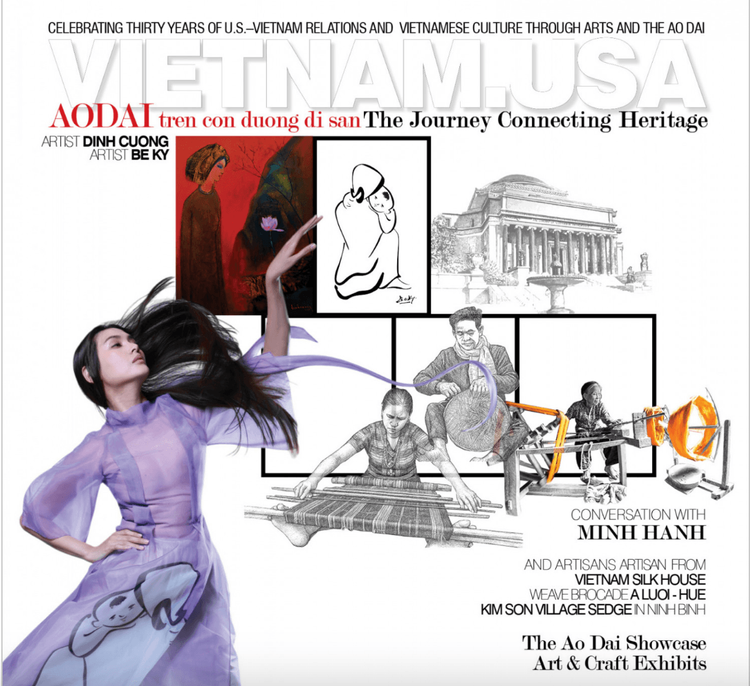
- Time: October 3, 2025 | 2:00 PM – 5:00 PM (local time)
- Place: Revson Plaza, Columbia University
Global Vietnam Studies at the Weatherhead East Asian Institute and Vietmode proudly present The Journey Connecting Heritage, a special program marking 30 years of U.S.–Vietnam reconciliation and celebrating the richness of Vietnamese culture through arts, crafts, and the iconic national dress, the áo dài.
Program Highlights
- Conversation with Minh Hanh and Artisans
Gain insights from Vietnam’s leading fashion designer Minh Hanh and master artisans on how the áo dài and traditional crafts embody national pride and foster global cultural exchange.
- The Áo Dài Showcase
Witness a live fashion performance featuring Minh Hanh’s contemporary áo dài creations. Her designs reimagine Vietnam’s national dress while drawing inspiration from traditional craftsmanship and celebrated Vietnamese painters. Art & Craft Exhibits
Explore silk weaving, embroidery, rattan work, and painting presented by artisans dedicated to preserving and revitalizing Vietnam’s cultural heritage.
About Designer Minh Hanh
Minh Hanh is one of Vietnam’s most celebrated fashion designers and a pioneer in integrating traditional crafts into modern design. Recognized for her innovative approach that blends ethnic fabrics, motifs, and embroidery with contemporary aesthetics, she has elevated the áo dài into a global symbol of artistry and cultural pride.
Her practice often combines fashion with education, engaging artisans, students, and scholars in workshops that preserve and reimagine Vietnam’s textile traditions. Minh Hanh’s contributions have earned her widespread recognition, including:
- Special Award, Asia Collection (Makuhari, Japan, 1997)
- Chevalier des Arts et des Lettres (France, 2006)
- Fukuoka Prize for Arts and Culture (Japan, 2015)
- ASEAN Selection Award – Top 10 ASEAN Artisans (Thailand, 2016)
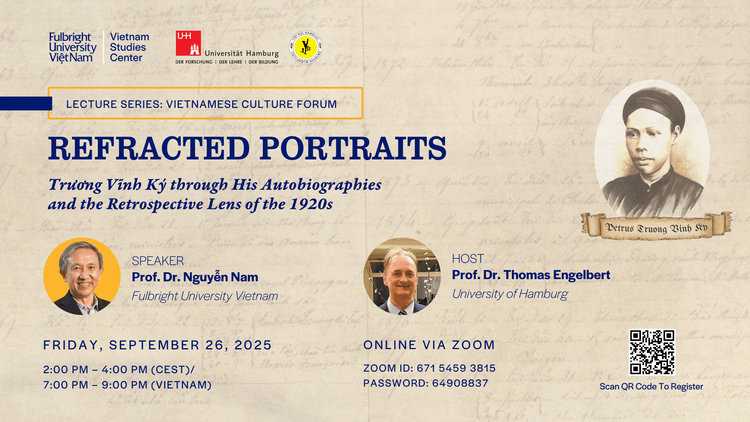
Date & Time: Friday, September 26, 2025 | 19:00–21:00 (GMT+7) | 14:00–16:00 (CEST)
Format: Online Talk, Vietnamese Culture Forum Lecture Series
Zoom Access: Webinar ID 671 5459 3815 | Passcode 64908837
Few names provoke as much debate in modern Vietnamese intellectual history as Petrus Trương Vĩnh Ký (1837–1898). Was he a colonial collaborator, a pragmatic intellectual navigating fraught circumstances, or a Catholic patriot committed to a distinct vision of national loyalty? Generations of scholars—Vietnamese and foreign, Marxist and non-Marxist—have offered divergent readings of this complex polymath.
The recent rediscovery of his autobiographical manuscripts offers us a rare opportunity: to examine how Trương chose to narrate his own life, and to reconsider the ways in which later authors refracted and reshaped his self-portrait to serve different cultural and ideological agendas.
In this talk, Dr. Nguyễn Nam (Fulbright University Vietnam) will guide us through the interplay between Trương’s autobiographies and subsequent portrayals, focusing on figures such as Jean Bouchot and Huyền Mặc Đạo Nhân Dương Mạnh Huy.
Dr. Nam argues that none of these accounts—Trương’s included—are neutral reflections. Instead, they are refracted images, shaped by the cultural, political, and intellectual lenses of their times. By situating Trương’s own voice alongside those who appropriated it, this lecture invites us to question not only what we know about Trương Vĩnh Ký but also how historical memory itself is constructed.
This event is part of the Vietnamese Culture Forum Lecture Series, organized as a collaboration between Vietnam Studies Center, Fulbright University Vietnam with the University of Hamburg. The series brings together leading voices in Vietnam Studies to foster dialogue across borders and disciplines.
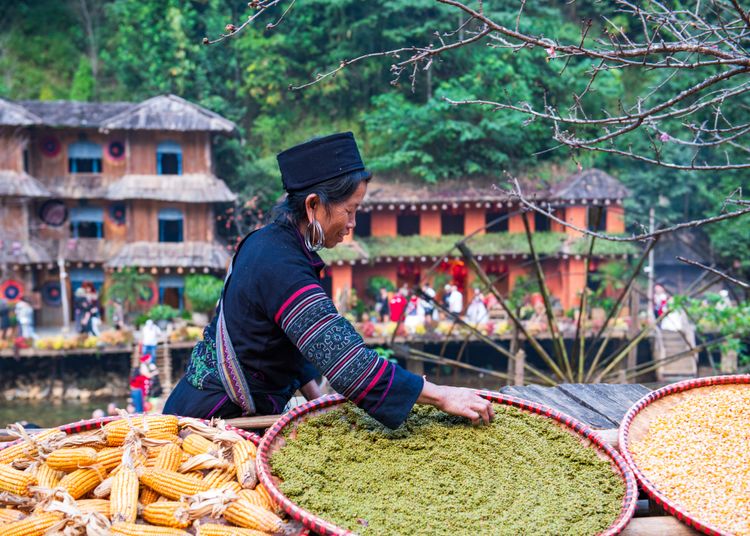
The Anthropology of Vietnam: Global Perspectives
📅 June 16–19, 2026
📍 Dalat University, Vietnam
Digitizing Vietnam is pleased to share the call for papers for the international conference The Anthropology of Vietnam: Global Perspectives, hosted by Dalat University from June 16–19, 2026.
Marking the 25th anniversary of Anthropology within the Vietnam National University system, the conference brings together scholars from Vietnam and abroad to reflect on the growth and internationalization of Vietnamese anthropology.
Highlights:
Key themes: balancing Vietnam’s uniqueness with global processes; strengthening Vietnamese anthropology locally & internationally; fostering collaboration while addressing academic hierarchies; Vietnam’s contribution to decolonizing anthropology.
Structure: 2.5 days of panels and keynote lectures (June 16–18) and study trips in Lam Dong province (June 19).
Bilingual sessions: English and Vietnamese with simultaneous interpretation.
Participation:
Presenters: Submit title + 250-word abstract by December 1, 2025 via submission form.
Observers: Register by April 1, 2026 via email: vian2026@hcmussh.edu.vn.
Funding: There are no registration fees for the conference. Participants from outside Vietnamese institutions will be responsible for their own travel to Dalat, accommodation, and a small transportation contribution for the local excursions on the final day. The organizing committee is committed to minimizing these expenses wherever possible.
📩 For more details: vian2026@hcmussh.edu.vn
👉 Full PDF announcement available here.
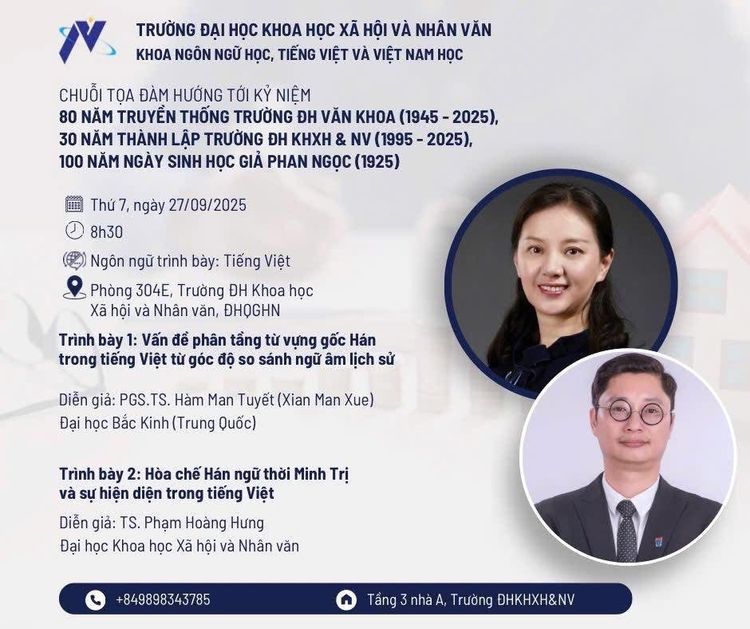
🗓 Time: 8:30 AM, Saturday, September 27, 2025
📍 Venue: Room 304E, University of Social Sciences and Humanities, VNU Hanoi
🌐 Language of presentation: Vietnamese
Presentation 1: The Stratification of Sino-Vietnamese Vocabulary from the Perspective of Historical Phonological Comparison
Speaker: Assoc. Prof. Dr. Xian Manxue – Professor at Peking University (China), specialist in historical linguistics and comparative Sino–Vietnamese lexicology.
Presentation 2: Sino-Japanese Lexicon of the Meiji Era and Its Presence in Vietnamese
Speaker: Dr. Phạm Hoàng Hưng – Lecturer at the University of Social Sciences and Humanities, VNU Hanoi, researcher in language contact, Sino-Vietnamese vocabulary, and the history of the Vietnamese language.
📞 Contact: +849898343785
📍 Office: 3rd Floor, Building A, USSH, VNU Hanoi
This is a valuable opportunity to meet, exchange, and learn from the insightful academic perspectives of two distinguished scholars in the field of Sino–Vietnamese linguistics.
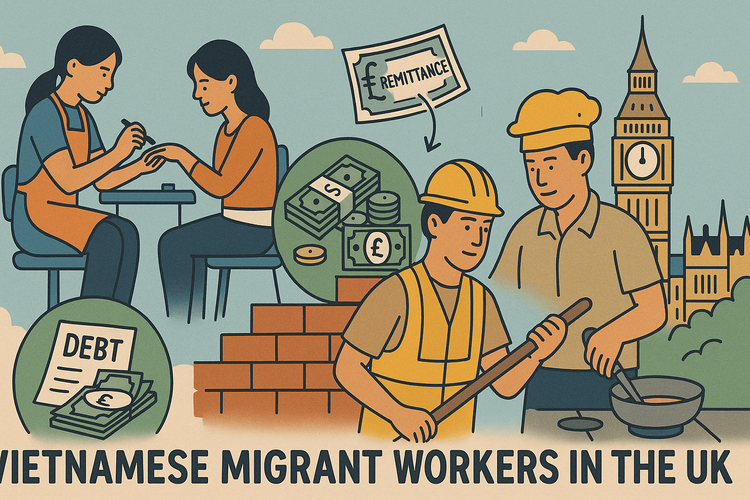
The forthcoming CHASM seminar will be delivered by Dr Seb Rumsby, Leverhulme Early Career Fellow at the University of Birmingham’s Institute for Research into International Migration and Superdiversity (IRiS), on September 30th, 2025. Dr Rumsby is an interdisciplinary scholar whose research encompasses everyday politics, migrant labour exploitation, irregular migration, ethno-religious politics, grassroots development, and financialization.
This presentation examines the strategies by which marginalized labour migrants endeavour to sustain livelihoods in the context of precarious employment, indebtedness arising from migration financing, remittance obligations, and inflationary pressures. Focusing on the recent migration of Vietnamese workers to the United Kingdom, the seminar situates migrants’ financial and employment decisions within the broader political economy shaped by financial and immigration regimes in both sending and receiving countries. Drawing on extensive ethnographic fieldwork with the Vietnamese community in the UK, Dr Rumsby will analyse the rationales underpinning migrants’ economic practices amidst legal precarity and exploitative labour conditions.
For registration, visit the University of Birmingham event page.
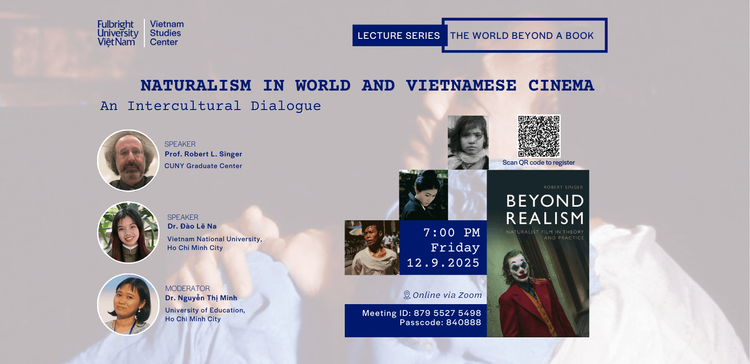
The Vietnam Studies Center, as part of its The World Beyond A Book series, invites participants to the upcoming online dialogue “Naturalism in World and Vietnamese Cinema: An Intercultural Dialogue” on 12 September 2025. The event will feature the presentation “Unpleasant Aesthetics: Naturalist Cinema in Theory and Practice”, tracing naturalism in film from its philosophical and artistic roots in the 19th century to its contemporary global presence. Moderated by Dr. Nguyễn Thị Minh, the discussion brings together Prof. Robert L. Singer (CUNY Graduate Center) and Dr. Đào Lê Na (Vietnam National University, Ho Chi Minh City), highlighting how naturalism, rather than idealizing, engages with the raw realities of poverty, labor, addiction, and marginalization.
The session will spotlight key works in Vietnamese cinema, including Girl from Hanoi (Hai Ninh, 1974), Return (Đặng Nhật Minh, 1994), Cyclo (Trần Anh Hùng, 1995), and Aimless (Phạm Nhuệ Giang, 2013), alongside films by Yasujirō Ozu, Wang Bing, Jayant Somalkar Digambar, and Carlota Pereda. A special speaker highlight is Prof. Robert L. Singer, a leading scholar of film history and aesthetics, author of Beyond Realism: Naturalist Film in Theory and Practice (2024), and co-editor of the “ReFocus: American and International Film” series. With his background in both scholarship and filmmaking, Prof. Singer’s perspective bridges theory and practice, promising rich insights into the global and intercultural dimensions of naturalist cinema.
- Date & Time: 19:00, 12/09/2025 (Vietnam Time)
- Meeting ID: 879 5527 5498 | Passcode: 840888
- Format: Online via Zoom
- Language: English
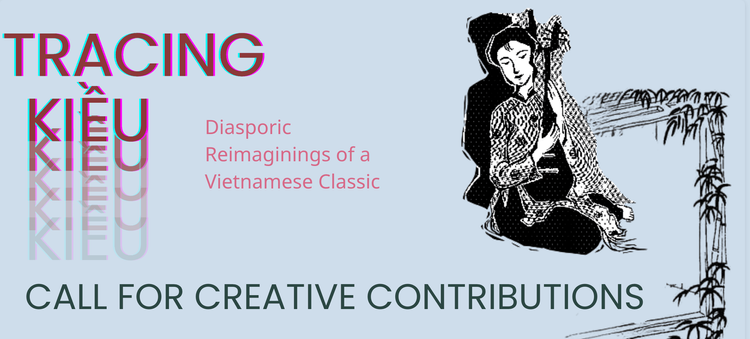
Tracing Kiều invites creators across the global Vietnamese diaspora to reimagine The Tale of Kiều through contemporary lenses of identity, migration, and belonging. A core method is bói Kiều—opening the poem for guidance and letting a line, image, or theme spark new work. The project is diaspora-led and developed in dialogue with advisors at the Diasporic Vietnamese Artists Network (DVAN).
The call welcomes writers, visual artists, designers, filmmakers, and performers across generations; Vietnam-based contributors and cross-border collaborations are encouraged. Accepted forms include short fiction, poetry, essays, creative dialogues, short scripts; illustration, comics, collage, photography, photo–text, and storyboards; plus documentation of installation, video, sound, and performance (2D material for print). The focus is on creative works (not Q&A); new and existing works are both eligible; first-person pieces—letters, monologues, or narrative forms shaped from conversation (with consent)—are welcome.
- Express interest: by 01/10/2025 → mail@tracingkieu.net
- More info: See the full call (EN/DE/VN/FR), FAQs, and submission form on the Tracing Kiều site
- Contact: mail@tracingkieu.net
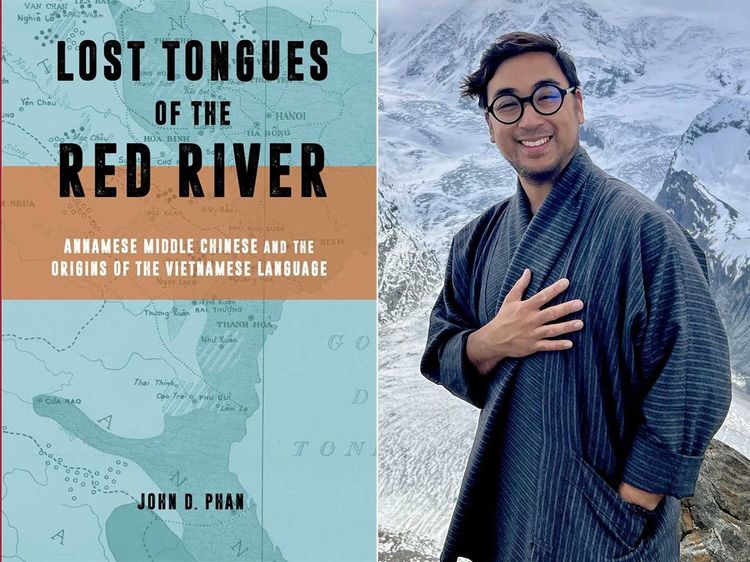
The Weatherhead East Asian Institute congratulates faculty member John D. Phan, Associate Professor of Vietnamese Humanities in the Department of East Asian Languages and Cultures and a co-founder of Global Vietnam Studies at Columbia University, on the publication of his first book.
Released by the Harvard University Asia Center this spring, the evocatively titled Lost Tongues of the Red River: Annamese Middle Chinese and the Origins of the Vietnamese Language uncovers the emergence of Vietnamese under the influence of a lost Sinitic (Chinese) language Professor Phan calls “Annamese Middle Chinese,” native to an area of northern Vietnam, in the early centuries of the second millennium C.E.
Professor Phan says that although Lost Tongues of the Red River is rooted in a premodern Southeast Asia, it centers on a set of concerns that are highly relevant to the work of the Weatherhead East Asian Institute. Revealing the Vietnamese language’s tangled roots in an older Sinitic language, Lost Tongues situates it in a cosmopolitan, linguistically shifting milieu that doesn’t align with nation-state borders on any map.
By unearthing this multilingual mixed society, the book refutes what Professor Phan describes as a “very modern mindset”—the idea that “language, nation, culture, and ethnicity all form a monolithic block,” which in his view “doesn’t conform to reality.”
“Language shows us that modern nation-state configurations of identity can have a destructive or limiting influence on how we understand the ancient past.”
Professor Phan has lived with this material for many years. The book is rooted in the dissertation that he defended at Cornell in 2012, and he submitted a first draft of the manuscript during the Covid-19 pandemic.
For this monograph, Professor Phan drew on linguistic, philological, and historical methodologies. He conducted field work in north central Vietnam, excavating languages of the Mường, Vietnam’s third-largest minority, and also drew on the archives of the Institute for Sino-Nom Studies in Hanoi, the largest collection of Sino-Vietnamese manuscripts in the world.
How does it feel to have completed his first book? “It’s important to have things in a published, material form,” he tells us, “out in the wild, where other scholars can interact with it.”
Professor Phan goes further into his motivations for writing Lost Tongues of the Red River in an extensive (and highly recommended) June interview with Columbia News. In that conversation he also shares some recommendations from his recent reading and, even better, offers a preview of his next book project. That book will bring Professor Phan’s research up into the 17th and 18th centuries by tracking the rise of Vietnam’s vernacular language, in the form of the Chữ Nôm character script, and demonstrating how that vernacular enabled the creation of “new forms of literature.”
On the evening of July 19, 2025, Columbia University played host to Vietnam on Screen: Generations in Dialogue, a landmark event celebrating the dynamic voices shaping contemporary Vietnamese cinema. Co-hosted by the Weatherhead East Asian Institute (WEAI) and the New York Asian Film Festival (NYAFF), the event brought together filmmakers, artists, and audiences for a night of conversation, connection, and cinematic exploration.
The evening opened with remarks by Ambassador Đỗ Hùng Việt, Vietnam’s Permanent Representative to the United Nations, whose presence set a tone of cultural diplomacy and artistic bridge-building. This was followed by a thought-provoking panel discussion moderated by filmmaker Tony Bui, director of the award-winning Three Seasons, Artist-in-Residence at WEAI, and curator of Criterion’s Legacies of War series.
The panel featured three generations of Vietnamese and Vietnamese-American creative voices:
- Kiều Chinh, a legendary actress, producer, and philanthropist, whose career spans over six decades and multiple continents. Her life and work represent a remarkable legacy of resilience and cultural representation in global cinema.
- Catherine T. Nguyễn, a rising director and producer known for her sensitive, boundary-crossing storytelling. Her films—including Chicken (Tribeca 2022) and White Butterfly—speak to diasporic identity and generational memory.
- Nguyễn Lâm Thảo Tâm, a young voice from Vietnam’s new cinematic wave, acclaimed for her performances in Mắt Biếc, Fanti, and Móng Vuốt. A graduate of Fulbright University Vietnam, Thảo Tâm brings a multidisciplinary approach that blends visual storytelling with social inquiry.
Together, the speakers reflected on their creative journeys, the evolution of Vietnamese film at home and abroad, and the role of cinema in fostering global dialogue around history, identity, and imagination.
Following the panel, guests gathered for a lively reception that furthered the spirit of community and cross-cultural exchange.
The evening concluded with the U.S. premiere of Skin of Youth, the latest feature from Vietnamese-born director Ash Mayfair, celebrated internationally for her debut The Third Wife. Set in a dreamlike vision of 1990s Saigon, the film tells the story of San, a transgender cabaret performer, and Nam, her lover and underground fighter, as they navigate love, danger, and the search for liberation amidst societal constraints. With lush cinematography and a tender but unflinching gaze, Skin of Youth is a bold meditation on gender, intimacy, and resilience. The screening was introduced by representatives from the festival and the director.
More than just a celebration of film, Vietnam on Screen spotlighted the power of storytelling to connect generations, geographies, and futures. In its blend of art and dialogue, the evening underscored Vietnamese cinema’s growing role on the global stage—and its ability to speak to our shared human experiences.
About the Partners
Weatherhead East Asian Institute (Columbia University)
A premier research institute for East Asian studies, WEAI fosters dialogue across cultures and disciplines through events, residencies, and academic programming.
New York Asian Film Festival (NYAFF)
Founded in 2002, NYAFF is one of North America's leading showcases for Asian cinema, renowned for celebrating bold and original voices from across the continent.
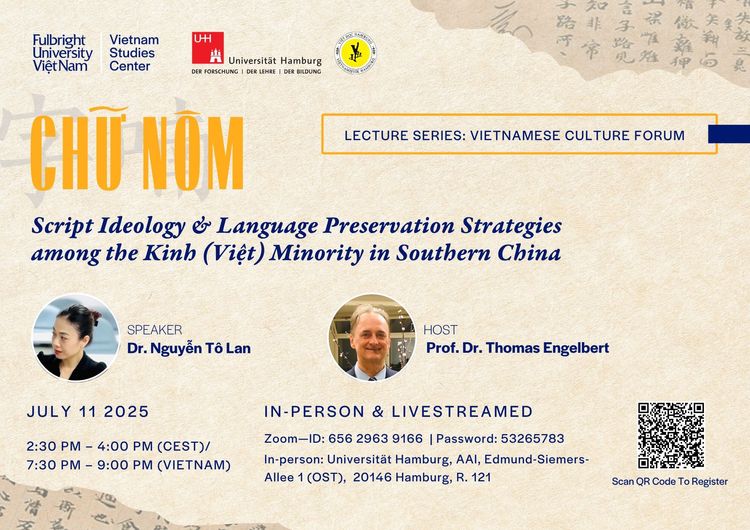
The Vietnam Studies Center at Fulbright University Vietnam, in collaboration with the Department of Vietnamese Studies at Universität Hamburg, cordially invites you to the third session of the Vietnamese Culture Forum lecture series:
“Chữ Nôm: Script Ideology and Language Preservation Strategies among the Kinh (Việt) Minority in Southern China”
- Speaker: Dr. Nguyễn Tô Lan (Institute for Philosophy, Vietnam Academy of Social Sciences)
- Host: Prof. Thomas Engelbert (University of Hamburg)
🗓 Date: Friday, 11 July 2025
🕑 Time: 2:30 – 4:00 PM (Central European Summer Time)
7:30 – 9:00 PM (Vietnam Time)
📍 Venue: Universität Hamburg – Asien-Afrika-Institut, Edmund-Siemers-Allee 1, Room 121 (in person)
💻 Zoom Livestream:
Zoom ID: 656 2963 9166
Password: 53265783
This talk will examine the symbolic and functional role of chữ Nôm as a cultural script and explore the strategies used by ethnic Vietnamese (Kinh) communities in Southern China to preserve their language and cultural identity. Through insights from fieldwork and interdisciplinary research, Dr. Nguyễn Tô Lan will present a critical perspective on script consciousness, linguistic identity, and transnational heritage politics.
The event will be conducted in English and is open to the public.
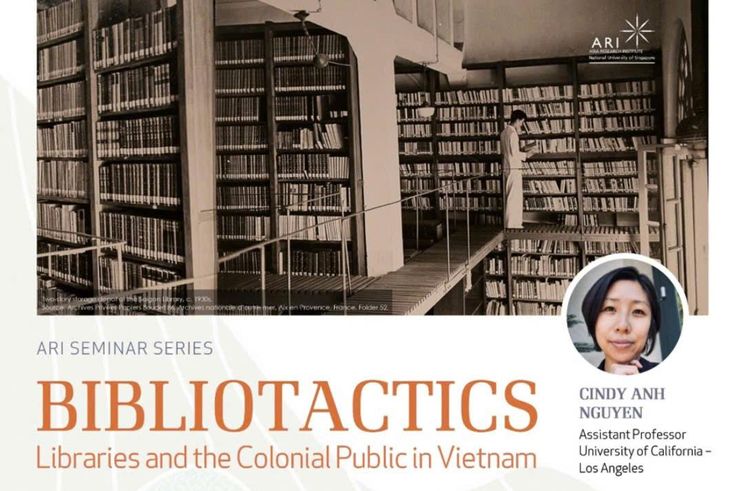
The Asia Research Institute (ARI) will host a webinar on August 14, 2025, titled Bibliotactics: Libraries and the Colonial Public in Vietnam, featuring Dr. Cindy Anh Nguyen, Assistant Professor at UCLA. In this seminar, Dr. Nguyen will examine how Vietnamese readers reimagined and repurposed colonial libraries in Hanoi and Saigon, turning them into spaces of critique, education, and civic engagement that challenged imperial intentions. Drawing on her book published by the University of California Press, she explores the complex role of libraries in shaping colonial and postcolonial publics in Vietnam and across Southeast Asia.
📍 Hybrid format: NUS AS8 04-04 and Online via Zoom
🕓 Time: 4:00–5:30 PM (SGT)
The event promises insights into the history of information, censorship, and public knowledge under colonial rule.
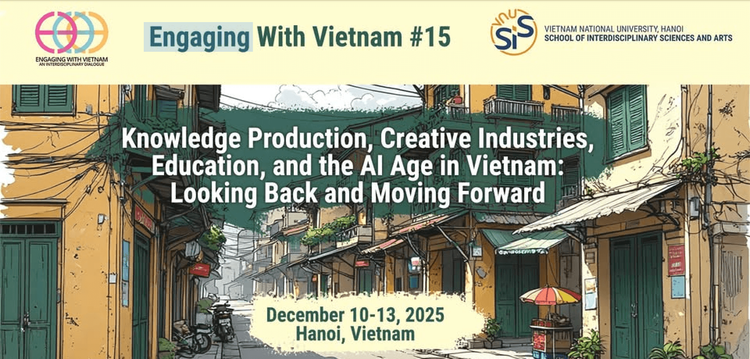
Digitizing Việt Nam is pleased to share the latest announcement from the 15th Engaging With Vietnam Grand Event, a major international conference that will take place from 10–13 December 2025 in Hanoi, Vietnam, in collaboration with the School of Interdisciplinary Sciences and Arts, Vietnam National University Hanoi (SIS-VNU Hanoi).
This year’s theme: “Knowledge Production, Creative Industries, Education, and the AI Age in Vietnam: Looking Back and Moving Forward” invites scholars, artists, educators, and innovators to critically reflect on Vietnam’s dynamic intersections between knowledge, creativity, and technology.
Full conference details and proposal submission instructions are available at: https://engagingwithvietnam.org
Key Dates
- Proposal Submission Deadline: 31 July 2025
- Notification of Acceptance: 15 August 2025
We encourage researchers and practitioners across disciplines to contribute to this exciting milestone in the Engaging With Vietnam journey.
Please help us circulate this information widely!
For further updates, follow Engaging With Vietnam and join us in Hanoi this December as we explore the past and future of Vietnam’s intellectual and cultural landscapes.
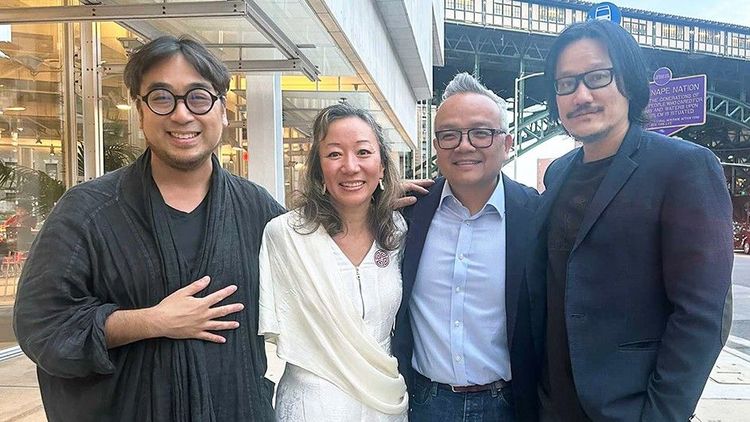
Fifty years ago, the United States lost a war to a country that few Americans could find on a map; in the intervening decades, however, more has been written on the Vietnam War than most of America’s other conflicts. Why?
On the semi-centennial anniversary of the fall of Saigon on April 30, 1975, the Weatherhead East Asian Institute (WEAI) set out to answer that question by mounting a profound and moving three-day symposium. It commemorated not one milestone, but two—the 50th anniversary of the end of the Vietnam War and the 30th anniversary of U.S.-Vietnam reconciliation.
Presented in partnership with the Journalism School, Columbia Global, and the School of the Arts, 50-30: From War to Peace in Vietnam and the United States (April 30-May 2, 2025) was one of the most high-profile, international commemorations of these milestones outside of Vietnam. By convening an extraordinary group of historians, writers, artists, activists, and filmmakers, as well as diplomats and military veterans from both countries, the symposium addressed the legacies of the war in Vietnam, particularly from perspectives south of the 17th parallel; the long road to reconciliation and the future of the U.S.-Vietnam Comprehensive Strategic Partnership; and the power of arts and culture to heal the wounds of war and promote peace in America and Vietnam today.
The four organizers, Columbia professors Tony Bui (School of the Arts and WEAI artist-in-residence), Lien-Hang Nguyen (History and WEAI director), John Phan (East Asian Language and Cultures), and Duy Linh Tu (Journalism), are Vietnam War refugees, or hail from the generation that fled Saigon in the 1970s. Reflecting on this anniversary, Nguyen said, “As a historian of the Vietnam War and co-founder of Global Vietnam Studies (GVS) at Columbia, the semi-centennial forced me to reckon with the tragedy of the past and how far we’ve come since 1975.”
Phan acknowledged the dual nature of the April 30th anniversary: “It is a day of well-deserved joy for millions of Vietnamese, of pride and of celebration. But for millions of other Vietnamese,” he continued, “it is a day of loss, grief, and trauma.” Billed as an integral part of Nguyen’s Global Core lecture course, The Vietnam War: A Special 50th Anniversary Edition, the conference attracted not only hundreds of students from the course, but also WEAI community members and those whose lives were touched by the Vietnam War.
The Wounds of War Will Heal
In the opening panel at Pulitzer Hall, New Histories of the Republic of Vietnam and the South Vietnamese Diaspora, historians delved into the latest research on the 30-year conflict, which ended with the fall of Saigon. Based on the recently published, three-volume Cambridge History of the Vietnam War, for which Nguyen was the general editor, the panel offered new directions from South Vietnam, the side most often overlooked in the Hanoi-and-Washington-centric histories. Combined with the subsequent panel featuring GVS co-founder Phan, along with literary scholars and critics dedicated to South Vietnamese literature, the message was: “The real civil war has ended. The wounds of war will heal. Successive generations are ready to rewrite a future history.”
But the story of the Vietnam War has an impact beyond historiography and literature: Contemporary Vietnamese-American politics is profoundly shaped by the past. Another panel, From the Fall of Saigon to Political Participation in the U.S., brought the diaspora narrative into the present day, as Tu engaged his panelists in an exploration of why many Vietnamese Americans, relative to other Asian Pacific islanders, tend to skew conservative in their politics. “The shadow cast by the fall of Saigon endures,” Tu said, “as intergenerational trauma and socioeconomic factors continue to influence Vietnamese political views in the United States.”
The keynote reception included a conversation between Bui and legendary Vietnamese-American actress Kieu Chinh, who regaled the audience with highlights of her career, which shows no signs of flagging after nearly 70 years. Photographs of Chinh attending film festivals with Chiang Kai-shek and Japanese actor Toshiro Mifune in the 1960s, and with Robert Downey Jr. in 2024, gave evidence of a perennial glamour. Chinh also discussed the hardships imposed by her abrupt exile from Vietnam in 1975, as well as her later professional triumphs like The Joy Luck Club and the recent HBO adaptation of Viet Thanh Nguyen’s novel, The Sympathizer.
Statecraft Takes Center Stage
Statecraft took center stage on Day Two with the program, From Enemies to Friends. WEAI Senior Advisor Thomas Vallely anchored discussions that explored the past, present, and future of U.S.-Vietnam relations. Vallely, along with another WEAI advisor, Chinh Chu, steered two panels that included current Vietnam ambassadors to the U.S., Nguyen Quoc Dzung, and to the United Nations, Dang Hoang Giang, as well as two former U.S. ambassadors to Vietnam, David Shear and Daniel Kritenbrink. They all reflected on the history of U.S.-Vietnam reconciliation and the future of the U.S.-Vietnam Comprehensive Strategic Partnership.
Branching beyond bilateral relations, Wafaa El-Sadr, who wears many hats at Columbia, chaired Lessons from U.S.-Vietnam Reconciliation: Roadmap for the World. This panel, which featured former Vietnam Ambassador to the UN Dang Dinh Quy, assessed whether the restoration of ties between the one-time combatants offers a viable model for the rest of the world.
The Cathartic Power of the Arts
No commemoration of the end of the Vietnam War would be complete without addressing what is perhaps the most-watched documentary on the conflict: Ken Burns’s The Vietnam War, a fixture of Nguyen’s seminars on the war. Vallely and Burns had invited members of the team who made the documentary, including co-director Lynn Novick and co-producer Ho Dang Hoa, to discuss the making of the film. The conversation elicited heartfelt testimonials from audience members of all ages—undergraduates to veterans—who described the powerful experience of watching the documentary.
Day Three highlighted two panels—Conversations Left Unsettled: Healing the Wounds of War, and Cinema, War, and Conscience—under the direction of Bui. Tapped to curate a special collection of Vietnam War movies for the Criterion Channel, Bui is adamant that Hollywood and the U.S. must not be the only voices of the cinematic Vietnam War narrative. “This anniversary is a time to reflect, not just remember,” Bui said. “I hope to present a more layered, human representation from all sides of the conflict.” Bui tried to promote a more nuanced understanding of a country too long perceived by outsiders through the lens of conflict, with the help of poet and novelist Nguyễn Phan Quế Mai—whose 2020 novel, The Mountains Sing, became an international bestseller—and Peter Steinhauer, an American photographer who has lived and worked in Vietnam for more than 30 years.
At the start of the final panel, Bui asked, “Can cinema remember what history forgets?” Vietnam Ambassador Giang’s response was a resounding yes, as his opening comments emphasized the Vietnam government’s support of the arts to promote greater understanding on both sides of the former conflict. School of the Arts Dean Sarah Cole echoed this sentiment by focusing on the importance of art in times of turbulence and war. In a talk between Bui and Phillip Noyce, the two filmmakers gave concrete examples of how movies can rescue the past from the dustbins of history.
“By highlighting and shaping our understanding of the past, and the responsibilities involved,” Bui said, “this isn’t just about writing history—it’s about memory, and memory shifts depending on who’s telling the story.”
A slideshow, complete lists of participants, and additional information about the 50-30 conference are available on the Weatherhead East Asian Institute’s website, and a complete playlist of 50-30 videos is available to stream on its YouTube channel.
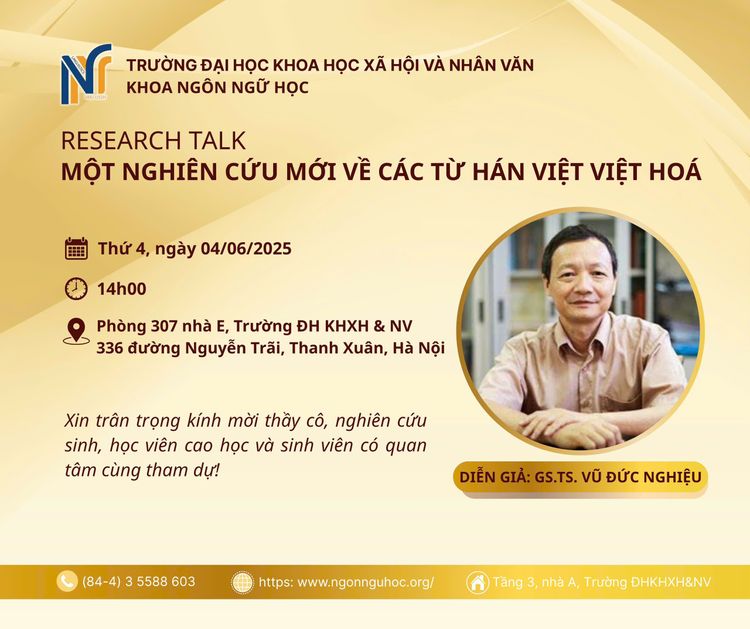
The Faculty of Linguistics, University of Social Sciences and Humanities, Vietnam National University, Hanoi, cordially invites faculty members, researchers, graduate students, and undergraduates to attend a Research Talk entitled "A New Study on the Localization of Sino-Vietnamese Words", presented by Prof. Dr. Vũ Đức Nghiệu—one of the leading scholars in the field of Vietnamese historical linguistics.
This talk will present Professor Nghiệu’s latest findings on the phenomenon of localized Sino-Vietnamese vocabulary, referring to the process by which Chinese-origin words, upon entering Vietnamese, not only retain certain phonetic features but also undergo semantic, syntactic, and usage transformations to better align with the native Vietnamese linguistic system. His research sheds new light on the localization of Chinese linguistic elements in the evolution of the Vietnamese language, while also opening pathways for interdisciplinary inquiries bridging linguistics, cultural studies, and Han-Nom philology.
📅 Time: 14:00, Wednesday, June 4, 2025
📍 Venue: Room 307, Building E, University of Social Sciences and Humanities,
336 Nguyễn Trãi Street, Thanh Xuân District, Hanoi
Prof. Dr. Vũ Đức Nghiệu is a distinguished scholar in Vietnamese linguistics. He has held several leadership positions at the University of Social Sciences and Humanities, VNU Hanoi, and has produced a significant body of research on linguistic acculturation, especially the historical influence of Chinese on Vietnamese. Throughout his academic career, he has been deeply engaged in the study of Sino-Vietnamese vocabulary, Han-Nom textual data, and medieval literature, making substantial contributions to the understanding of linguistic Vietnamization—particularly at the lexical level.
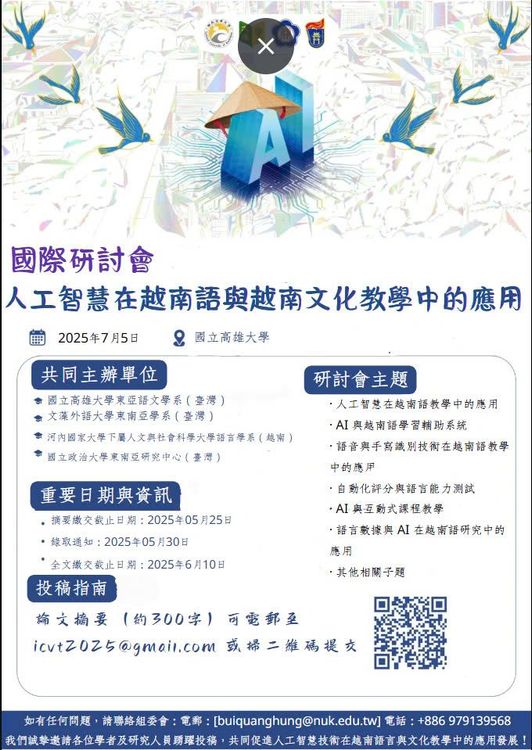
The International Conference on the Application of Artificial Intelligence (AI) in Teaching Vietnamese Language and Culture will be held on July 5, 2025, at the National University of Kaohsiung, Taiwan, in a hybrid format (both in-person and online). This event is co-organized by:
- National University of Kaohsiung (Taiwan)
- Wenzao Ursuline University of Languages (Taiwan)
- National Chengchi University (Taiwan)
- Faculty of Linguistics, University of Social Sciences and Humanities, Vietnam National University, Hanoi
The conference offers a platform for scholars and educators to explore the integration of AI technologies into the teaching and learning of Vietnamese as a foreign language, as well as the dissemination of Vietnamese culture. Topics of interest include AI applications in language instruction, speech and character recognition, automated assessment, intelligent tutoring systems, and the use of linguistic data and AI in Vietnamese language and cultural research.
The Digitizing Việt Nam Project will participate in the conference and present a report titled: Digitizing Việt Nam: Digital Tools for Han-Nom Studies and Cultural Heritage Preservation.
Important deadlines:
- Abstract submission (approx. 300 words): May 15, 2025
- Full paper submission: June 15, 2025
- Conference languages: Vietnamese, English, Chinese
Submissions can be sent via email to icvt2025@gmail.com or through the QR code provided in the poster. For further inquiries, contact ngocbinh@vnu.edu.vn.
Contributions from scholars and educators interested in the intersection of AI, language education, and cultural studies are warmly welcomed to participate.
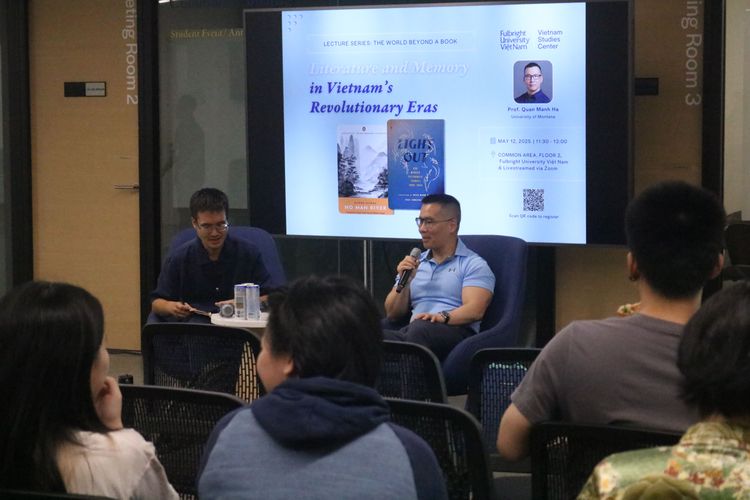
On May 12, the Vietnam Studies Center held the final seminar of the Spring semester in its ongoing series “The World Beyond the Book.” The guest speaker was Dr. Hà Mạnh Quân, a scholar of English Literature at the University of Montana (USA), as well as a translator and editor of several English-language anthologies of Vietnamese literature.
The talk took place as Vietnam looks ahead to two major anniversaries: the 80th anniversary of the August Revolution (1945–2025) and the 50th anniversary of national reunification (1975–2025). With the theme “Literature and Memory in Vietnam’s Revolutionary Periods,” Dr. Hà Mạnh Quân reflected on his experience translating two works: Light Out and Modern Vietnamese Stories, 1930–1954 and the novel No Man River (Bến không chồng) by author Dương Hướng. Both translations contribute to reconstructing significant cultural and political memories of Vietnam through the lens of literature.
Speaking about Light Out and Modern Vietnamese Stories, 1930–1954, Dr. Hà emphasized the diversity of voices and lived experiences captured in the collection. It opens a window into the layered and multifaceted lives of people during this period—where memory belongs not only to the victors, but also to mothers, wives, and marginalized individuals often forgotten in the grand narrative of revolution.
From a translation perspective, Dr. Hà highlighted the challenge of conveying culturally embedded nuances—from intimate family terms to words rich with meaning or unique to Vietnamese culture. A key priority, he noted, is to avoid excessive footnotes that disrupt the emotional rhythm of the text. Instead, his translations were refined in collaboration with native English-speaking creative writers to preserve the story’s natural flow and vitality.
The discussion also touched on the impact of artificial intelligence on translation. “The more we use it, the more we risk becoming dependent and losing the deeply human creativity of the translator,” he shared. Alongside scholarly analysis, Dr. Hà candidly expressed his own philosophy of translation: sometimes one must be bold enough to “take risks,” for only then can a translation preserve the creative spirit and honest vision of the original work.
The seminar concluded with engaging questions from the audience—not only on translation techniques and AI tools, but also on literature’s role in connecting generations, evoking collective memory, and preserving Vietnamese identity amid the currents of globalization.
The 7th International Conference on Vietnamese Studies, themed Sustainable Development in the New Rising Era, will be held in October 2025. This large-scale academic forum of international stature will bring together scholars and researchers from Vietnam and around the world to review achievements, share experiences, and exchange academic insights in the field of Vietnamese studies.
The conference aims to identify key and urgent issues in Vietnam's path toward sustainable development in the context of globalization and rapid global changes. Participants will propose practical solutions to unlock national potential, inspire development aspirations, and implement national development strategies based on these discussions. Additionally, the event will promote global networking in Vietnamese studies and enhance the international image of Vietnam and its people.
This conference is a major scientific and technological event of the year, held in celebration of the 80th anniversary of the founding of the Democratic Republic of Vietnam.
For more information, please visit the official website of Vietnam National University, Hanoi.
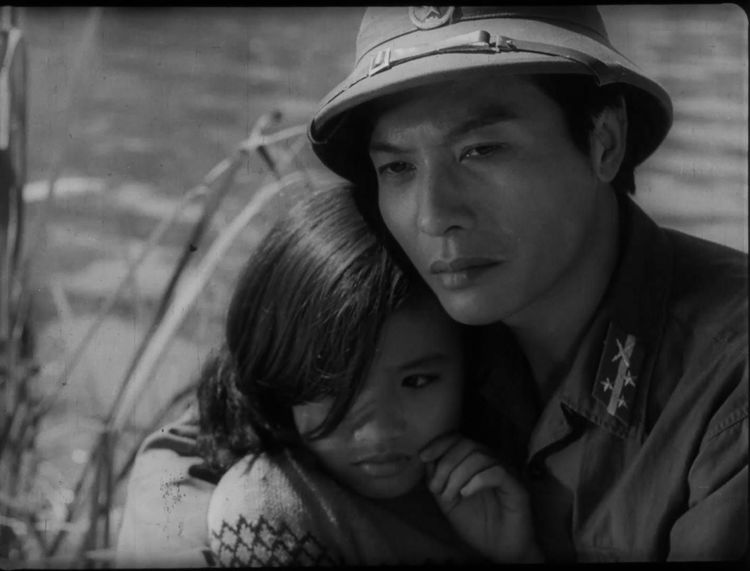
Fifty years after the end of the Vietnam War, its echoes continue to shape how the conflict is remembered and retold—across cultures, generations, and continents. In the United States, the war is often framed through the lens of American involvement, sacrifice, and trauma. In Vietnam, its legacy is more layered, encompassing both the costs of prolonged struggle and the aspirations for national reunification and renewal. For those who left the country during and after the war, memory is equally shaped by displacement, resilience, and the longing for home.
To mark this milestone, filmmaker Tony Bui has curated Legacies of War: Vietnam Across the Divides, a program on the Criterion Channel that brings together films from both Vietnam and the United States. Spanning several decades and genres—fiction and documentary, wartime and postwar, Vietnamese and American—these films offer a broader, more human view of the war and its aftermath. Many U.S. viewers may be familiar with landmark American titles like Platoon and Full Metal Jacket, but few have had the opportunity to engage with Vietnamese films like The Little Girl of Hanoi or When the Tenth Month Comes, which illuminate lives shaped by war in distinct and powerful ways.
This curated collection is not simply an act of remembrance—it is a conversation across cultures and histories. In the interview titled Tony Bui on the Vietnam War’s Cinematic Legacy, Bui discusses the importance of expanding how we see and understand the Vietnam War on-screen, and the enduring relevance of the stories these films continue to tell.
In an in-depth conversation with Criterion, Bui shares the inspiration behind the series, reflects on his own film Three Seasons, and discusses why these stories still matter today.
You can read the full interview with Tony Bui on the official Criterion Collection website, also accessible through Columbia University’s Weatherhead East Asian Institute website.
Three Seasons (1999), directed by Tony Bui, is a landmark in Vietnamese diasporic cinema—and a quietly radical reimagining of how we remember the Vietnam War and its aftermath. Selected by Vietnam as its official submission to the Academy Awards and honored at Sundance with the Grand Jury Prize, Best Cinematography, and Audience Award, the film’s impact continues to resonate 25 years later. In this video, presented during the “Vietnam at 50” conference at Columbia University, filmmaker Tony Bui and historian Professor Nguyen Thi Lien-Hang discuss the enduring legacy of Three Seasons—a cinematic time capsule that captures the sounds, poetry, and emotional undercurrents of Vietnam in the late 1990s.
Rejecting the dominant war narrative often seen in Hollywood productions, Three Seasons instead centers on the quiet resilience of ordinary people navigating a transforming postwar Vietnam. Told through three interwoven vignettes, the film meditates on memory, dignity, and the small but powerful choices individuals make in the shadows of historical trauma.
This conversation offers rare insight into Bui’s personal journey as a Vietnamese American artist—his emotional return to Vietnam at age 19, the influence of his mother’s poetry, and the challenges of making an independent Vietnamese-language film at a time when Vietnamese voices were largely absent from American screens. From working with Harvey Keitel to resisting stereotypical war tropes, Bui’s creative choices illuminate a deeper vision of reconciliation—one grounded in human connection, not battlefield spectacle.
Now digitally restored and newly celebrated by the Criterion Collection, Three Seasons stands as both a cinematic milestone and a cultural bridge—one that continues to speak to Vietnamese and international audiences alike. We invite you to watch this intimate and inspiring reflection on the film’s journey, meaning, and renewed relevance today.
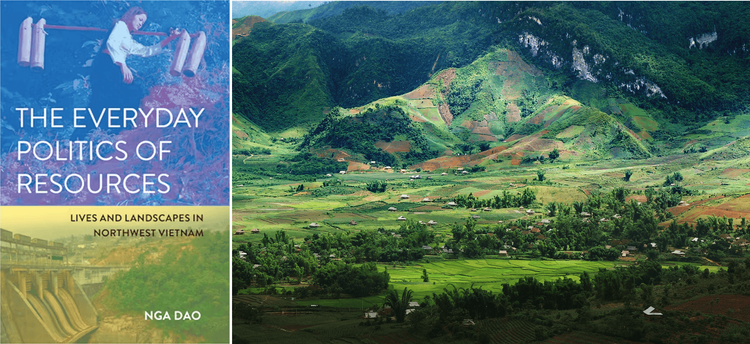
The monograph The Everyday Politics of Resources: Lives and Landscapes in Northwest Vietnam by Associate Professor Nga Dao, Department of Social Sciences, York University (Canada), will be published by Cornell University Press on May 15, 2025.
This work offers a critical examination of the transformative effects of development initiatives—such as hydropower dams, rubber plantations, and mining operations—on the lives, livelihoods, and environments of communities in Northwest Vietnam. While these projects have generated significant profits for the state and private enterprises, they have also resulted in widespread displacement, impoverishment, and ecological degradation.
Drawing on more than two decades of in-depth ethnographic fieldwork, Professor Dao documents the highly uneven outcomes of these development processes. The monograph presents compelling narratives from individuals and communities who have faced dispossession and loss, alongside those who have adapted and, in some cases, benefited from these transformations. Through this nuanced analysis, The Everyday Politics of Resources provides an urgent and insightful contribution to debates on development, inequality, and environmental change in contemporary Vietnam.
We invite readers and scholars with interests in Southeast Asian studies, Vietnam Studies, development studies, anthropology, and political ecology to engage with this publication.
For more details, visit the official Cornell University Press page
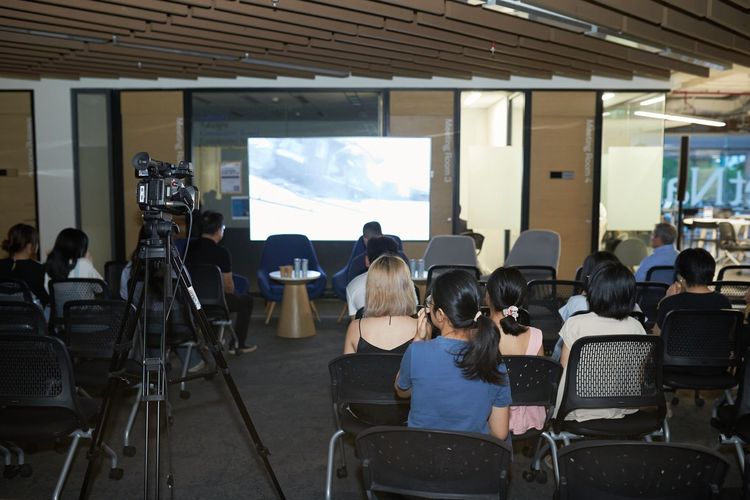
Following the conversation with director Bùi Thạc Chuyên during Fulbright University Vietnam’s Cinema Week, the roundtable "Screen, War, and Peace: Reflections on 50 Years of Reunification" took place on the evening of April 18, 2025, bringing together guests from across generations: directors Phan Đăng Di and Trịnh Đình Lê Minh, Dr. Nguyễn Nam, and student Nguyễn Anh Thư.
Through personal stories and cinematic memories, the discussion opened multiple avenues of reflection on how Vietnamese cinema portrays war—not only as a historical event but as an enduring trauma that continues to shape lives today.
Postwar Identities
Director Phan Đăng Di began with the image of the Vietnamese man across four stages of life—childhood, adulthood, middle age, and old age—captured subtly in his film Bi, Don’t Be Afraid! as a glimpse into postwar life.
"The postwar Vietnamese man is always chasing something unattainable," he shared. In Father and Son, he continued to explore generational fractures:
"Vietnamese society has an extraordinary ability to recover quickly, but it also has an enormous capacity for forgetting."
He emphasized that the lack of connection between generations is a quiet aftermath of the constant upheavals in national history—when memory is not fully passed down, and each generation becomes engrossed in its own separate world.
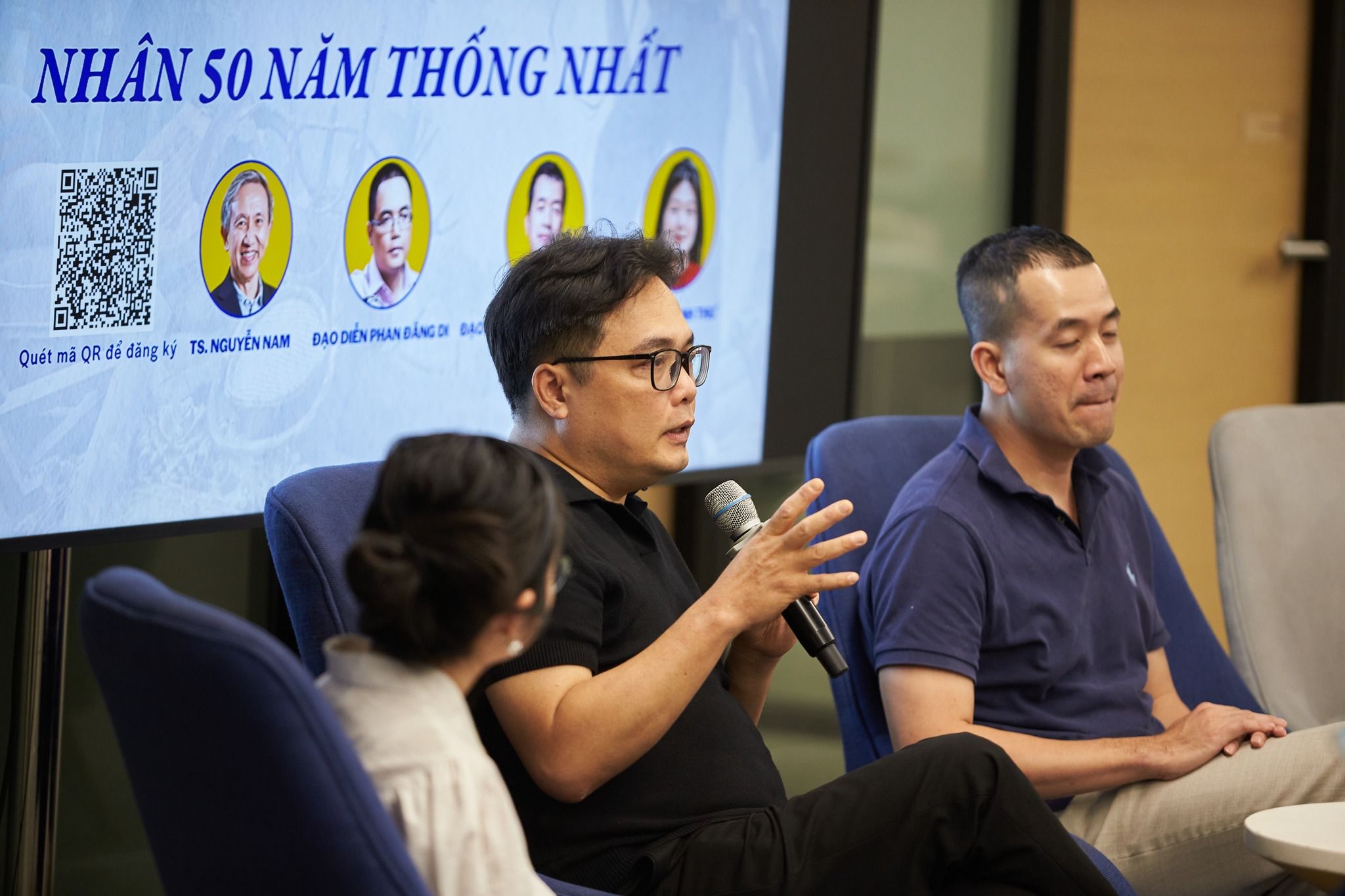
Women: Silent witnesses of history
While Phan Đăng Di portrayed postwar life through the lens of men, director Trịnh Đình Lê Minh led audiences toward the unspoken realities of postwar women.
In Goodbye Mother, the figure of the Vietnamese mother appears gentle yet resilient in her silence:
"She never complains, but her eyes reveal the depth of her love for her child."
In Once Upon a Time There Was a Love, he describes the film as a "fairy tale love story" and a journey of healing from the wounds of war memory.
"I treasure this work because it allowed me to explore the inner world of women—those who quietly choose between love and duty," he shared.
Throughout war and peace, in his cinematic perspective, women are the ones who mend the wounds of history with silent tenderness.
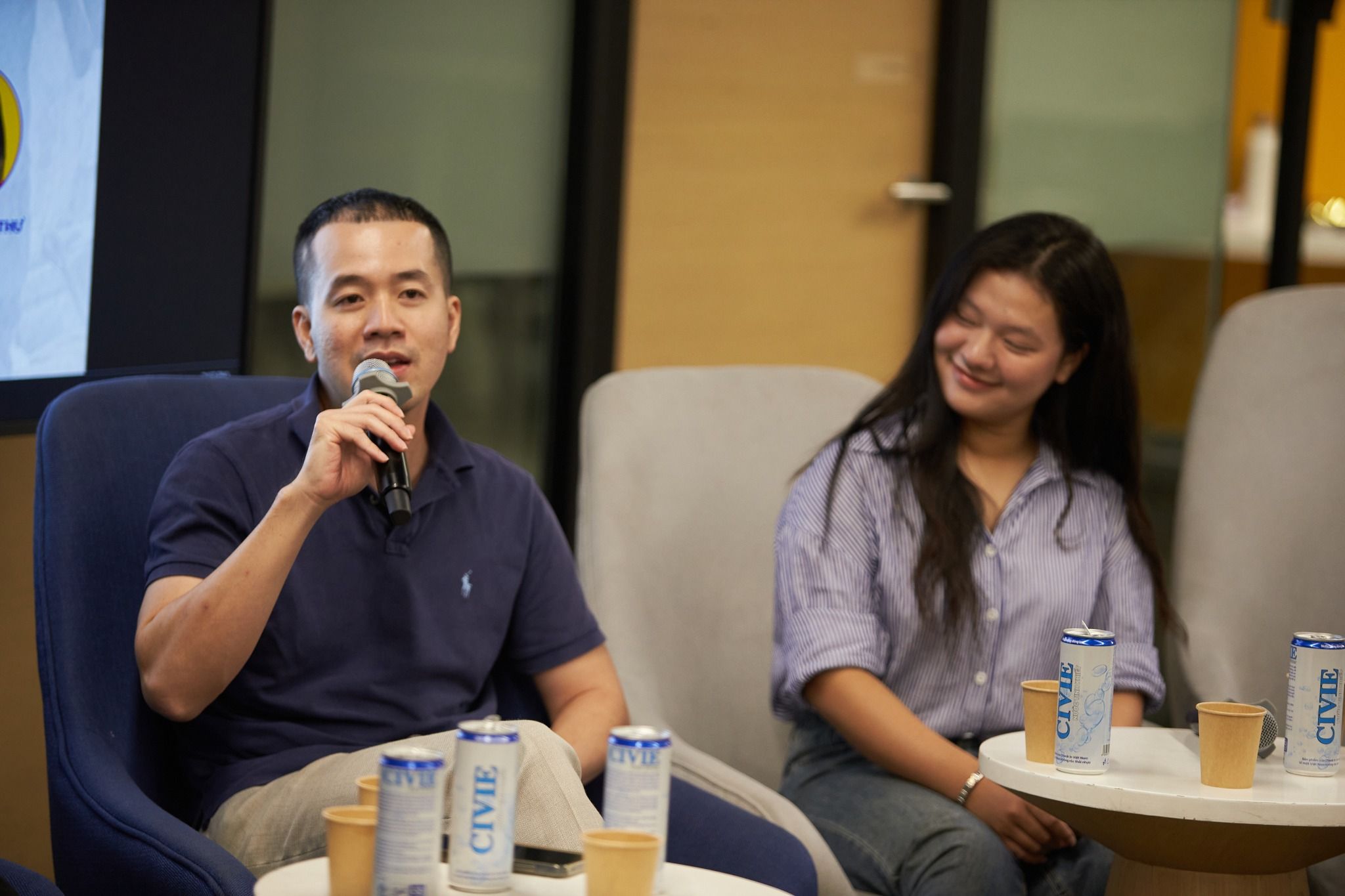
Gen Z & shared memory
Representing Gen Z at the roundtable, student Nguyễn Anh Thư from Quảng Trị shared her generation's sense of responsibility toward history:
"I grew up with my elders' words: 'Your mission is to live well.' Those words inspired me to tell the story of my hometown through educational tours and community projects."
For Thư, cinema is not only a means for young people to approach history but also a bridge for empathy with memories they never personally lived through—memories conveyed through images and emotions.
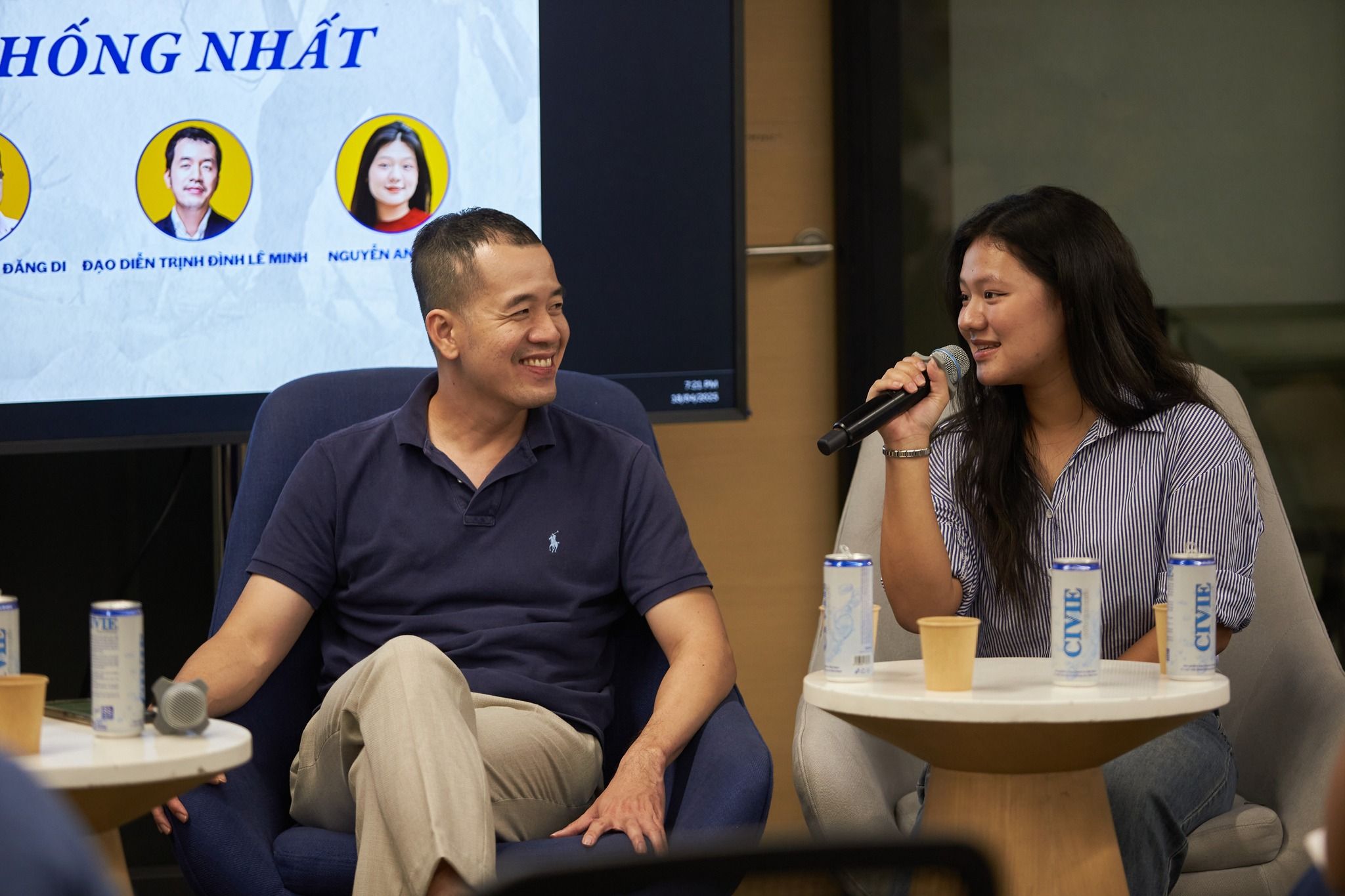
From a scholarly perspective, Dr. Nguyễn Nam emphasized:
"Cinema does not merely reflect war; it compels us to question national identity. Amid globalization and deglobalization, the most important thing remains the story of national identity."
For him, works like The Abandoned Field: Free Fire Zone (Cánh đồng hoang) and When the Tenth Month Comes (Bao giờ cho đến tháng Mười) demonstrate cinema’s ability to record "the humanity that survives war."
At the end of the roundtable, participants listened to an excerpt from The Sorrow of War about Kiên—the soldier who lives forever in the springtime of youth, love, and ideals:
"Unaffected by the erosion of forgetfulness, his soul forever lives in the springtime of feelings that have now faded or mutated. Thanks to this, he lives eternally in those painful yet glorious days, those unhappy yet deeply human days—days when we knew exactly why we had to enter the war, endure everything, and sacrifice everything. Days when everything was still young, pure, and sincere."
In this view, cinema—like literature—is a space where people select memories carefully, because there is too much to remember from a long, brutal war. The conversation invited young people to connect more deeply with the memories of older generations, to continue writing new pages from the ashes of war.
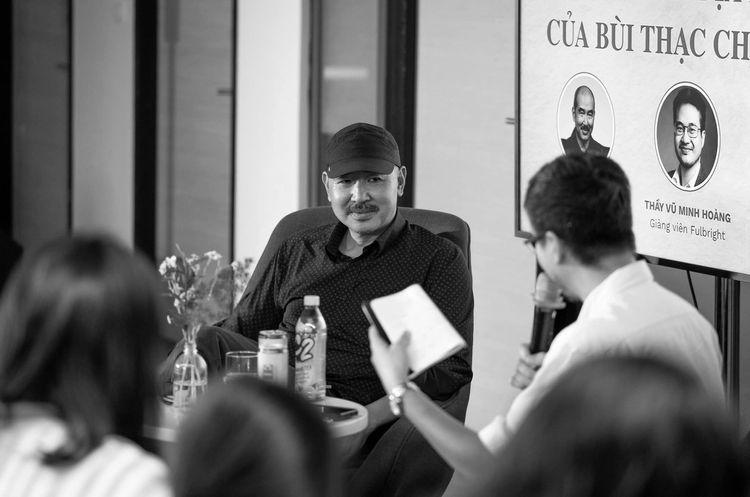
On April 14, as the opening event of Cinema Week, the Vietnam Studies Center at Fulbright University Vietnam, in collaboration with the Fulbright Digital Humanities Lab, hosted a conversation titled: “Reimagining History on Screen: The Journey of Địa Đạo with Director Bùi Thạc Chuyên.”
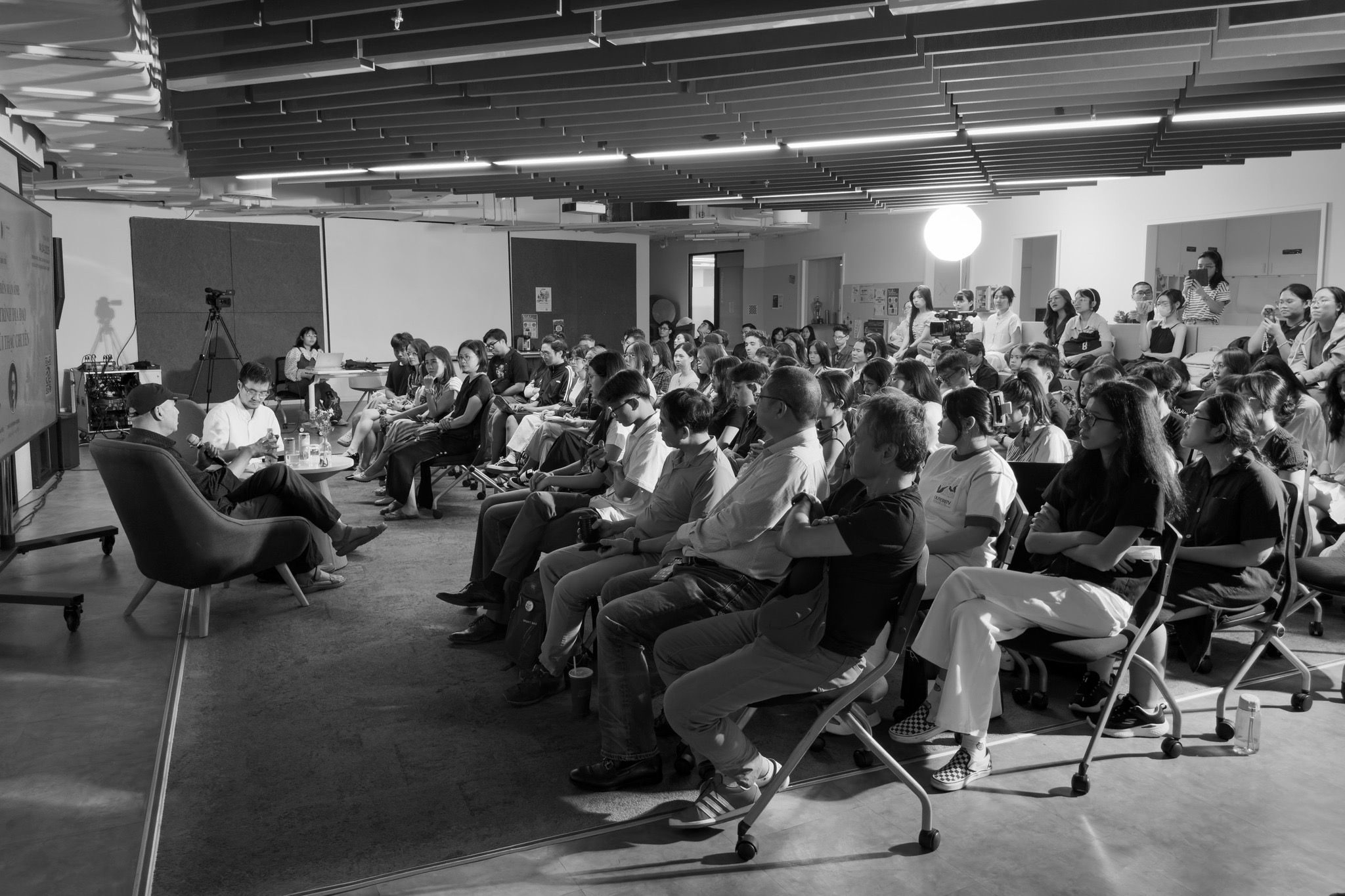
Director Bui Thac Chuyen shared his filmmaking journey with Fulbright students.
This event offered Fulbright students a rare opportunity to meet the acclaimed director behind this haunting film, listen to behind-the-scenes stories, and explore the deep challenges of portraying a fierce yet heroic chapter of Vietnamese history.
Guerrilla Warfare: When the People Became the Vanguard
Speaking to the audience, director Bùi Thạc Chuyên shared that what touched him most during the making of Địa Đạo was capturing the monumental achievement of the Củ Chi Tunnels — a feat built entirely by the hands, minds, and resilience of the Vietnamese people.
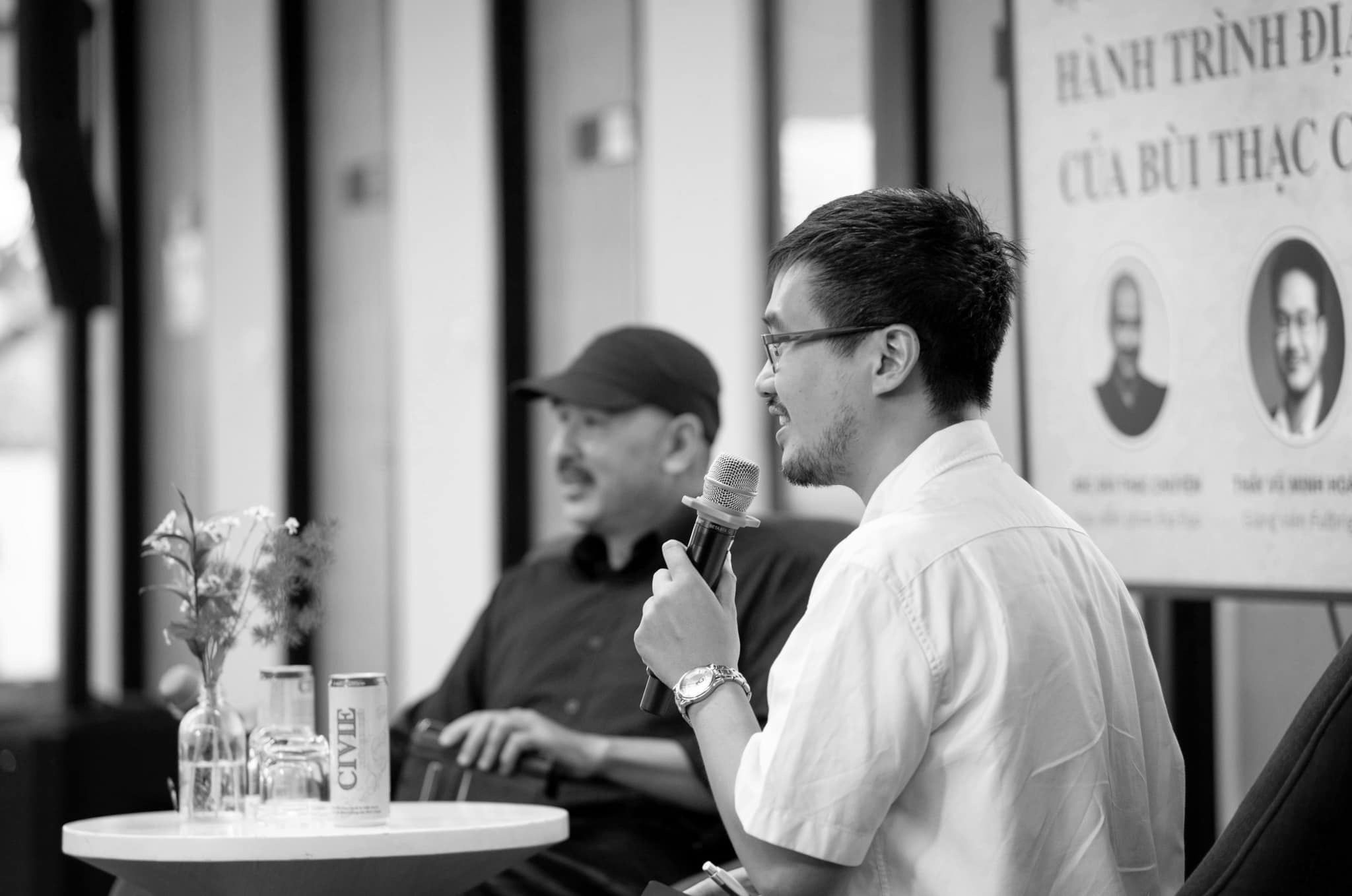
The discussion was led by Dr. Vu Minh Hoang, a key advisor of Digitizing Việt Nam.
In his view, what set the Củ Chi campaign apart was its nature as a true people’s war. Everyone contributed what they had — guns, bamboo traps, and most critically, unwavering spirit, unity, and determination.
“If we speak of strength, [the Americans] were certainly stronger, much stronger. The surface of Củ Chi was laid bare — trees and houses burned to the ground. Yet, the people remained. That was guerrilla warfare. That was people’s warfare. And that spirit of persistence is what the tunnels symbolize throughout the film: Hold on at all costs.”
The battle of Củ Chi stands as a profound testament to the guerrilla warfare model that Hồ Chí Minh and revolutionary leaders advocated — empowering grassroots forces to act independently and creatively. And once entrusted, the people fought with a remarkable ingenuity the world had never seen before.
The Củ Chi Tunnels: Architecture of Improvisation
More than a symbol of resilience and tactical brilliance, the Củ Chi tunnels embody a unique form of "organic" architecture — evolving day by day, shaped by urgent needs rather than rigid blueprints.
“Sometimes one would dig a tunnel branch and knock toward the other side, listening carefully. If sounds echoed back, it meant a tunnel was near — and they'd change direction to avoid colliding.”
For director Chuyên, filming within the tunnels posed a nearly insurmountable challenge: tight, dark, and stifling conditions made traditional cinematography almost impossible.
Thus, “Bringing Sunlight into Darkness” became not just a metaphor for the tunnels themselves, but also for the filmmaking effort — a journey to shed cinematic light on a subterranean history, hidden from the sun.
Love and Life Amidst Bombs and Gunfire
Fulbright students shared their curiosity about various details in the film.
When asked about the intimate scenes in Địa Đạo, the director responded candidly:
“A war film that’s only about fighting isn't truthful.”
Through in-depth interviews with living witnesses, he realized that behind the heroic narratives were countless everyday stories — deeply human, tender, and poignant.
Scenes of love, intimacy, and longing were integral to portraying the full spectrum of human experience during wartime. Soldiers were not mere fighters; they were people who loved, dreamed, and yearned for normalcy amidst chaos.
Regarding Út Khờ’s unborn child, director Chuyên deliberately left the question of paternity unresolved, embracing a documentary spirit that invites viewers to ponder and interpret.
A Duty to History and the Nation
“Marking 50 years of peace, I knew I had to do something meaningful.”
From the outset, Bùi Thạc Chuyên approached Địa Đạo not merely as a film project but as a mission to record living memory — by seeking out and listening to those who once lived and fought beneath the earth.
Many of them are no longer with us. In this sense, Địa Đạo serves as both a tribute and a spiritual legacy for future generations.
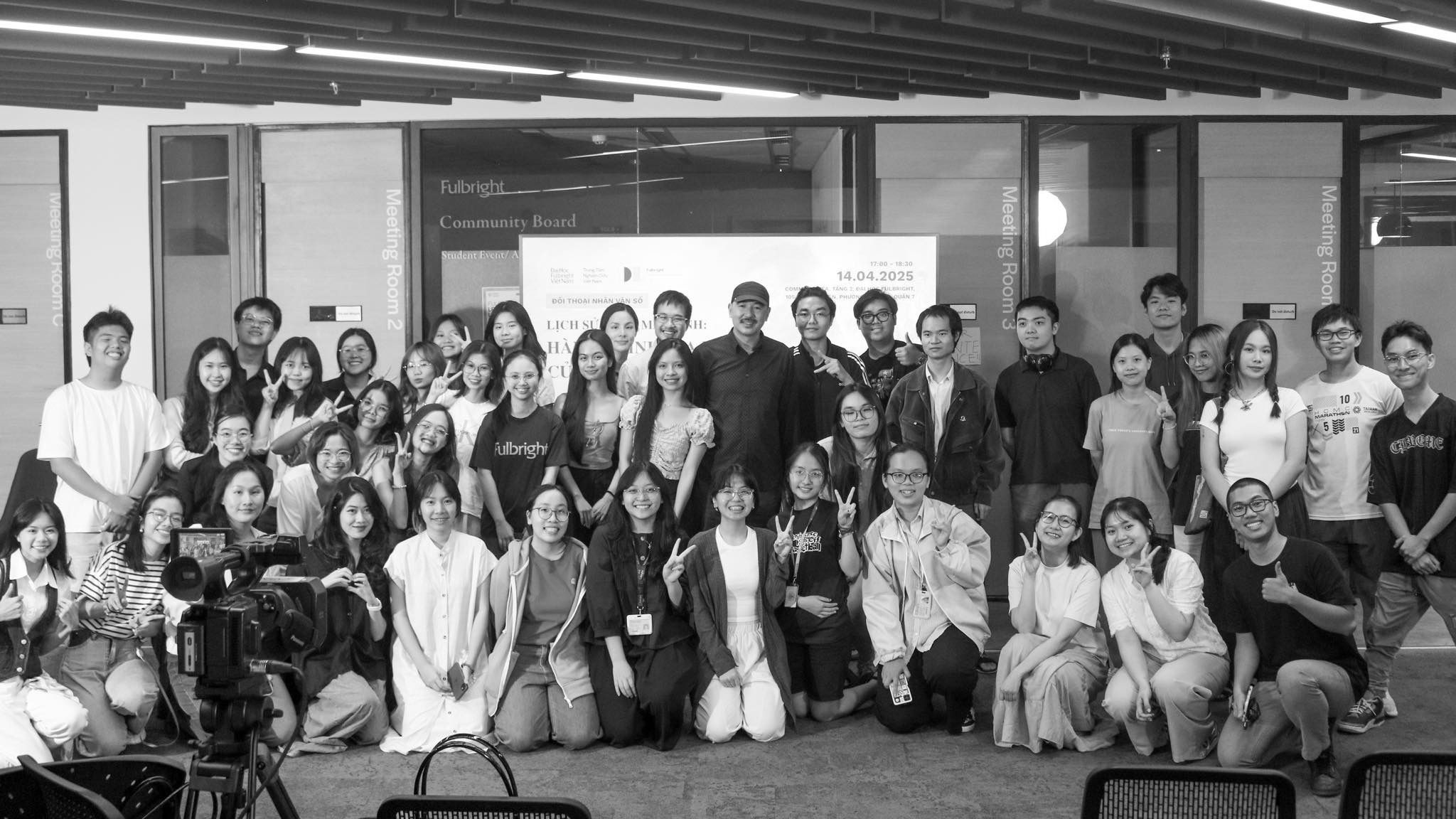
Fulbright students and staff took a souvenir photo with the director.
The film’s stark, emotional, and haunting imagery transported audiences back to a time when war raged fiercely — but so too did humanity and love. For today's youth, it offered a moving glimpse into the brutal realities and profound sacrifices of those who came before.
Titled 50–30: From War to Peace in Vietnam and the U.S, this special event series will take place from April 30 to May 2, 2025, at Columbia University in New York, marking two major milestones: the 50th anniversary of the end of the Vietnam War and the 30th anniversary of the normalization of diplomatic relations between Vietnam and the United States.
Organized by Global Vietnam Studies at the Weatherhead East Asian Institute, in collaboration with partners including the Columbia Journalism School, Columbia Global, and the School of the Arts, the program will feature panel discussions, film screenings, exhibitions, and cultural dialogues.
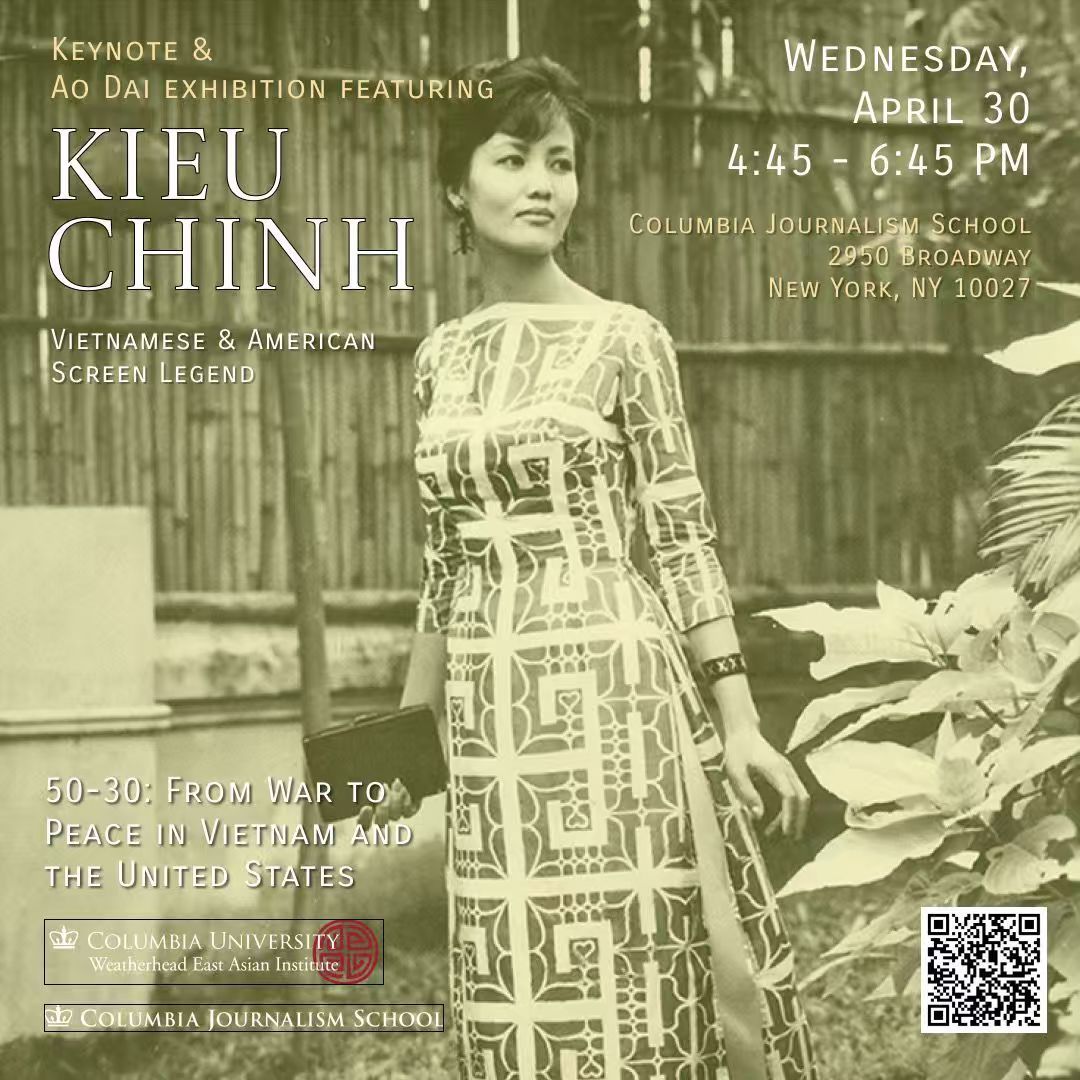
The series aims to open up space for diverse perspectives on the war and the path to peace, revisit conversations left unresolved in the arts and culture, and reflect on the lessons these histories hold for the future of U.S.–Vietnam relations and global conflict resolution.
Bringing together leading historians, writers, filmmakers, artists, veterans, and historical figures from both the war and the reconciliation process, 50–30 promises to be a meaningful and thought-provoking commemoration of these significant anniversaries.
For more details, visit the official WEAI event page.
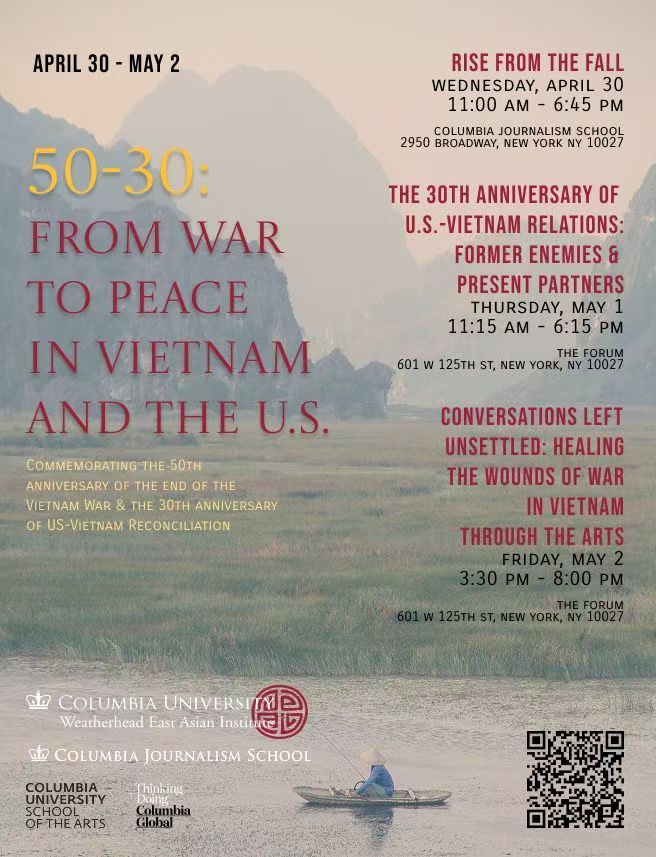
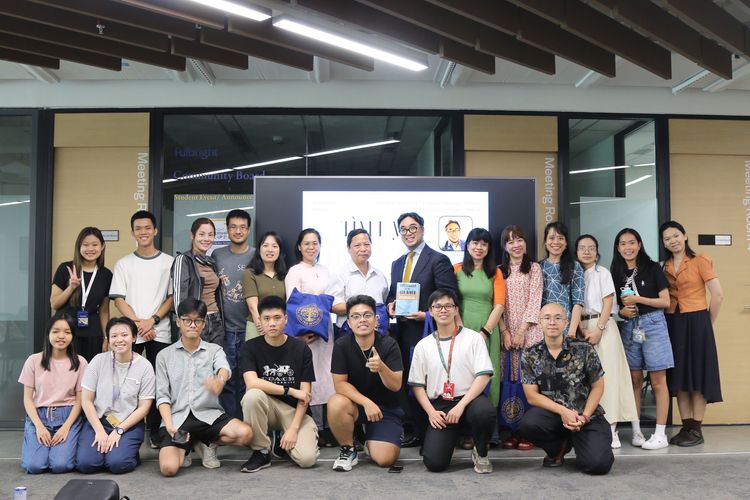
The Digitizing Vietnam project—a major digital humanities initiative dedicated to preserving and promoting Vietnamese heritage—officially launched its public website on April 11, 2025, during the event “Tongues Lost & Found: Preserving Vietnamese Heritage for Future Generations” at Fulbright University Vietnam.
A collaborative effort between the Vietnam Studies Center and the Weatherhead East Asian Institute at Columbia University, Digitizing Vietnam is supported by the Henry Luce Foundation. The project aims to provide open access to a growing body of digitized Vietnamese cultural materials while equipping researchers, educators, and the public with powerful tools for engagement.
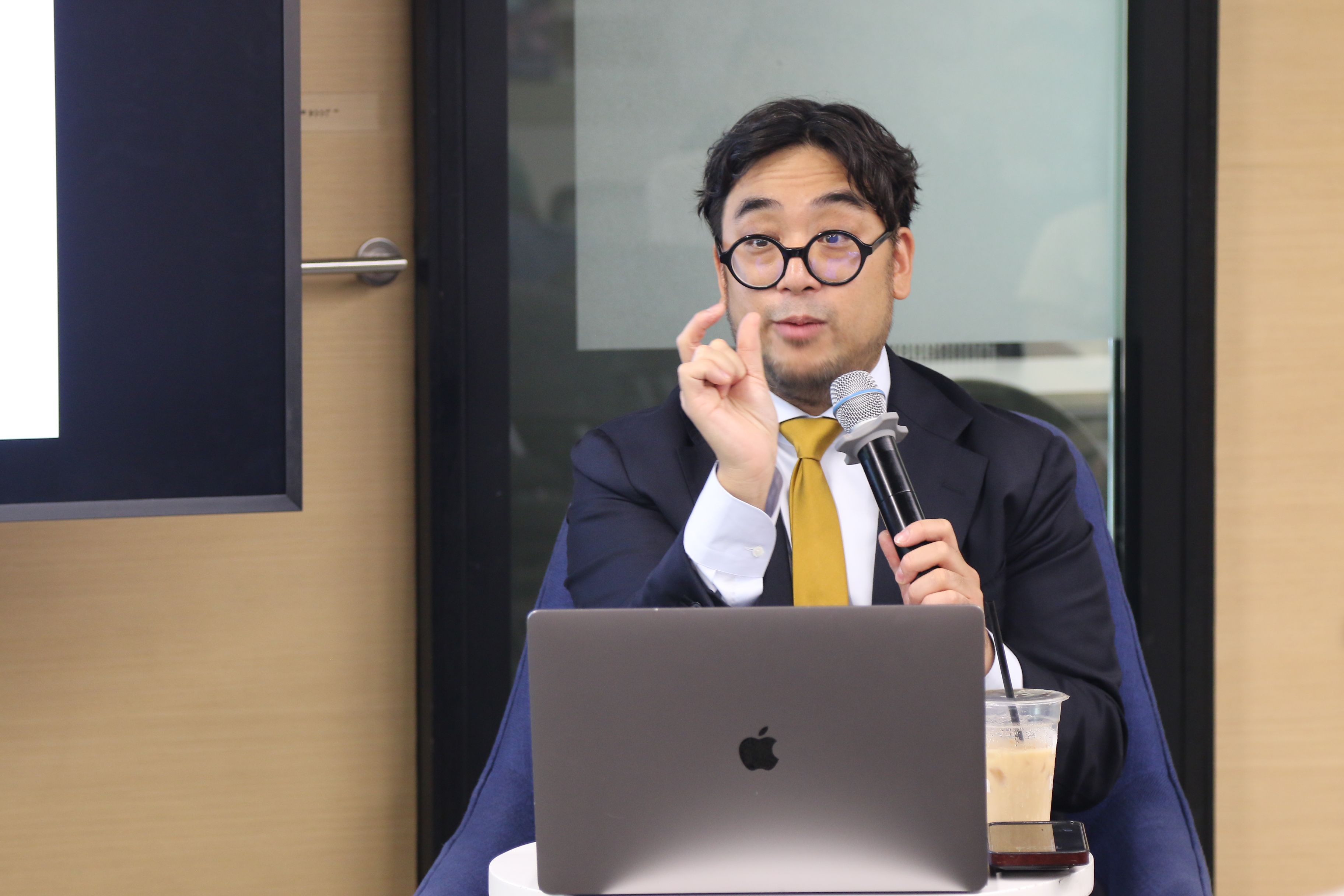
Prof. John Phan discussed his latest work on the Vietnamese language.
The launch event featured keynote speaker Professor John Phan (Columbia University), whose presentation “Lost Tongues of the Red River: Annamese Middle Chinese and the Origins of the Vietnamese Language” highlighted the rich, multilingual origins of Vietnamese and challenged monolithic views of national linguistic identity.
At the center of the event was the unveiling of the Digitizing Vietnam platform, which houses:
- A comprehensive digital archive of premodern Sino-Nom texts and modern Vietnamese cultural documents;
- A suite of cutting-edge research tools to support annotation, translation, and philological inquiry;
- A growing pedagogical library connecting academic research with classroom and public education.
Featured Collections
The platform currently showcases a wide range of collections, including:
- Language. Script. Philology
Featuring research by Prof. Dr. Sc. Nguyễn Quang Hồng on Vietnamese linguistics, scripts, and philology. - Ethnic Groups in Vietnam: Language and Culture
Exploring the linguistic and cultural diversity of Vietnam’s ethnic communities. - Essence of Vietnamese Literature and Language
A curated body of scholarship on Vietnamese literary and linguistic traditions. - Nữ Giới Chung (Women’s Bell)
A digitized version of the first women’s newspaper in Vietnamese press history. - The Tale of Kiều
A searchable archive with high-resolution scans of rare editions, including one dating back to 1866. - The Tale of Lục Vân Tiên
Includes a special manuscript edition (1866–1873) from Mrs. Châu Anh Phụng’s collection in Bến Tre. - Oral History of Trịnh Công Sơn
Audio-visual materials featuring recollections from friends and family of the late composer. - Vietnam In Still Shots
A photographic collection capturing diverse regional landscapes and communities donated by Heritage Magazine.
Noteworthy contributions also include rare film and manuscript materials, such as a special edition of the 1924 adaptation Kim Vân Kiều, which offer critical value for studies in adaptation and cultural continuity.
Tools and Technologies
Digitizing Vietnam is also developing a number of digital tools to support researchers and students alike:
- Kiều Tool
Annotated Nom characters for each edition of The Tale of Kiều; features like sentence comparison and unique sentence indexing are in development. - Sino-Nom Dictionaries
Including annotated dictionaries by Prof. Nguyễn Quang Hồng, Father Trần Văn Kiệm, the Taberd Dictionary (Dictionarium Anamitico-Latinum), and others. - Image OCR Platform
A tool designed to extract text from historical images and scanned documents, enhancing access for scholars working with visual materials.
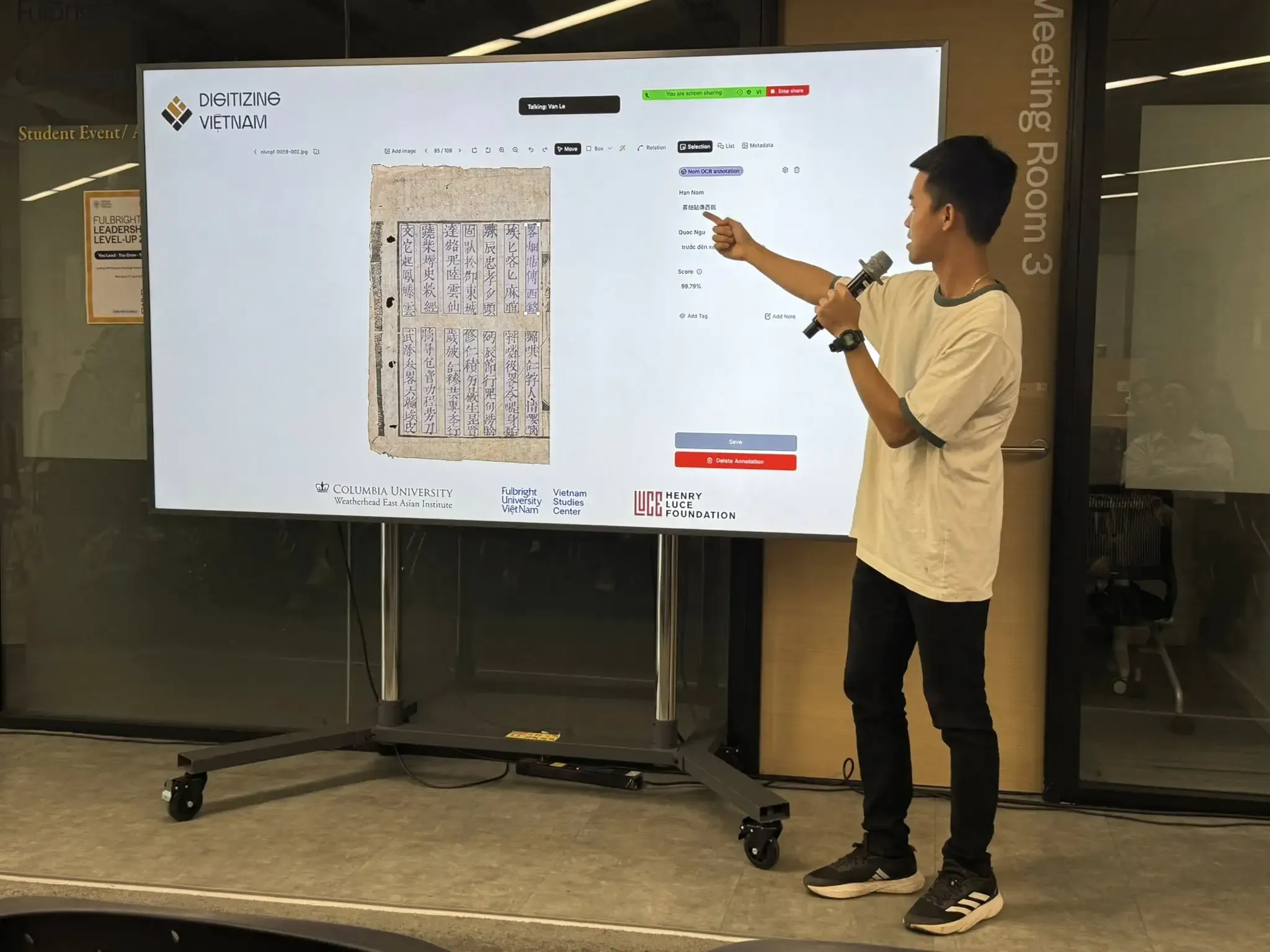
Fulbright Computer Science alumnus Lê Hoàng Phúc, Digitizing Việt Nam Core Team Member, demonstrated how the Image OCR Platform works.
A Shared Effort Toward Cultural Stewardship
The event also welcomed Associate Professor Dr. Đinh Điền, who led a live demonstration of Kim Hán Nôm, a Sino-Nom translation tool developed at the University of Science (VNU-HCM). Earlier this year, Digitizing Vietnam contributed 4.7 TB of Sino-Nom data from Columbia University’s archives to enhance the tool’s recognition and translation capabilities.
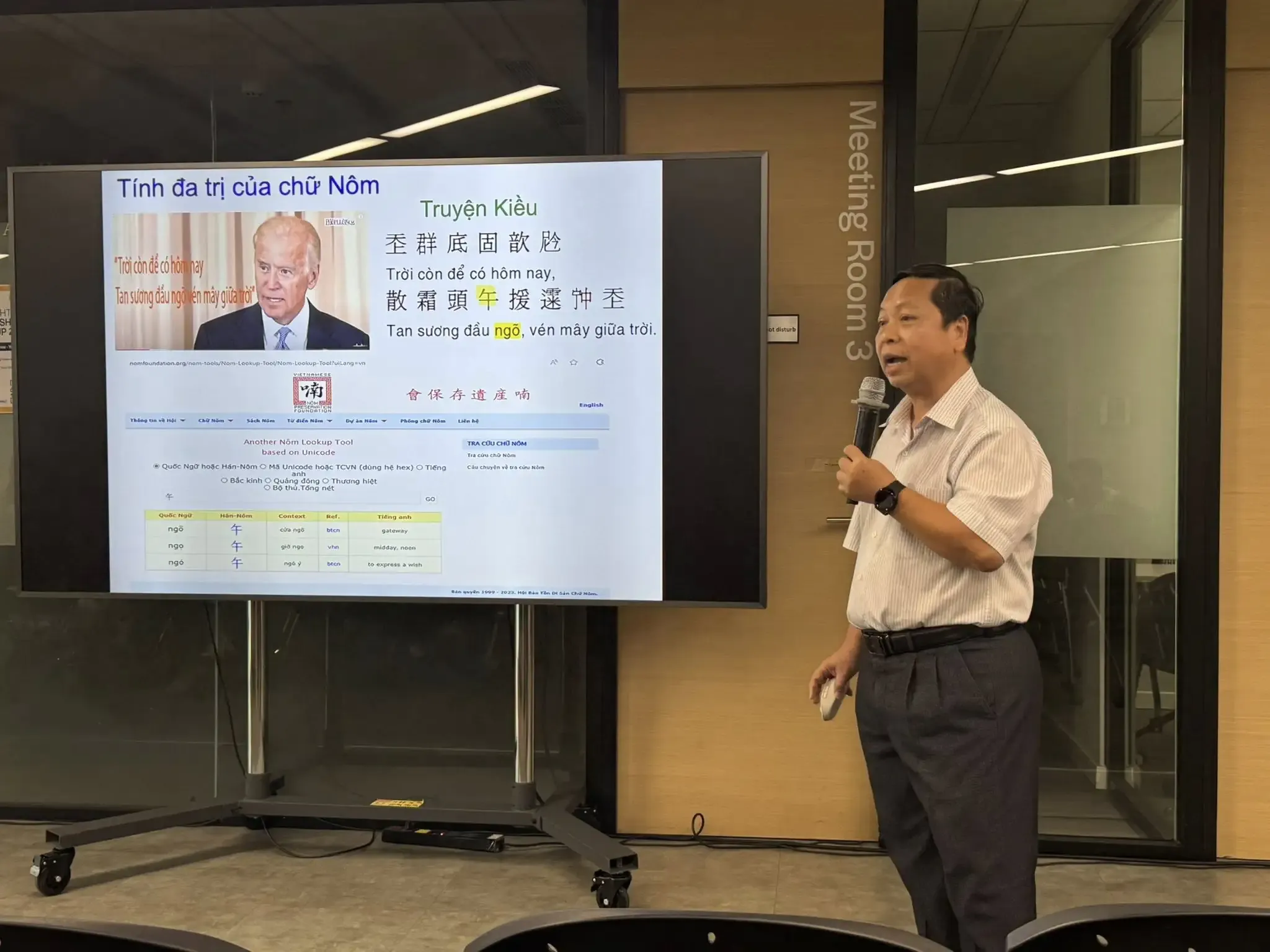
The event also welcomed Associate Professor Dr. Đinh Điền, who directly guided the audience in using the Sino-Nom translation tool developed by the University of Science, VNU-HCM.
This translation tool is now housed in the platform’s Digital Humanities Tools Library, where it is accessible for further scholarly use and community improvement. Researchers are encouraged to contribute annotation data to continuously refine its accuracy and functionality.
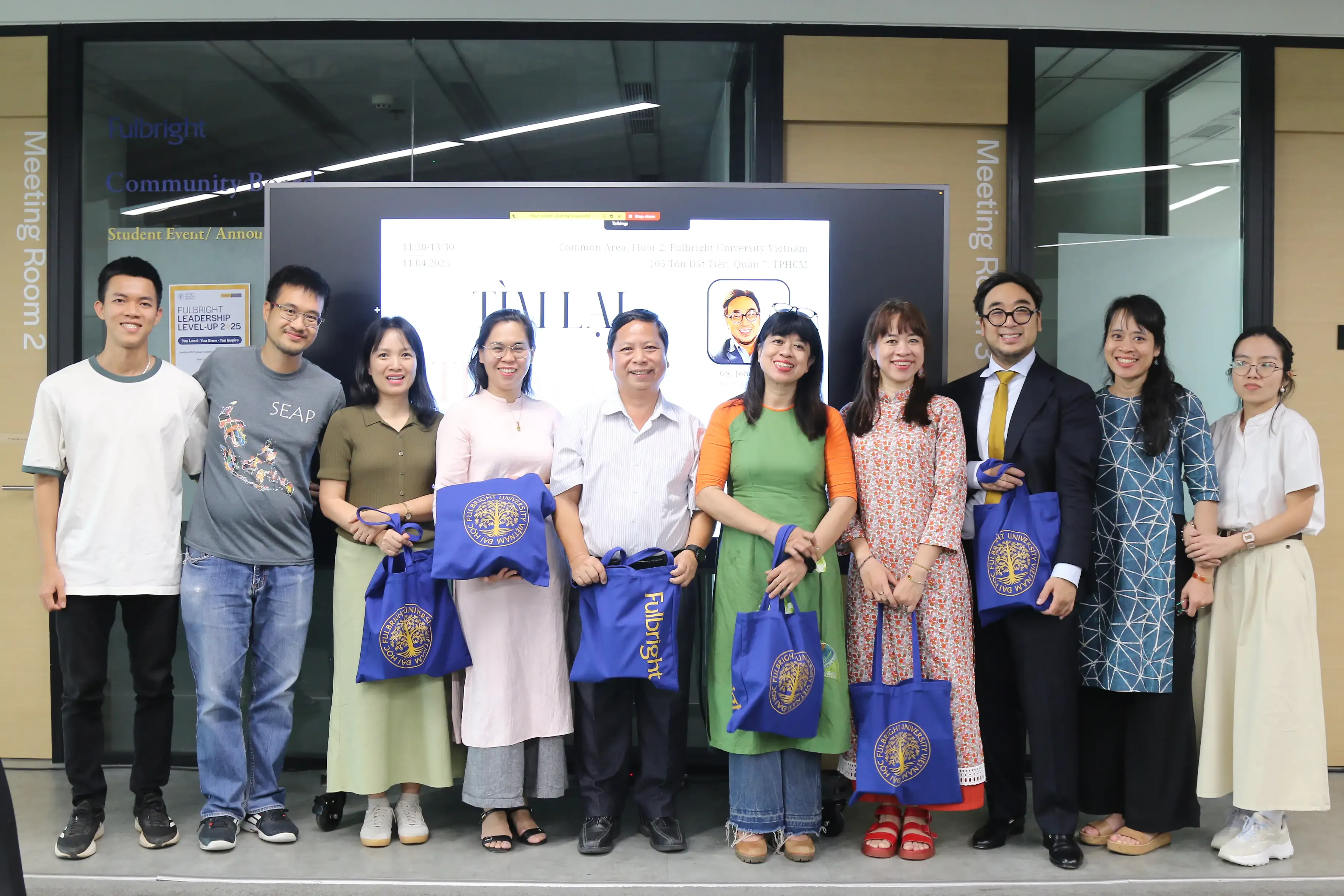
The core team along with advisors & donors
By combining rigorous research, rare archival content, and open-access digital tools, Digitizing Vietnam opens new pathways for learning and re-engagement with the country’s complex cultural and linguistic heritage. The project affirms that even in the digital age, Vietnam’s stories—etched in woodblocks, whispered in verse, and preserved in memory—can be traced through digital ink.
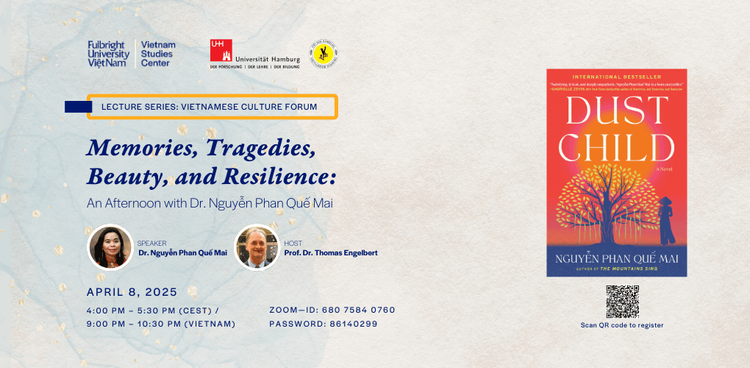
The Vietnam Studies Center, Fulbright University Vietnam, is delighted to invite you to a special online lecture as part of our Vietnamese Culture Forum—a collaborative series with the Department of Vietnamese Studies at the University of Hamburg.
Memories, Tragedies, Beauty, and Resilience: An Afternoon with Dr. Nguyễn Phan Quế Mai
Date: Tuesday, 8 April 2025
Time: 4:00 PM – 5:30 PM (CEST) / 9:00 PM – 10:30 PM (Vietnam Time)
Location: Zoom Webinar
🔗 Join via Zoom Link
Webinar ID: 680 7584 0760
Password: 86140299
📝 Registration: https://forms.office.com/r/aZCmZY7YQL
Dr. Nguyễn Phan Quế Mai is one of Vietnam’s most celebrated contemporary authors. Writing in both Vietnamese and English, her works—including The Mountains Sing and Dust Child—have received critical acclaim for their powerful storytelling and exploration of Vietnam’s complex history. Her literary voice resonates with themes of memory, trauma, resilience, and beauty, offering deeply human perspectives on the past and present.
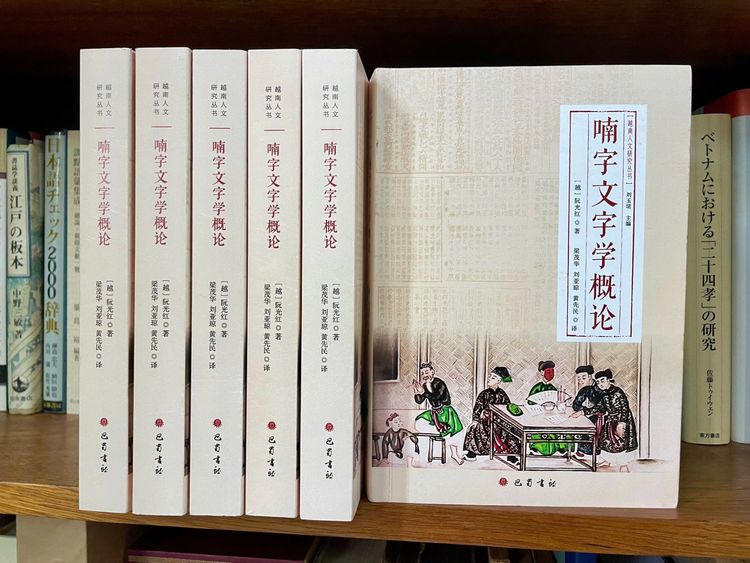
The scholarly monograph An Introduction to Chu Nom Grammatology by Prof. Nguyễn Quang Hồng, which was awarded the State Prize in Science and Technology in 2017, has now been officially introduced to Chinese readers through its newly published Chinese edition. Released by Bashu Publishing House in December 2024, the book comprises 520 pages and is part of the Vietnamese Humanities Research Series, curated by Prof. Liu Yuqun.
The Chinese translation was meticulously executed with high professionalism and dedication by translators Liang Maohua, Liu Yaqun, and Huang Tiandan. The translation process began before the COVID-19 pandemic and went through multiple stages of revision and refinement to ensure accuracy and relevance for a Chinese-speaking audience. After years of dedicated efforts, the translated edition was officially completed and published at the end of 2024.
The Vietnamese Humanities Research Series, curated by Prof. Liu Yuqun, is an essential collection that brings together significant research on the languages and cultures of Vietnam’s ethnic minorities. The publication of this Chinese translation marks an important step in bridging scholarly exchanges between Vietnam and China, making invaluable knowledge about the Nom script more accessible to a broader audience.
📖 Read the 2009 book review [here].
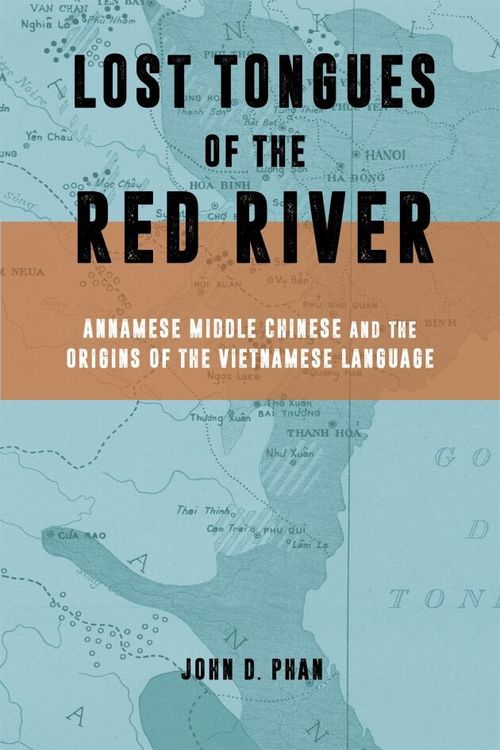
Event Details:
Date: Thursday April 17th, 2025 , 6:15pm EDT
Location: The Heyman Center, Second Floor Common Room, Columbia University
Virtual Registration: Click Here
Book Content Overview:
The Vietnamese language offers a distinctive perspective on the vibrant and interconnected world of premodern Asia. Contemporary approaches to language history are often shaped by nationalist frameworks that seek to reinforce a specific nation’s cultural, social, or political identity. However, a deeper exploration of Vietnamese reveals a complex history of exchange and evolution that transcends the boundaries of nation-states.
Utilizing philological, textual, and comparative linguistic analysis, John D. Phan reconstructs the trajectory of a Sinitic language that once thrived in northern Vietnam’s Red River Plain—what he terms “Annamese Middle Chinese.” The rise and eventual decline of this language set in motion profound linguistic shifts, ultimately leading to the emergence of Vietnamese in the early centuries of the second millennium.
By weaving together linguistic, demographic, intellectual, and cultural threads, Phan situates the development of Vietnamese within the broader landscape of East and Southeast Asia’s cosmopolitan past. Lost Tongues of the Red River reveals how language serves as an intimate record of human interaction, offering invaluable insights into the complexities of history and deepening our understanding of the past.
About the Author
John D. Phan, Assistant Professor of Vietnamese Humanities at Columbia University, studies language history to uncover social and political dynamics, focusing on Sino-Vietic contact and the vernacularization of early modern Vietnamese society.
Experts Speaking at this Event
Mark Alves has taught ELAP courses at Montgomery College, researched Southeast Asian linguistics, co-authored ESL materials, and served as Editor-in-Chief of the Journal of the Southeast Asian Linguistics Society since 2015.
Robert Hymes, Carpentier Professor of Chinese History at Columbia University, specializes in the social and cultural history of middle period and early modern China, with a focus on elite culture, kinship, medicine, religion, and social networks.
David Lurie, a professor at Columbia University, specializes in premodern Japanese history and literature, focusing on writing systems, linguistic thought, mythology, and the Japanese reception of Chinese texts.
Gray Tuttle, Leila Hadley Luce Professor of Modern Tibetan Studies at Columbia University, specializes in modern Tibetan history and Sino-Tibetan relations, focusing on Buddhism’s role and Tibet’s ties with the Qing Empire.
---
For more details, visit the official SOFHCH event page.