A Vietnamese Moses: Philiphê Bỉnh and the Geographies of Early Modern Catholicism
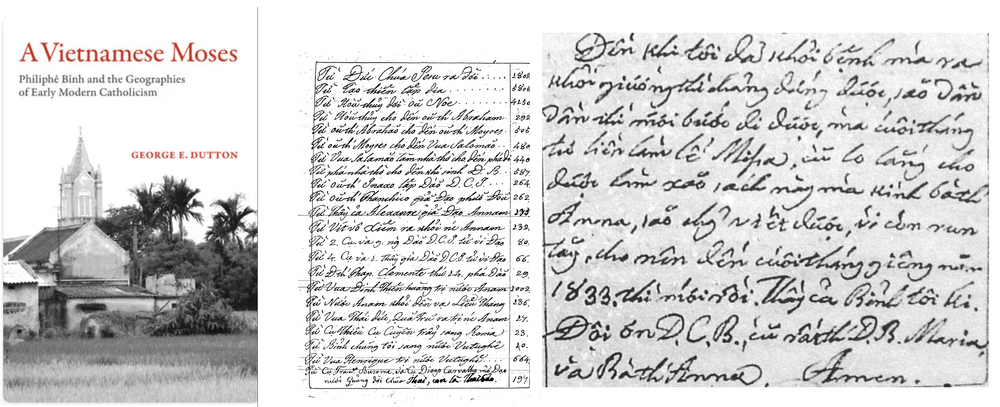
This is the title of a book written by the scholar George E. Dutton about a Jesuit priest named Philiphê Bỉnh.
In the early modern world, faith traveled. It crossed oceans in the hulls of Portuguese caravels, moved along monsoon circuits of Asian trade, and settled in river deltas and mountain villages far from Rome. Catholicism in the seventeenth and eighteenth centuries was not merely a European export; it was a global process of translation, negotiation, and reinvention. In this meticulously researched book, historian George E. Dutton brings into focus one of the most compelling figures in that global history: Philiphê Bỉnh, a Vietnamese priest whose life and writings illuminate the intertwined geographies of Catholicism, empire, and local devotion. Published by University of California Press (2017), this work reorients early modern Christian history away from a Eurocentric diffusion model toward a multidirectional network of agency and encounter.
Philiphê Bỉnh (1759–1833) was born in northern Vietnam at a time when Christianity had already taken root through the missions of the Padroado — the Portuguese patronage system that linked Asia to Lisbon and Rome. By the late eighteenth century, however, that fragile ecclesiastical order was fracturing. Conflicts between Portuguese and French missionary jurisdictions, compounded by political upheaval in Vietnam, placed local Catholic communities in a precarious position. It was in this crucible that Bỉnh emerged — not simply as a parish priest, but as a leader, advocate, and ultimately, an exile.
In 1796, Bỉnh embarked on a voyage that would take him from Tonkin to Goa and then to Lisbon, petitioning the Portuguese crown to restore episcopal leadership for Vietnamese Catholics aligned with the Padroado. His journey was extraordinary, not because it mirrored European missionary expansion, but because it reversed it. Here was a Vietnamese priest traveling westward, crossing imperial and ecclesiastical frontiers, addressing monarchs and bishops in their own capitals. His odyssey reframes the geography of early modern Catholicism: the direction of movement, the flow of authority, and the locus of agency all shift.
To call Bỉnh a “Vietnamese Moses” is not merely a metaphor. Like the biblical figure, he led a dispersed and threatened community, sought deliverance through intercession, and navigated the wilderness of political and spiritual uncertainty. Yet unlike Moses, Bỉnh did not arrive at a promised land. He would spend the remainder of his life in Portugal, cut off from the homeland he sought to serve. His mission, at least institutionally, failed. But failure is not the end of this story. Through his petitions, letters, and writings — preserved across archives from Lisbon to the Vatican — Bỉnh left behind a rare archive: a Vietnamese-authored account of Catholicism’s global entanglements at the turn of the nineteenth century.
This book places Bỉnh at the center of a wider history. Rather than narrating Catholic expansion as a one-way movement from Europe to Asia, it maps a multidirectional network of people, texts, and institutions that connected Vietnam to Goa, Macau, Lisbon, and Rome. It follows the bureaucratic paper trails of petitions and patronage, the maritime routes of imperial commerce, and the devotional practices that sustained believers across continents. In doing so, it challenges the assumption that Asian Christians were merely recipients of European theology. They were interpreters, strategists, and theologians in their own right.
The “geographies” of this study are both physical and conceptual. They include port cities and royal courts, seminaries and ship decks, but also linguistic terrain—Vietnamese written in romanized script, petitions composed in Portuguese, ecclesiastical Latin that structured debates over jurisdiction. Bỉnh inhabited all these worlds. His writings move fluidly between spiritual reflection and political argument, revealing a man who understood that faith could not be separated from imperial structures. Catholicism, in his experience, was always mediated by patronage systems, colonial rivalries, and the fragile alliances of early modern diplomacy.
At the same time, this book attends to the intimate scale of belief. Beneath the grand architecture of empires lay fragile village congregations in Tonkin, families who baptized their children under threat of persecution, catechists who memorized prayers translated across languages. Bỉnh’s activism was rooted in their vulnerability. His westward journey was not a quest for personal advancement but an attempt to secure sacramental continuity for communities that feared abandonment. Through his eyes, we see how global Catholic politics reverberated in local lives.
The story of Philiphê Bỉnh compels us to rethink categories such as “center” and “periphery.” Lisbon, often imagined as the imperial center, becomes in this narrative a place of exile and bureaucratic inertia. Tonkin, typically framed as a missionary frontier, emerges as a theological and communal core. The directionality of authority becomes unstable. Who speaks for Catholicism? Who defines orthodoxy? Who has the right to shepherd souls across oceans?
By tracing Bỉnh’s movements and writings, this book contributes to a growing scholarship that understands early modern Christianity as a world religion shaped as much by Asian, African, and American actors as by European institutions. It invites readers to reconsider global history not as diffusion from a single source but as negotiation across plural sites of power. In Bỉnh’s petitions to the Portuguese crown, in his meditations penned far from home, and in the networks that sustained his community, we encounter a Catholicism that was at once universal and deeply particular.
A Vietnamese Moses is therefore not only a biography. It is a cartography of faith in motion. It follows a man who crossed oceans to defend a fragile ecclesiastical order and, in the process, revealed the layered geographies of early modern Catholicism. His life reminds us that global religion was made not only by emperors and popes but by those who dared to traverse the spaces between them.