Beauty and Politics: Women and the Nation in Interwar Vietnam
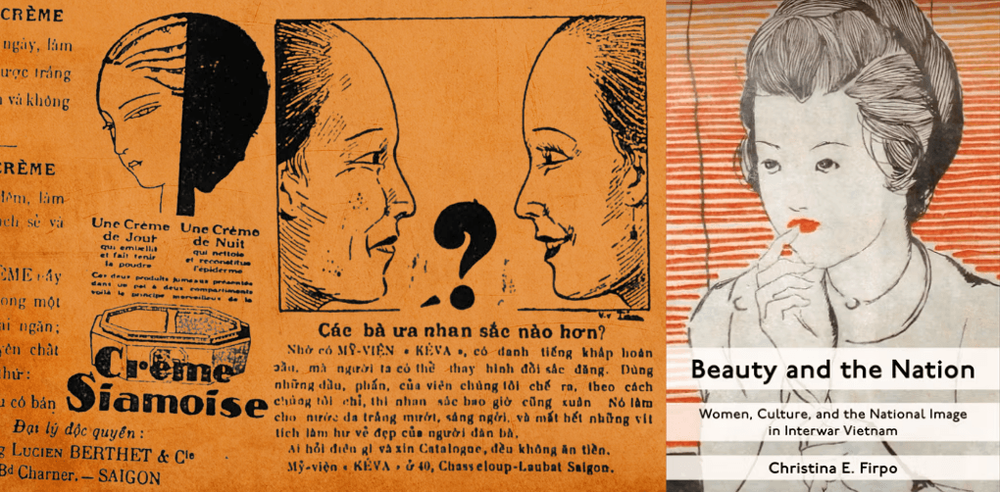
Published by Columbia University Press in 2026, Christina E. Firpo’s Beauty and the Nation: Women, Culture, and the National Image in Interwar Vietnam examines the transformation of Vietnamese beauty culture during the interwar years.
Essentially, the book argues that beauty culture during the interwar period was not simply a story of Western influence replacing Vietnamese tradition. Instead, it was shaped by the interaction of three major forces: Europeanization (Âu hóa), Vietnamese modernism, and Neo-Confucian revivalism. Through debates over clothing, cosmetics, hairstyles, physical appearance, and beauty contests, Vietnamese society struggled to define what it meant to become modern while maintaining a distinct national identity. Dr. Firpo’s major contribution lies in demonstrating that beauty was not outside politics; rather, everyday practices of appearance became a form of cultural negotiation through which Vietnamese people imagined themselves and their nation in a rapidly changing colonial world.
1. Beauty, Gender, and the Making of the Modern Nation
The book begins with the figure of “Anna Phiếm,” a satirical representation of the modern Westernized Vietnamese woman appearing in the 1938 newspaper Vịt Đực. The character embodies the anxieties surrounding a new feminine identity: she has white teeth, wears makeup, dresses in fashionable áo dài, uses high heels, carries a purse, and rides a bicycle. To critics, such characteristics represented excessive Western influence and moral decline. Yet the satire also reveals a contradiction: many people who criticized these trends eventually adopted similar fashions themselves.
Before the interwar period, the ideal Vietnamese woman was associated with Confucian concepts such as tam tòng (Three Dependencies) and tứ đức (Four Virtues). Women were expected to prioritize obedience, domestic responsibility, modesty, and moral virtue. The idealized khuê các woman represented female seclusion and respectability. However, after World War I, a new generation of women increasingly challenged these expectations. They attended schools, entered professions, traveled through cities, participated in sports, watched films, and entered public spaces.
The emergence of new beauty practices was therefore connected to a broader transformation of women’s social roles. Fashion and cosmetics represented not only changing tastes but also changing possibilities for female identity.
2. Colonial Encounters and the Origins of New Beauty Ideals
A major strength of Beauty and the Nation is Dr. Firpo’s argument that new beauty practices emerged through complex colonial encounters rather than through simple imitation of French culture. Europeanized beauty ideals developed through networks of military occupation, migration, education, consumer culture, and media circulation.
Dr. Firpo traces some of these transformations back to colonial Cochinchina. Although the French colonial population remained relatively small, French political and administrative reforms significantly reshaped urban Vietnamese culture. At the same time, French and Foreign Legion troops were stationed throughout rural areas, bringing European cultural practices into contact with local communities. One important example is the emergence of me tây, Vietnamese women who entered romantic or sexual relationships with European soldiers. In the late nineteenth century, these women became associated with new beauty practices, including white teeth and unbound breasts, reflecting the preferences of their European partners. At the time, such practices were viewed as violations of Vietnamese social and gender norms, and me tây were often stigmatized as symbols of foreign influence and moral disorder. Yet Dr. Firpo highlights an important historical transformation: practices that initially appeared shocking later became incorporated into mainstream Vietnamese beauty culture.
The circulation of beauty ideals also extended beyond urban centers. Rural women encountered new trends through newspapers, traveling cinemas, state-organized fairs, and migration networks. Newspapers brought images of beauty queens, cosmetic instructions, and fashionable clothing patterns into provincial areas. Traveling cinemas introduced rural audiences to glamorous actresses and new forms of femininity, while fairs provided opportunities to encounter consumer goods and beauty contests. The boundary between rural and urban culture became increasingly blurred as people moved between regions for employment, education, and leisure.
3. Vietnamese Modernism: Fashion as Political Expression
Although Europeanization introduced new styles into Vietnam, Dr. Firpo emphasizes that Vietnamese modernists transformed these foreign influences into symbols of national renewal. Appearance itself became a political language through which reformers expressed their vision of a modern Vietnam.
At the beginning of the twentieth century, Vietnamese modernists adopted short hair and the three-piece Western suit as markers of modernization. The case of Phan Châu Trinh illustrates this transformation. After participating in the Duy Tân movement in Japan, Phan Châu Trinh returned to Vietnam in 1906 wearing a short haircut. His appearance shocked fellow reformer Phan Khôi because cutting one’s hair challenged Confucian ideas that hair was part of the body inherited from one’s parents and should not be altered. However, Phan Châu Trinh’s haircut represented a deliberate rejection of outdated traditions and an embrace of reform. Within a short time, other members of the Duy Tân movement followed his example.
Similarly, the three-piece suit became associated with Vietnamese modernity. Although introduced by French colonizers, the style was popularized by Vietnamese reformers who used it to demonstrate their participation in global civilization. Phan Châu Trinh himself wore Western suits in public while continuing to wear traditional Vietnamese clothing on official and religious occasions, illustrating the selective and negotiated nature of Vietnamese modernization. By adopting aspects of colonial appearance, Vietnamese modernists blurred the distinction between the supposedly “civilized” colonizer and the supposedly “uncivilized” colonized.
4. Individualism, Education, and the New Vietnamese Self
The transformation of beauty culture was closely connected to the emergence of individualism during the colonial period, developed through colonial education and migration.
By World War I, the Franco-Annamite educational system, with its French curriculum and teaching of quốc ngữ, introduced students to ideas about individualism and equality while weakening the influence of traditional Confucian education. A significant consequence was the changing relationship between individuals and family structures. Under earlier social systems, education and income were closely tied to family and village networks. Colonial graduates, however, entered professions where salaries belonged directly to individuals. Even language reflected this transformation: older generations used ta, which carried both collective and individual meanings, while younger generations increasingly used tôi, emphasizing an individual sense of self.
Literary movements such as Thơ Mới (New Poetry) and the Self-Reliant Literary Group (Tự Lực văn đoàn) further promoted themes of individuality, emotional expression, and personal freedom. Concepts such as cá nhân (the individual) and vóc dáng (physical stature) became increasingly important, including in discussions of women’s beauty. Beauty practices therefore reflected a broader cultural transformation: the emergence of the individual body as a site of identity and self-expression.
The spread of Europeanized lifestyles was also shaped by transnational movement. Vietnamese students who studied in France and approximately one hundred thousand Vietnamese tirailleurs who participated in World War I returned home with new experiences of European culture. They brought back tastes for French food, wine, fashion, and perfume, contributing to changing expectations of modern lifestyles in Vietnam.
The return of Emperor Bảo Đại to Vietnam in 1932 represented the height of this Europeanized image. With his slicked-back “tango” hairstyle, tailored Western suit, and Oxford shoes, Bảo Đại embodied the values associated with Europeanization: materialism, individualism, and romantic marriage. His appearance shocked many observers because it symbolized not only personal fashion choices but also a broader transformation of Vietnamese social values.
5. Reading Beauty as History
One of the most important contributions of Beauty and the Nation is methodological. Dr. Firpo challenges historians to take seriously sources traditionally considered marginal: advertisements, fashion columns, beauty manuals, photographs, newspapers, and public debates. These materials reveal experiences often absent from conventional political histories.
By studying beauty culture, Dr. Firpo reconstructs how Vietnamese women and men understood social change. Newspapers reveal debates over morality and modernity; advertisements demonstrate the growth of consumer culture; beauty manuals show how women learned new practices; and public controversies reveal competing visions of national identity.
This approach expands Vietnamese history beyond political movements and elite intellectual debates. It demonstrates that everyday practices—choosing a hairstyle, applying lipstick, wearing new clothing—could become meaningful forms of participation in society.
6. Whose Beauty? Representing Vietnamese Women or the Urban Middle Class?
The greatest strength of Beauty and the Nation is its originality. By examining beauty culture, Dr. Firpo opens a new perspective on colonial Vietnamese history and demonstrates how gender, consumer culture, nationalism, and colonialism intersected in everyday life.
The book is also valuable because it highlights women’s agency. Vietnamese women were not simply victims of colonial influence or conservative traditions. They actively engaged with new possibilities, using appearance to negotiate changing social identities.
However, the focus on beauty culture also raises questions. Since many sources come from newspapers and urban middle-class discussions, one might ask how fully these materials represent poorer rural women’s experiences. Dr. Firpo acknowledges that beauty trends crossed class and regional boundaries, but further attention to how different groups of women interpreted and adapted these changes would enrich the discussion.
Read about the publication on Columbia University Press's website.