Cham Living Archives and the Long Nineteenth Century
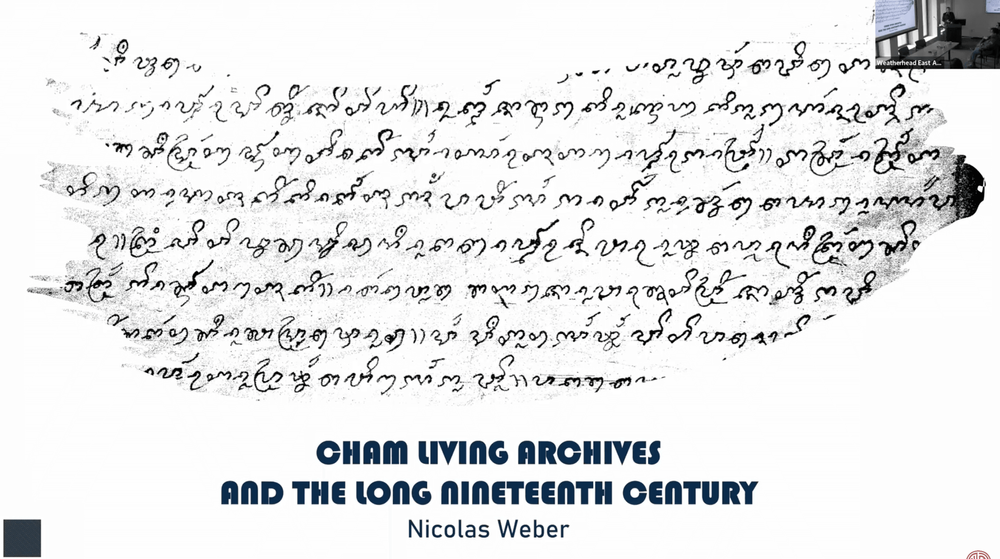
On December 5, 2025, Professor Nicolas Weber presented a talk on a nineteenth-century Cham verse narrative, The Rhyme of Looking Forward, one of fifteen texts in his book project Forbidden Voices, Silenced Memory: The Making of a Cham Century. The project restores Cham perspectives and memory to the making of modern Southeast Asia by centering voices long excluded from state-centered histories.
Hosted by the Weatherhead East Asian Institute and co-sponsored by NYSEAN, the event was moderated by John Phan, Associate Professor of East Asian Languages and Cultures at Columbia University.
History Carried by Voice
Rather than turning to imperial or colonial archives, Professor Weber focused on Cham verse narratives—texts composed in modern Cham and meant to be chanted or sung. These narratives circulated through memory, performance, and copying, surviving not through institutions but through communities. Weber described them as “living archives”: sources that preserve emotional truth, moral reasoning, and lived experience where official records fall silent.
Collapse and Memory
The Cham are an Austronesian people and heirs to the former kingdom of Champa, which once spanned much of today’s central Vietnam. By the early nineteenth century, Champa had been reduced to its southern principality, Panduranga, which retained limited autonomy until its annexation by the Nguyễn dynasty in 1832 under Emperor Minh Mạng. The annexation brought violent repression, land reorganization, forced labor, and the dismantling of Cham political and ritual life.
It was in this context that The Rhyme of Looking Forward was composed. Rather than narrating events directly, the poem renders annexation as the collapse of an entire moral world. Images of thunder, fire, and trembling earth depict conquest as cosmic catastrophe, while scenes of broken kinship and ritual humiliation convey how violence entered everyday life. Through dense and unsettling metaphors, the poem records how meaning itself became unstable.
A Living Text
More than a century later, in 1968, Cham intellectuals republished The Rhyme of Looking Forward during the Vietnam War, pairing it with a moral teachings text. As Weber explained, this return was not nostalgic. It transformed memory into a guide for endurance during another moment of upheaval marked by war, religious conflict, and assimilation pressures. The poem’s survival across centuries demonstrates how Cham communities repeatedly turned to verse to make sense of rupture and reaffirm ethical foundations.
Why It Matters
Professor Weber concluded by arguing that Cham verse narratives are not supplementary sources but corrective histories. They restore marginalized voices, challenge state-centered accounts of the past, and remind us that history is not only written in archives, but also sung, remembered, and carried forward through community life.