Chasing Traces: A Groundbreaking Exploration of History and Ethnography in the Uplands of Socialist Asia
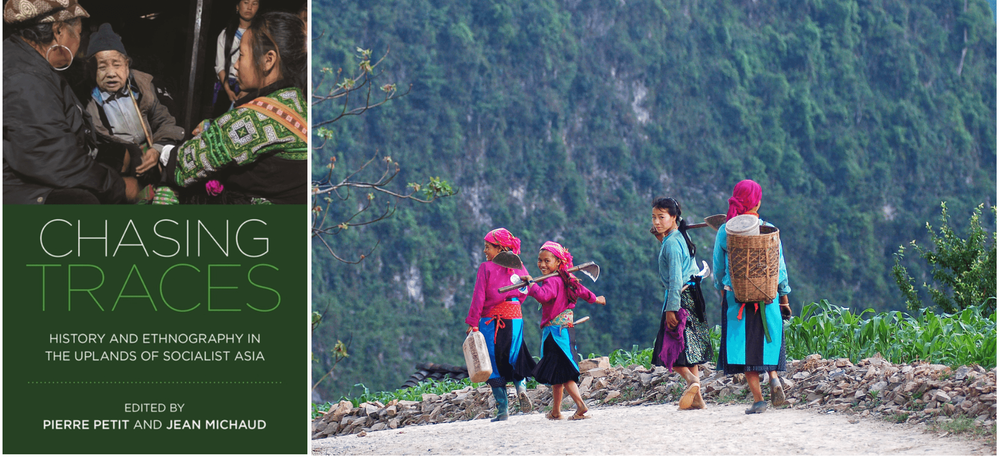
In the mountainous borderlands where Vietnam, Laos, and southwest China converge, tracing the past is never a straightforward endeavor. Here, memory is entangled in layers of political sensitivity, cultural silence, and the afterlives of revolution. In these regions, local communities may avoid recounting history altogether—out of caution, trauma, or resistance—while official narratives and heritagization efforts shape and sometimes obscure the ways the past is expressed.
Chasing Traces: History and Ethnography in the Uplands of Socialist Asia is the first volume to grapple head-on with these tensions, offering a rare and timely contribution to the study of memory, history, and ethnographic research in this complex region. Drawing on the reflections of a dozen scholars with decades of experience in the highlands of Vietnam, Laos, and China, the book poses urgent questions: How do researchers access local knowledge about the past in politically sensitive contexts? How is history performed in rituals, speech, and silences? What methodological and ethical challenges arise when working with oral traditions, fragile archives, and contested memories?
The chapters in Chasing Traces do not claim to present a seamless historical account. Instead, they document the messy, often uncertain process of research in places where history is lived and remembered in ways that resist both national frameworks and Western academic categories. With deep attention to context, the contributors reflect on archival silences, local storytelling, collaboration with community members, and the impact of surveillance and state narratives on their fieldwork.
Crucially, the book makes a case for a critically reflexive approach to historical ethnography—one that values the backstage, the partial, the whispered. It speaks to scholars across disciplines who are navigating the blurred lines between anthropology and history, and it offers a practical and theoretical guide for doing research in constrained environments, whether due to political instability, violence, or global disruptions like the COVID-19 pandemic.
By centering the experiences of both researchers and communities, Chasing Traces challenges dominant assumptions about what counts as history and how it can be written. It is essential reading for anyone interested in Southeast Asia, minority studies, oral history, and the ethics of knowledge production in post-revolutionary and postcolonial settings.
Thanks to the University of Hawai‘i Press, Chasing Traces is available as an open access resource. Readers can access the full book for free at: https://manifold.uhpress.hawaii.edu/projects/chasing-traces.