Quốc Ngữ Script and Hán-NômScript: Revisiting a Cultural Debate
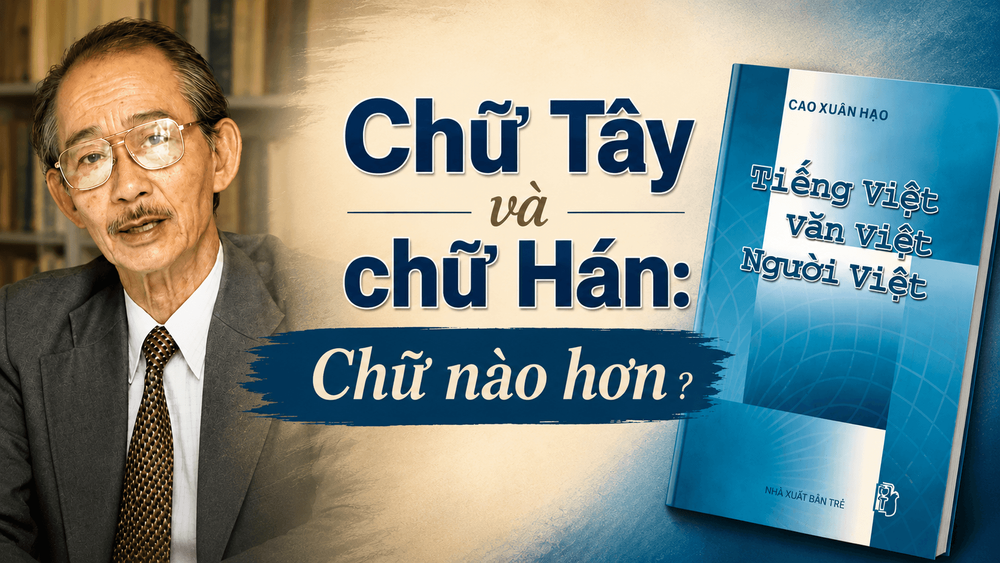
In modern Vietnamese history, the transition from Chinese characters (chữ Hán) and Chữ Nôm to the Quốc Ngữ script is often regarded as an inevitable turning point in the country’s modernization process. With its relatively simple and accessible Latin-based alphabet, Quốc Ngữ contributed significantly to the expansion of literacy, the development of journalism and education, and the emergence of modern public life in Vietnam. Yet in his essay “Chữ Tây và chữ Hán, chữ nào hơn” (“Western Script and Chinese Characters: Which Is Superior?”), Professor Cao Xuân Hạo raised a provocative question: have we been too quick to assume that Western phonetic writing systems are inherently “superior” to Chinese characters?
According to Cao Xuân Hạo, the belief that phonetic scripts represent the “most scientific” form of writing originated from a nineteenth-century misconception, when European scholars assumed that the sole function of writing was to record speech sounds. He points out that, beginning with the work of the Prague School of Linguistics in the 1930s, linguists increasingly recognized that writing is not merely a phonetic transcription system, but also a tool for organizing and recognizing meaning. Therefore, the value of a writing system cannot be judged solely by how accurately it represents pronunciation.
One of Cao Xuân Hạo’s most striking arguments concerns the visual recognizability of Chinese characters. In his view, each Chinese character functions as a “Gestalt”, a complete visual whole, enabling readers to grasp meaning almost instantaneously. By contrast, Quốc Ngữ requires readers to process letters sequentially in order to construct words and meaning. He compares characters such as 山 (mountain), 水 (water), and 永 (eternal) with their alphabetic spellings, arguing that Chinese characters facilitate a more immediate and direct form of visual recognition.
Cao Xuân Hạo also draws upon Western studies on dyslexia and alexia to suggest that some researchers questioned whether reading difficulties stem entirely from children themselves, or partly from the linear structure of the Latin alphabet. He refers to experiments conducted in the United States during the 1970s showing that certain children labeled “disabled” when learning through alphabetic systems were nevertheless able to read Chinese characters relatively well. From this, he suggests that reading Chinese characters may activate perceptual mechanisms different from those involved in Western phonetic scripts.
However, Cao Xuân Hạo’s essay should not be interpreted as a call to abandon Quốc Ngữ and return to Chinese characters. Rather, what he critiques is the tendency to absolutize Quốc Ngữ as the sole symbol of civilization and progress. He asks: if Quốc Ngữ were truly a necessary condition for modernization, how could Japan, Korea, and China continue to develop so successfully while still maintaining Chinese characters or writing systems deeply shaped by them?
He pays particular attention to Japan. Japanese is a multisyllabic language with a highly complex grammatical structure, yet the Japanese continue to use Kanji alongside Kana. According to Cao Xuân Hạo, the Japanese experience demonstrates that Chinese characters are neither “backward” nor incompatible with modern society. On the contrary, combining ideographic and phonetic writing systems may, in some cases, produce greater cognitive efficiency.
From a linguistic perspective, he further argues that Western phonological theories, developed primarily based on European languages, are not fully suited to isolating languages such as Vietnamese and Chinese. Consequently, imposing the Latin alphabet as a universal standard reflects a form of Eurocentrism in linguistic thought.
Nevertheless, Cao Xuân Hạo also acknowledges the historical importance of Quốc Ngữ in modern Vietnam. It was precisely because of the relative compatibility between the monosyllabic structure of Vietnamese and the Latin-based phonetic script that Quốc Ngữ spread rapidly, helping to expand education and disseminate knowledge throughout the twentieth century. Yet he warns that this success should not lead to a complete dismissal of the Hán-Nôm heritage.
In his view, modern Vietnamese society risks losing a deeper understanding of Sino-Vietnamese vocabulary, which constitutes a substantial portion of the Vietnamese lexicon, if it becomes entirely disconnected from Chinese characters. He writes that just as French speakers cannot fully understand French without some knowledge of Latin, Vietnamese speakers may struggle to fully grasp their own language if they remain completely unfamiliar with Chinese characters, which were historically used to write the majority of Sino-Vietnamese vocabulary for centuries.
For this reason, he proposes that the study of Chinese characters should be reintroduced into secondary education, not to replace Quốc Ngữ, but to help Vietnamese people better understand their own language, history, and culture. For Cao Xuân Hạo, the study of Hán-Nôm is not merely about preserving an ancient heritage; it is also a means of maintaining cultural connections among East Asian societies that once shared a common civilizational sphere.
Thirty years after the publication of his essay, in an era when digital technology and artificial intelligence are opening new possibilities for the digitization, study, and accessibility of Hán-Nôm materials, many of Cao Xuân Hạo’s reflections appear newly relevant. Perhaps the question is not which script is “superior,” but rather how each writing system carries within it a distinct intellectual history, mode of thought, and cultural memory. Quốc Ngữ helped Vietnam enter modernity; yet Chinese characters and Chữ Nôm remain vital gateways to understanding the deeper layers of the nation’s past.
Read Professor Cao Xuân Hạo’s book on the Digitizing Vietnam platform.