Rethinking the Classical in Vietnam and the Diaspora
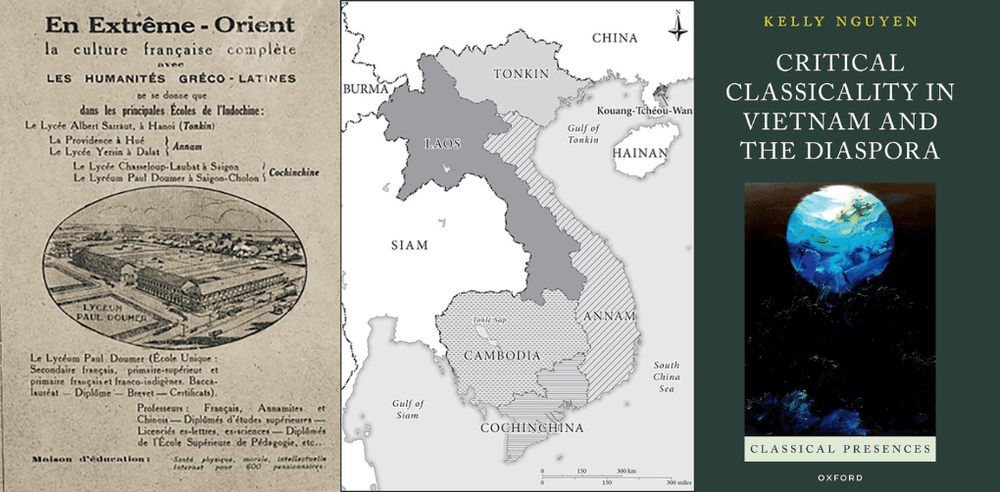
Published by Oxford University Press on 4 August 2026, Kelly Nguyen’s Critical Classicality in Vietnam and the Diaspora begins with a mistranslation that ends in death. During the early years of French colonial rule, a Vietnamese interpreter facing execution attempts to save himself by announcing in Latin, “Ego sum Petrus, interpretus”—“I am Petrus, the interpreter.” The French sailor charged with carrying out the executions does not understand him and hangs him anyway. Nguyen lingers over the irony. French colonial observers subsequently treated the episode as evidence of Vietnamese linguistic inadequacy, even though it was the French sailor who could not understand Latin and even though the Latin reproduced by the French source itself contains an error. For Nguyen, the episode exposes something larger than linguistic misunderstanding: an imperial order in which colonized subjects could acquire the languages and intellectual traditions of Europe and nevertheless remain illegible as legitimate intellectual actors.
This opening encapsulates the central concern of Critical Classicality: not simply how Vietnamese writers encountered Greece and Rome, but how the authority to determine what counts as “classical” has historically been distributed. Nguyen’s intervention is therefore considerably more ambitious than recovering a neglected archive of Vietnamese classical reception. She asks what becomes visible about Classics itself when Vietnam and the Vietnamese diaspora cease to occupy the margins of its intellectual geography.
The result, at least as articulated in the book’s introduction, is a provocative attempt to reposition Vietnam within several overlapping conversations: classical reception, colonial and postcolonial studies, Vietnamese intellectual history, refugee studies, and debates over the decolonization of the humanities. Its strongest proposition is also its simplest: Vietnamese engagement with Greco-Roman antiquity should not be understood merely as evidence of the global diffusion of a supposedly universal classical tradition. Rather, Vietnam provides a particularly revealing site from which to investigate how “classicality” itself is produced, policed, appropriated, and transformed.
From classical reception to classicality
Nguyen distinguishes her project from conventional classical reception through the concept that gives the book its title: critical classicality. Drawing especially on James Porter, Dan-el Padilla Peralta, Emily Greenwood, Sasha-Mae Eccleston, Aníbal Quijano, and Walter Mignolo, she treats “the classical” not as an inherent property possessed by particular texts or civilizations but as the outcome of processes of selection and valuation. Classicality is therefore less a stable quality than a mechanism through which certain pasts acquire authority over others.
One of Nguyen’s more memorable formulations adapts Padilla Peralta’s “machinery of classicism.” If classicism is a machine and classicization the process through which its products are manufactured, Nguyen proposes that classicality is the fuel. The metaphor matters because fuel both powers and transforms: classicality can energize imperial, nationalist, emancipatory, or oppositional projects, while producing ideological “byproducts” along the way.
This formulation enables Nguyen to shift the question from What is a classic? toward more politically and historically situated questions: Who makes something classical? Under what conditions? For whom? And toward what ends?
Vietnam makes these questions particularly productive because the arrival of European classical education did not occur on an empty intellectual terrain. French colonialism confronted an existing landscape of Confucian, Buddhist, Sino-Vietnamese, and Catholic textual traditions. The colonial encounter consequently involved not merely the imposition of one canon upon another but a struggle over competing forms of classical authority.
Nguyen is particularly perceptive when she connects this struggle to what she calls the classicization/colonization of time and space. Drawing upon Mignolo and critical studies of temporality, she argues that European modernity constructed Greco-Roman antiquity as simultaneously ancient and perpetually renewable: Greece and Rome belonged to the past but remained capable of generating the future. Colonized traditions, by contrast, were frequently rendered merely old. They belonged to a past from which modern subjects were expected to escape.
This asymmetry is essential to Nguyen’s argument. The problem was not simply that French colonial education privileged Greek and Latin over literary Sinitic. It assigned the traditions different temporal properties. Greco-Roman antiquity could travel, renew itself, and remain “universal”; Sino-Vietnamese learning could be represented as static, local, and obsolete. Classicality therefore operated as a technology for determining whose past could become somebody else’s future.
The colonial advertisement reproduced in the introduction of the book makes this hierarchy unusually tangible. It proudly announces the availability in Indochina of a “complete French education” accompanied by the “Greco-Latin humanities.” The accompanying map, meanwhile, locates that educational project within the territorial organization of French Indochina. Read together, these images reinforce Nguyen’s argument that classicality was never simply textual: curricula, institutions, racial classifications, and imperial geography worked together in determining access to cultural authority.
Vietnam as argument, not addition
Perhaps the book’s most consequential methodological claim is that Vietnamese materials should not simply be added to an already constituted field of Classics.
Nguyen is acutely aware of the limitations of additive inclusion. Expanding a canon by placing Chinese or Vietnamese “classics” alongside Greek and Roman ones may appear pluralistic while leaving intact the conceptual machinery that determined what counts as classical in the first place. Indeed, she warns that projects of “global classics” can reproduce civilizational equivalences—East versus West, Confucius versus Plato—that flatten the very historical differences they claim to recognize.
This is where the adjective critical performs substantial work. Nguyen derives it from the Greek krinein: to separate, judge, or decide. Critical classicality consequently does not seek to establish a larger, more inclusive list of classics. It asks us to examine acts of valuation themselves and, crucially, to reclaim the possibility of choosing how one engages with inherited traditions.
That emphasis on choice becomes especially important because Nguyen refuses an uncomplicated decolonial narrative in which Vietnamese intellectuals simply resist European classicality. The figures described in the first two chapters instead demonstrate how colonial epistemologies could structure the very languages available for anticolonial resistance.
Phạm Quỳnh, for example, defended Sino-Vietnamese intellectual traditions partly by comparing them with Greco-Roman civilization. Such comparison challenged French assertions of Vietnamese inferiority, but Nguyen argues that it simultaneously accepted Greco-Roman antiquity as the measure against which Vietnamese civilization needed to demonstrate its worth. Nguyễn Mạnh Tường similarly embraced Greco-Roman antiquity as a universal intellectual inheritance capable of bridging East and West. His universalism contested racial exclusion while potentially reproducing the cultural hierarchy through which European knowledge had become universal in the first place.
Nguyen calls such figures “conscripts of Antiquity,” adapting David Scott’s “conscript of modernity.” The phrase is productive because it avoids two temptations common to retrospective intellectual history: celebrating colonial intellectuals as uncomplicated resistance figures or condemning them for failing to possess the theoretical vocabulary of later generations. Instead, Nguyen asks what intellectual possibilities were available within colonial structures that had already established the terms through which civilization, progress, and universality could be articulated.
From colonial comparison to diasporic transformation
The book’s architecture, as Nguyen describes it, gradually moves from colonial engagements with classicality toward increasingly relational and diasporic ones.
Chapter 3 juxtaposes Nguyễn Phan Long’s Le Roman de Mademoiselle Lys (1921) with Lý Thu Hồ’s Printemps Inachevé (1962), bringing the latter into conversation with both Nguyễn Du’s Tale of Kiều and Homer’s Odyssey. Rather than requiring direct lines of influence, Nguyen draws on the idea of “frail” or “fuzzy connections.” This methodological choice is significant. It replaces genealogy—the search for who inherited what from whom—with relational reading, allowing texts from different traditions to illuminate shared structures without collapsing their differences.
The move becomes still more pronounced in the chapters on Vietnamese diasporic literature. Nguyen develops “refugee classicism” through Linda Lê and Ocean Vuong, arguing that refugee writers can engage Greco-Roman materials without submitting themselves to the genealogical fantasy of inheriting “Western civilization.” Classical texts instead enter what she describes as a “refugee repertoire”: mobile cultural materials that can be appropriated, refused, queered, or transformed.
The final chapter turns to Viet Thanh Nguyen’s The Sympathizer and The Committed, reading their engagements with the Odyssey through Ralph Ellison and Toni Morrison. The trajectory from Phạm Quỳnh to Viet Thanh Nguyen is therefore not simply chronological. It traces changing possibilities for engagement with classicality—from attempts to claim equality within colonial standards toward practices that destabilize the standards themselves.
This is one of the introduction’s most compelling propositions. The political potential of classical reception resides not necessarily in possessing the classics but in refusing predetermined relations to them.
A particularly Vietnamese intervention?
Another question follows from the book’s impressive theoretical breadth. The introduction moves among classical reception, decolonial theory, critical race studies, refugee studies, feminist criticism, queer theory, and Vietnamese diasporic studies. That interdisciplinary range is one of the project's strengths. But it also raises the question of what happens when Vietnam becomes not simply a site for testing theories generated elsewhere, but a source of theoretical vocabulary in its own right.
There are tantalizing moments when the introduction begins to do exactly this. Most striking is Nguyen's meditation on vượt biên. Literally “crossing the border,” the expression becomes something far more complicated in Vietnamese refugee experience: one crosses and yet may never fully arrive. Nguyen connects this condition to belonging, border thinking, and diasporic “cleaving”—simultaneously separating from and adhering to a homeland.
Here the book seems capable of making an intervention beyond classical reception altogether. Vượt biên can describe not only refugee movement but perhaps the movement of texts, concepts, and classicality itself: crossing borders while carrying traces of the structures from which one has departed. The underwater imagery of Ann Phong's Looking Up from the Bottom of Life, discussed at the end of the introduction and used for the book's cover, reinforces this possibility. Nguyen interprets the ocean not merely as a passage between departure and arrival but as an unstable space in which conventional distinctions between center and periphery, surface and depth, become difficult to sustain.
These moments are especially generative because they suggest a reversal of the conventional direction of theory. Instead of applying European or North American theoretical categories to Vietnamese materials, Vietnamese historical and diasporic experience begins to produce concepts through which classicality itself can be reconsidered.
Critical Classicality: A Genealogy of Intellectual Gatekeeping
Critical Classicality in Vietnam and the Diaspora makes a substantial claim for the importance of Vietnamese intellectual and literary history to debates that have too often treated Vietnam as peripheral. Nguyen's point is not that Vietnamese writers also read Homer, Aeschylus, or other Greco-Roman authors and therefore deserve representation within the increasingly global field of classical reception. It is that their engagements expose problems within the category of the classical itself.
The distinction matters. Inclusion would leave the architecture of the discipline substantially unchanged: one would simply add Vietnam to an expanding map of classical reception. Nguyen instead proposes that moving Vietnam and the Vietnamese diaspora from the margin toward the analytical center changes the questions we ask about that map—about who drew it, why Greece and Rome acquired their peculiar mobility within it, why some traditions are imagined as universal while others remain geographically bounded, and who is permitted to cross those boundaries.
The haunting interpreter with whom Nguyen begins therefore turns out to be more than an anecdotal illustration of colonial violence. He embodies the contradiction around which the book revolves. He possessed the supposedly universal language but remained outside the community authorized to claim it. Phạm Duy Khiêm later mastered precisely the Greco-Latin education through which French civilization defined its intellectual prestige and nevertheless confronted the question, in effect, of how someone could be both Vietnamese and a legitimate inhabitant of that tradition. Nguyen then places her own experience within this longer genealogy of intellectual gatekeeping. Across these episodes, knowledge alone does not produce belonging.
The larger contribution of Critical Classicality, therefore, may be its insistence that the most important question is not whether Greece and Rome “belong” to Vietnam, nor whether Vietnamese people can claim a place within Classics. Those formulations already concede too much authority to inherited disciplinary borders. The more consequential question is what happens to our understanding of the classical once Vietnamese intellectuals, refugees, women, and diasporic writers are treated not as peripheral recipients of an inherited tradition but as agents capable of deciding what to preserve, refuse, appropriate, transform, and set into relation.
In this sense, Nguyen's book is less an argument for expanding the classical canon than an invitation to reconsider the intellectual machinery that produces canons at all. Its most productive tensions—the elasticity of classicality, the difficulty of decolonizing a conceptual vocabulary inherited from European intellectual history, and the unstable meanings of liberation—do not necessarily weaken that intervention. They identify precisely the terrain on which the book asks its readers to think. And that may ultimately be the significance of approaching classicality from Vietnam: not simply to discover another history of the classical, but to make the classical itself strange enough to become visible again.
Read the Introduction of Critical Classicality in Vietnam and the Diaspora here.