Two Autumns of The Vietnamese Language: In Memory of Cao Xuân Hạo and Nguyễn Quang Hồng
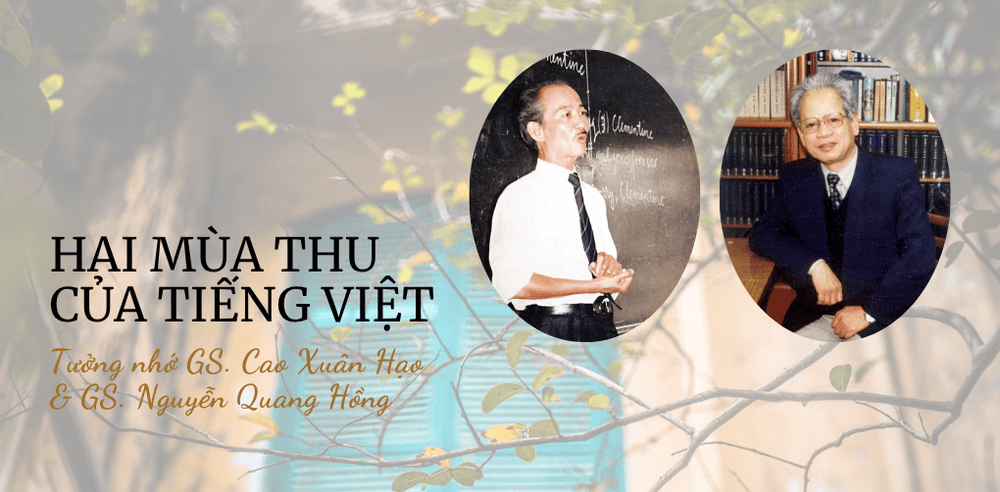
On an autumn day, October 7, 2025, linguist Prof. Dr. Sci. Nguyễn Quang Hồng passed away, leaving in the hearts of Vietnamese scholars an irreparable sense of loss. Eighteen years earlier, also on these autumn days, October 16, 2007, the renowned linguist Prof. Cao Xuân Hạo also departed this world, mourned deeply by his friends, students, and colleagues. Two towering figures of Vietnamese humanities—Cao Xuân Hạo and Nguyễn Quang Hồng—thus both chose the autumn days of humankind to close their earthly journeys. In a quiet and fateful way, autumn has become the season of farewell for two of the greatest minds in modern Vietnamese linguistics. To honor them, this article revisits the essay that Nguyễn Quang Hồng wrote in October 2007, when he reflected on his colleague and elder brother in scholarship, Professor Cao Xuân Hạo.
In that piece, Nguyễn Quang Hồng recalled learning of Cao Xuân Hạo’s passing through a phone call from a young colleague. Though aware of his mentor’s declining health, he was overcome with grief at the realization that he would never again share a conversation with Cao Xuân Hạo. His memory drifted back to 1965, when, fresh from his studies at Peking University, he first met the already accomplished Cao Xuân Hạo. The elder linguist devoted an entire autumn afternoon to explaining his theory of the Vietnamese syllable to the young scholar - a meeting that, as Nguyễn Quang Hồng recalled, revealed that Cao Xuân Hạo was seeking an entirely new way to understand Vietnamese from within its own nature.
According to Cao Xuân Hạo, the Vietnamese syllable is an indivisible whole—a unified phonetic, semantic, and functional unit—and cannot be mechanically divided into “initial, medial, nucleus, and final” parts, as in European phonological models. He called this perspective the theory of non-segmentality, presented most fully in his 1985 work Phonologie et Linéarité (Phonology and Linearity). The book earned high praise from international scholars; several French linguists observed that if speakers of monosyllabic languages such as Vietnamese had developed modern phonology, they would have chosen the syllable—not the phoneme—as its fundamental unit. From Vietnam, Cao Xuân Hạo raised an independent, decolonizing voice that challenged Eurocentric norms in global linguistics.
Beyond phonology, Cao Xuân Hạo ventured into Vietnamese grammar. Rejecting the traditional European “Subject–Predicate” framework, he proposed a “Topic–Comment” structure that better captures the logic of Vietnamese sentences, where the first part introduces the topic and the latter elaborates on it. His book Vietnamese: A Functional Grammar Outline (1991) became a turning point, helping generations of linguists and teachers see Vietnamese not as a distorted version of Western syntax but as a coherent linguistic system in its own right.
In Nguyễn Quang Hồng’s recollection, Cao Xuân Hạo was not only a rigorous theoretician but also a profoundly humanistic intellectual. His knowledge extended far beyond linguistics: fluent in Russian—so well that even native speakers admired him—he also mastered French, English, and Latin, was deeply versed in Chinese linguistics and writing, and translated Russian and French literature into Vietnamese, both precise and lyrical. His essays on language and culture, later collected in Tiếng Việt – Văn Việt – Người Việt (The Vietnamese Language, Literature, and People), brought linguistic thought closer to the general public, showing Vietnamese not merely as a tool of communication but as a cultural heritage worthy of care and pride.
Concluding his 2007 tribute, Nguyễn Quang Hồng wrote that Cao Xuân Hạo passed away peacefully, leaving behind an invaluable legacy for the Vietnamese language. This autumn, as Nguyễn Quang Hồng himself has also left this world, those words echo anew—like a double elegy for two scholars who devoted their lives to affirming the dignity and integrity of Vietnamese: a language that needs no borrowed mirror to be seen, for it is already complete and free in its own being.
Read Hoài niệm về Anh Cao Xuân Hạo by Nguyễn Quang Hồng:
https://ngonngu.net/nqhong_hoainiemvecaoxuanhao/354
Read Tiếng Việt – Văn Việt – Người Việt by Cao Xuân Hạo on Digitizing Việt Nam platform:
https://www.digitizingvietnam.com/en/our-collections/tinh-hoa-van-hoc-va-ngon-ngu-viet-nam/tieng-viet-van-viet-nguoi-viet