Shipwrecked in Vietnam: Cai Tinglan’s Remarkable Journey through the Nguyễn Dynasty
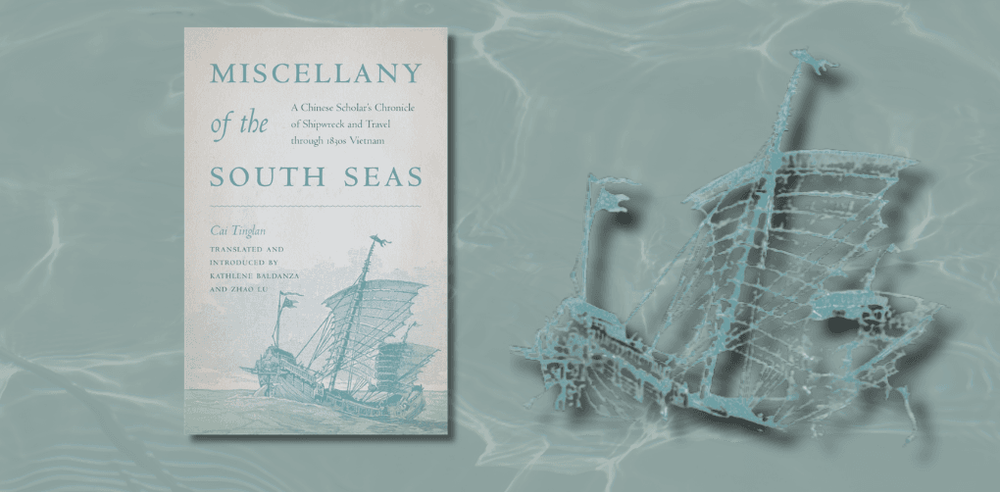
Published by the University of Washington Press in 2023, Miscellany of the South Seas: A Chinese Scholar’s Chronicle of Shipwreck and Travel through 1830s Vietnam brings into English for the first time the extraordinary travel account of Cai Tinglan (蔡廷蘭, 1801–1859), a scholar from the Penghu Islands in the Taiwan Strait. Translated and introduced by historians Kathlene Baldanza and Zhao Lu, the book combines Cai’s original nineteenth-century narrative with a substantial scholarly introduction, extensive annotations, maps, a glossary, bibliography, and notes that situate his journey within the social, political, economic, and maritime worlds of Nguyễn Vietnam.
The volume was published in hardcover, paperback, and ebook formats, and its digital edition has been made openly available through the University of Washington Press’s Manifold platform. The open-access publication was supported by Pennsylvania State University’s Departments of History and Asian Studies and its University Libraries, with additional support from the Chiang Ching-kuo Foundation for International Scholarly Exchange and the Charles and Jane Keyes Endowment for Books on Southeast Asia. The digital edition may be downloaded and shared under a Creative Commons Attribution-NonCommercial-NoDerivatives 4.0 license, subject to the publisher’s terms for separately copyrighted material.
The story at the heart of the book, however, began almost two centuries earlier.
In November 1835, Cai Tinglan boarded a vessel for what should have been a relatively ordinary journey across the Taiwan Strait. He was returning from Fujian to his home in the Penghu Islands after once again sitting for the highly competitive Qing civil service examinations.
He did not make it home.
Caught in a typhoon, Cai and his fellow travelers were driven far off course. For more than a week their vessel drifted through dangerous waters before eventually reaching the coast of central Vietnam. What began as a maritime disaster would become an extraordinary journey through the Nguyễn empire—and, eventually, a remarkable record of Vietnamese life in the 1830s.
Cai recorded these experiences in Hainan zazhu (海南雜著), first published in 1837. The work offers an unusual eyewitness account of early Nguyễn Vietnam, written not by a European missionary, diplomat, or colonial observer, but by a Chinese scholar who arrived by accident and traveled through the country under Nguyễn protection.
An Accidental Journey through Vietnam
Cai Tinglan was not an explorer setting out to document Vietnam. Nor was he a diplomat sent there on official business. His encounter with the country happened entirely by accident.
This is part of what makes his account so compelling.
After the ship reached the Vietnamese coast, Nguyễn officials initially had reason to be suspicious. Piracy and smuggling were serious concerns along the coast, and Cai and his companions had to establish who they were. Cai could not speak Vietnamese. Yet he possessed something that dramatically changed the course of his journey: the education of a classical scholar.
Officials tested his claim to scholarly status by giving him written examination questions. Cai passed. He could also communicate with educated Vietnamese officials through literary Chinese, using written conversation—or “brush talks” (bút đàm)—despite the absence of a mutually intelligible spoken language.
The distinction mattered. According to Cai's account, on December 24, 1835, Emperor Minh Mạng issued an edict recognizing his status and providing assistance to him and his companions. Cai subsequently received permission to make the long journey north overland, accompanied by Vietnamese escorts.
His accidental arrival had therefore opened a remarkable window onto the Nguyễn state.
As Cai traveled north, he entered government offices, met provincial officials, exchanged writings and poetry, encountered merchants and migrants, visited temples and markets, crossed rivers and mountain passes, and observed the rhythms of everyday life. His eventual journey home lasted months and carried him through Vietnam and southern China before he finally returned to Penghu.
Seeing Nguyễn Vietnam through Foreign Eyes
Miscellany of the South Seas is particularly valuable because Cai was simultaneously an outsider and someone capable of navigating the intellectual world of the Vietnamese elite.
His account contains observations on clothing, food, religious practices, roads, markets, administration, geography, and the everyday operation of government. The book combines three different forms of writing: a shipwreck narrative, a travel diary, and an account of Vietnamese history and culture.
This does not mean that Cai should be treated as a transparent or entirely objective observer. He interpreted what he encountered through his own education, ambitions, assumptions, and understanding of the world. His account of Vietnamese history, for example, sometimes differs from Vietnamese official historiography. Baldanza and Zhao suggest that precisely these discrepancies can be revealing: some may preserve understandings Cai heard from the people he encountered rather than reproduce the perspective of the Nguyễn court.
The result is not simply a description of nineteenth-century Vietnam. It is a record of how Vietnam appeared to a Qing scholar encountering the country at close range.
That distinction makes Miscellany especially valuable for historians. It allows Vietnamese history to be viewed through another contemporary Asian perspective, rather than exclusively through Vietnamese court records or the accounts of European missionaries, diplomats, merchants, and colonial observers.
A Shared World of Writing
Perhaps one of the most fascinating dimensions of Cai's journey is the role of the written word.
Cai could not converse orally with many of the Vietnamese officials he encountered, yet both sides participated in a learned culture centered on literary Chinese. Through written exchanges, poetry, classical references, and a shared Confucian educational tradition, strangers could recognize one another as members of an intellectual community extending across political borders.
Baldanza and Zhao place these encounters within what scholars have variously described as a “Confucian commonwealth,” “Sinosphere,” “Sinographosphere,” or broader transregional cultural world structured by the circulation of classical Chinese texts and practices. Cai's journey provides an unusually concrete example of how such a world functioned in practice.
This shared textual culture had practical consequences. Cai's ability to write literary Chinese helped transform him, in the eyes of Nguyễn officials, from a suspicious foreign castaway into a recognizable scholar.
For those interested in the history of writing and textual technologies, this is one of the book's most striking themes. Writing here was more than a means of recording information. It functioned as an instrument of communication across languages, a marker of social identity, and even a form of mobility.
Vietnam and the Maritime World
Cai's account also complicates the idea of nineteenth-century Vietnam as a society bounded neatly by the borders of the Nguyễn state.
Throughout his journey, he encountered communities of Chinese migrants and merchants, particularly people originating from Fujian and Guangdong. By 1835, Chinese communities in Vietnam had developed government-recognized native-place associations (bang). When Cai needed lodging, translation, money, or practical assistance, these networks frequently came to his aid.
His experiences therefore reveal overlapping geographies.
There was the political geography of the Nguyễn and Qing empires. But there were also maritime trading networks, Hokkien-speaking communities, migrant associations, scholarly networks, and routes connecting ports and towns across what we now divide into China, Taiwan, Vietnam, and Southeast Asia.
The sea that nearly killed Cai was also the medium that connected these worlds.
The translators consequently use his story to illuminate strong maritime connections between Fujian and central Vietnam. Cai's journey reminds us that the coastlines of Vietnam were part of a much larger network of movement in which merchants, sailors, scholars, officials, migrants, texts, commodities, and information circulated across considerable distances.
From an 1837 Book to a Twenty-First-Century Digital Edition
The survival of Miscellany of the South Seas is itself an interesting story of textual transmission.
Cai published the work soon after returning home, with two printings of its first edition appearing in 1837. Yet the book eventually slipped into relative obscurity. It was translated into Russian in 1877 and from Russian into French the following year, but it was not reprinted in Chinese again until 1959. A partial Japanese translation appeared in 1992, while Taiwanese scholar Chen Yiyuan published an important study and compilation of Cai's work in 2006. Ngô Đức Thọ and Hoàng Văn Lâu subsequently translated Chen's book into Vietnamese as Thái Đình Lan và tác phẩm Hải Nam Tạp Trứ in 2009.
Of particular importance to Vietnamese textual heritage is the manuscript preserved in Hanoi. Baldanza and Zhao based their English translation principally on a handwritten copy of the first edition held by the Institute of Sino-Nom Studies (Viện Nghiên cứu Hán Nôm), shelf number HVv.80, while comparing it with other surviving editions.
The translators also made an important effort to preserve the multilingual character of Cai's journey. Rather than treating Chinese characters as belonging to a single linguistic world, they employ different systems of transliteration to make visible the Vietnamese, Hokkien, Mandarin, and other linguistic environments through which Cai moved. As they explain, this approach is intended to highlight “the diversity of the communities Cai Tinglan encountered and the multiple linguistic registers he moved through.”
The translation therefore does more than make an old text readable in English. Its extensive introduction, annotations, maps, glossary, bibliography, and translation notes reconstruct the historical and linguistic worlds surrounding the original document.
Why Read Miscellany of the South Seas Today?
Miscellany of the South Seas offers a particularly productive way to think about Vietnamese history.
It shows a Vietnam connected by sea rather than isolated by borders; a Vietnam encountered by Chinese merchants, migrants, and travelers as well as Europeans; and a Vietnam whose educated officials participated in a transregional world of texts, examinations, poetry, and written conversation.
At the same time, the book demonstrates why digitization and translation matter.
A text written after an accidental shipwreck in 1835, published in China in 1837, preserved in multiple libraries, including a manuscript in Hanoi, and transmitted through Chinese, Russian, French, Japanese, Vietnamese, and now English scholarship can today be read anywhere in the world.
For a work whose central story begins with unexpected movement across borders, its continuing journey across languages, archives, print editions, and digital platforms seems especially appropriate.
More than 190 years after Cai Tinglan was blown unexpectedly onto the Vietnamese coast, Miscellany of the South Seas once again invites readers to travel with him, and to encounter Nguyễn Vietnam through the eyes of a visitor who never intended to be there.
Read the open-access edition: Miscellany of the South Seas on the University of Washington Manifold platform