Republican Vietnam, 1963–1975: War, Society, Diaspora
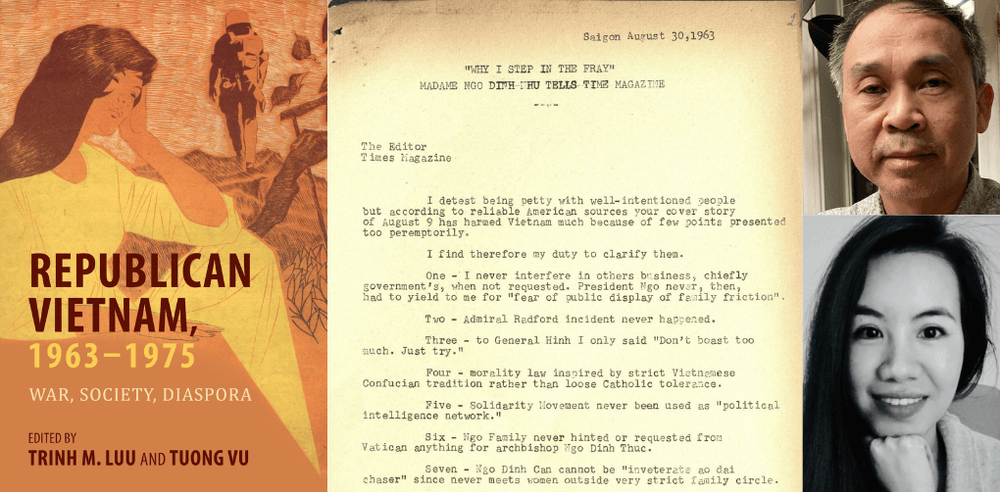
English-language scholarship has too often reduced South Vietnam to a mere American fabrication, portraying it as little more than an outgrowth of U.S. imperialism. As another title amongst the series Studies of the Weatherhead East Asian Institute, Columbia University, Republican Vietnam, 1963–1975: War, Society, Diaspora (University of Hawaii, 2025), edited by Trinh M. Luu and Tuong Vu, decisively challenges this view by revealing the Second Republic as a diverse, dynamic, and internally driven society. Across twelve essays grounded in original archival research, the volume reconstructs the Second Republic in all its complexity, showing how politicians, students, educators, publishers, journalists, musicians, religious leaders, businesspeople, and ordinary citizens together forged a richly layered social world. This society was marked by remarkable entrepreneurial energy, a combative and outspoken press, globally connected religious institutions, a vibrant intellectual and associational life, and a level of artistic production unparalleled since the Vietnam War.
Although this period was brief, its intensity and creativity fostered a resilient republican spirit that Vietnamese refugees later carried into exile. The abundant legacy of vernacular music, print culture, and the many associations established by the Vietnamese diaspora attest to the republican values that once animated South Vietnamese life. Yet despite this complexity, popular media and much American scholarship have continued to depict South Vietnam as a fundamentally dependent polity, ruled by corrupt leaders beholden to U.S. interests. Against such reductive portrayals, this volume places South Vietnamese actors at the center of their own history, emphasizing their agency, aspirations, and struggles.
Republican Vietnam is the first scholarly collection devoted to the Second Republic to appear since the end of the Vietnam War, and among the earliest to employ republicanism as an analytical lens for reexamining twentieth-century Vietnamese history, the war itself, and the Vietnamese diaspora. Taken together, the essays demonstrate how warfare, intertwined with foreign intervention, shaped South Vietnam’s economy, culture, and the everyday lives of individuals and families. By bringing together scholarship from both Vietnam-based and diasporic studies, the volume bridges two fields that have long developed in parallel, laying essential groundwork for future cross-disciplinary research.