Rethinking Belonging from the Inside: Vietnamese Migration and the “Border Within” in Berlin
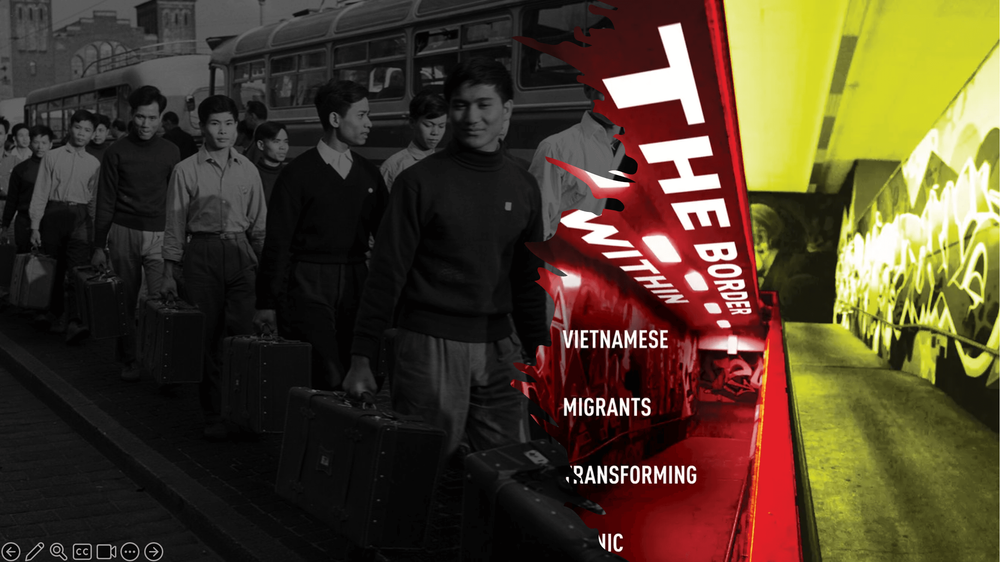
In The Border Within: Vietnamese Migrants Transforming Ethnic Nationalism in Berlin (2022), anthropologist Phi Hong Su offers a compelling rethinking of what borders are and how they operate. Rather than viewing borders as fixed lines separating nation-states, Su argues that borders persist within societies—shaping everyday life, identity, and social relations among migrants themselves.
Published by Stanford University Press, the book draws on long-term ethnographic research in Berlin to examine how Vietnamese migrants actively reshape ethnic identity and nationalism in a post–Cold War context. It is now widely recognized in migration studies and anthropology as a key contribution to understanding diaspora beyond simplistic models of integration or assimilation.
Cold War Histories and the Making of a Divided Diaspora
A central argument of the book is that the Vietnamese community in Germany is not a unified entity, but rather one shaped by two distinct migration histories. On the one hand are Vietnamese contract workers who were sent from socialist North Vietnam to East Germany; on the other are Vietnamese refugees who fled South Vietnam and resettled in West Germany. These trajectories were formed under very different political and economic conditions, a distinction well documented in German institutional research, including publications by the Federal Agency for Civic Education (bpb), which show how Cold War geopolitics structured migration flows into East and West Germany in fundamentally different ways. After German reunification, these two populations came to inhabit the same national space. Yet, as Phi Hong Su demonstrates, their differing political backgrounds, economic trajectories, and social networks did not simply dissolve; instead, they continued to shape social relations, becoming the basis for enduring distinctions within the Vietnamese diaspora..
Berlin as an Ethnographic Site
The city of Berlin provides a particularly rich setting for this analysis. As Germany’s capital and a key site of post-reunification transformation, Berlin brings together diverse migrant populations within a rapidly changing urban environment.
Within this landscape, spaces such as the Dong Xuan Center, a major hub of Vietnamese commerce, serve as focal points of community life. These sites are not merely economic centers; they are also social arenas where distinctions, alliances, and identities are negotiated.
Demographic data from the Statistisches Bundesamt further contextualize the significance of the Vietnamese population in Germany, one of the country’s most established and socioeconomically distinct migrant groups.
Ethnic Nationalism Reimagined
One of the book’s most important interventions lies in its rethinking of ethnic nationalism. Rather than treating nationalism as a fixed ideology tied to the homeland, Phi Hong Su shows that it is continuously reinterpreted in diaspora, shaped by historical memory and generational change, and expressed through everyday practices rather than formal politics. This perspective complicates conventional narratives that frame migrant communities as either cohesive or divided. Instead, it reveals a more dynamic process in which unity and division coexist, unfolding simultaneously within the same social field.
Beyond the Edge of the State
The Border Within has been widely discussed in sociology and anthropology, including in venues such as Contemporary Sociology, in part because it shifts the analytical focus from external borders to internal social boundaries. Its implications extend well beyond the Vietnamese case, challenging binary models of integration versus exclusion, drawing attention to the importance of differences within diasporic communities, and reframing borders as ongoing social processes rather than static lines. In doing so, the book offers a framework that can be applied to migrant communities across Europe and beyond. At a moment when migration debates tend to center on the edges of the state, The Border Within redirects attention inward, suggesting that the most consequential boundaries may not be those that separate nations, but those that structure life within them. By grounding theory in detailed ethnographic observation, Phi Hong Su demonstrates that borders are not simply crossed but lived, reproduced, and continually transformed through everyday experience. This insight makes the book not only a study of Vietnamese life in Berlin but also a broader reflection on how identity, history, and power shape the meaning of belonging in the contemporary world.